

Yemeni truce ‘broadly holding’: UN envoy

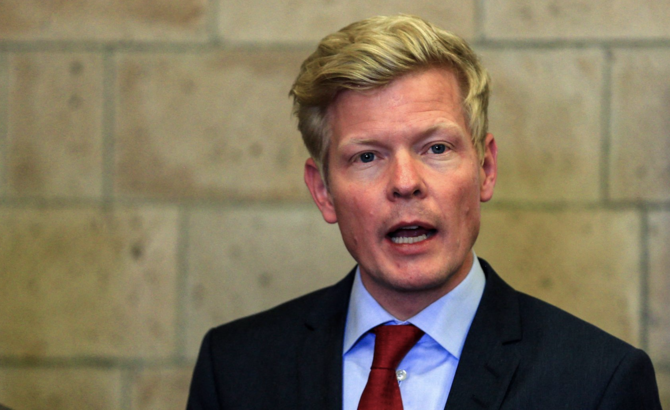
UN special envoy Hans Grundberg gives a press conference at Sanaa's international airport before his departure from the Yemeni capital, on April 13, 2022. (AFP)
Short Url
Updated 14 April 2022
Follow

Yemeni truce ‘broadly holding’: UN envoy

  • Hans Grundberg, Security Council members laud $3bn Saudi, UAE aid package
  • Emirati representative welcomes “unprecedented consensus” towards ending war

LONDON: A two-month truce agreed between parties to the Yemeni conflict at the start of April is “broadly holding,” UN Envoy Hans Grundberg told the Security Council on Thursday.

He said no confirmed airstrikes or cross-border attacks had been reported, but he urged all sides to commit to bringing an end to the seven-year conflict.

“I want to thank the Yemeni government for their leadership and for making compromises to reach this agreement,” Grundberg told the UN Security Council, thanking Saudi Arabia, the UAE and Oman for their efforts.

“What we now need is work on the political front. The truce is the result of the parties’ commitment but it is temporary, and we must take this rare moment to pivot towards a peaceful future.”

Grundberg, China, India, Russia, the UK and the US welcomed the $3 billion aid package announced by Saudi Arabia and the UAE, which will see $2 billion put into the Yemeni Central Bank.

A further $1 billion supplied by the Saudis will be put towards projects benefiting the Yemeni people.

Having been agreed on April 1, the truce came into effect the following evening and covers the Houthi militia and the internationally recognized Yemeni government.

Abdullah Al-Saadi, Yemen’s permanent representative to the UN, urged the UNSC to increase efforts to reduce attacks by the Tehran-backed militia.

“The Houthis want to remain a tool in the hand of Iran. They have used ballistic missiles that have killed civilians and destroyed civilian infrastructure, and we urge the council to play its role as a moral authority and exert pressure on them to respect the peace,” he said. “Our country nonetheless is committed to all provisions of the truce.”

Linda Thomas-Greenfield, US ambassador to the UN, urged “movement towards a comprehensive ceasefire,” with her Chinese, Indian and Russian counterparts all echoing her comments to bring the war to an end.

China’s Zhang Jun said: “It is in no one’s interests to resume hostilities in Yemen, and the humanitarian crisis in the country is one of the worst in the world.”

India’s representative TS Tirumurti condemned cross-border attacks against Saudi Arabia last month, saying he “hoped the ceasefire would put an end to the violence and terror.” He added: “India has extended humanitarian aid to Yemen in the past, and we remain committed to this.”

Martin Griffiths, undersecretary-general for humanitarian affairs, said the truce had resulted in civilian casualties falling to their lowest numbers in months, with fuel ships arriving in Hodeidah reducing costs of living.  

But Yemenis are “still struggling to survive,” and increased aid is needed so as not to offset “today’s good news,” he added.

“Furthermore, we call on all parties to facilitate access in line with international humanitarian law, and call on Houthi authorities to release two UN staff members that were arrested earlier this year,” he said.

“On top of which, we are seeking the release of five members of staff abducted in February and who have not been seen for 60 days now.”

Representatives from multiple countries noted the “increased optimism” that the ongoing truce was engendering.

Emirati representative Lana Zaki Nusseibeh said she was pleased to see “unprecedented consensus” towards ending the war.

“We express our gratitude towards the efforts of the secretariat of the GCC (Gulf Cooperation Council) to bridge the divide between the Yemeni parties… but renew our condemnation of Houthi terrorist attacks,” she added.

“This delicate agreement brings renewed hope, but we call on regional stakeholders to find a peaceful solution.”


First responders enter devastated Aleppo neighborhood after days of deadly fighting

Updated 12 January 2026
Follow

First responders enter devastated Aleppo neighborhood after days of deadly fighting

  • The US-backed SDF, which have played a key role in combating the Daesh group in large swaths of eastern Syria, are the largest force yet to be absorbed into Syria’s national army

ALEPPO, Syria: First responders on Sunday entered a contested neighborhood in Syria’ s northern city of Aleppo after days of deadly clashes between government forces and Kurdish-led forces. Syrian state media said the military was deployed in large numbers.
The clashes broke out Tuesday in the predominantly Kurdish neighborhoods of Sheikh Maqsoud, Achrafieh and Bani Zaid after the government and the Syrian Democratic Forces, the main Kurdish-led force in the country, failed to make progress on how to merge the SDF into the national army. Security forces captured Achrafieh and Bani Zaid.
The fighting between the two sides was the most intense since the fall of then-President Bashar Assad to insurgents in December 2024. At least 23 people were killed in five days of clashes and more than 140,000 were displaced amid shelling and drone strikes.
The US-backed SDF, which have played a key role in combating the Daesh group in large swaths of eastern Syria, are the largest force yet to be absorbed into Syria’s national army. Some of the factions that make up the army, however, were previously Turkish-backed insurgent groups that have a long history of clashing with Kurdish forces.
The Kurdish fighters have now evacuated from the Sheikh Maqsoud neighborhood to northeastern Syria, which is under the control of the SDF. However, they said in a statement they will continue to fight now that the wounded and civilians have been evacuated, in what they called a “partial ceasefire.”
The neighborhood appeared calm Sunday. The United Nations said it was trying to dispatch more convoys to the neighborhoods with food, fuel, blankets and other urgent supplies.
Government security forces brought journalists to tour the devastated area, showing them the damaged Khalid Al-Fajer Hospital and a military position belonging to the SDF’s security forces that government forces had targeted.
The SDF statement accused the government of targeting the hospital “dozens of times” before patients were evacuated. Damascus accused the Kurdish-led group of using the hospital and other civilian facilities as military positions.
On one street, Syrian Red Crescent first responders spoke to a resident surrounded by charred cars and badly damaged residential buildings.
Some residents told The Associated Press that SDF forces did not allow their cars through checkpoints to leave.
“We lived a night of horror. I still cannot believe that I am right here standing on my own two feet,” said Ahmad Shaikho. “So far the situation has been calm. There hasn’t been any gunfire.”
Syrian Civil Defense first responders have been disarming improvised mines that they say were left by the Kurdish forces as booby traps.
Residents who fled are not being allowed back into the neighborhood until all the mines are cleared. Some were reminded of the displacement during Syria’s long civil war.
“I want to go back to my home, I beg you,” said Hoda Alnasiri.