Lebanon to demolish blast-hit Beirut silos

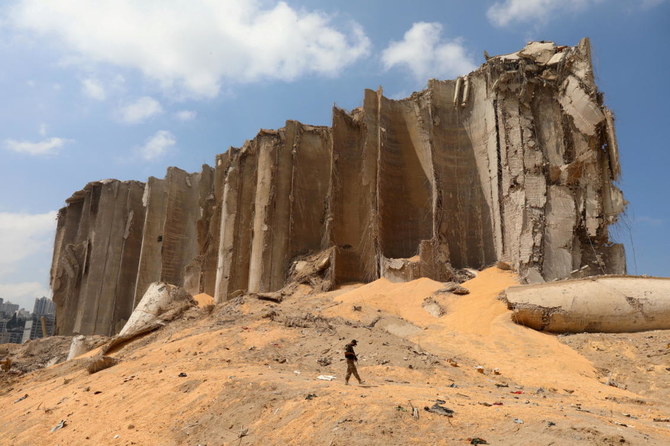
The silos were decimated in the devastating blasts that ripped through the port. (FILE/REUTERS)
Short Url
Updated 14 April 2022
Follow

Lebanon to demolish blast-hit Beirut silos

  • Once boasting a capacity of more than 100,000 tons, the imposing 48 meter (157 foot) high structure has become emblematic of the catastrophic August 4 port blast
  • More than 200 men, women and children were killed in the blast

BEIRUT: Lebanon on Thursday ordered the demolishment on Beirut’s grain silos, at risk of collapse following a devastating 2020 port explosion, despite calls to preserve them as a memorial site.
“We tasked the Council for Development and Reconstruction with supervising the demolition process,” Information Minister Ziad Makari said after a cabinet meeting, without specifying a time frame.
Makari said the government’s decision was based on a report by Lebanon’s Khatib and Alami Engineering Company, which warned that the silos in the port of the capital Beirut could collapse within months.
“Repairing them will cost a lot,” Makari said.
Last year, Swiss company Amann Engineering also called for their demolition, saying the most damaged of the silos were tilting at a rate of two millimeters per day.
Once boasting a capacity of more than 100,000 tons, the imposing 48 meter (157 foot) high structure has become emblematic of the catastrophic August 4 port blast, that killed more than 200 people and damaged swathes of the capital in 2020.
The silos absorbed much of the blast’s impact, shielding large swaths of west Beirut from its ravaging effects.
Activists and some relatives of blast victims have called for the grain silos to be preserved as a memorial site.
“The silos are a witness to the massacre you committed against us,” said a statement last month by the victim’s families, referring to authorities.
“They will not be demolished, no matter how hard you try.”
To assuage potential anger over the decision, the cabinet on Thursday tasked the interior and culture ministries with erecting a monument commemorating the victims of the explosion.
Authorities say the blast was caused by a shipment of ammonium nitrate fertilizer, that caught fire after being impounded for years on end in haphazard conditions.
Investigations into the tragedy have been paused for months over what rights groups and relatives of the victims have decried as political interference.
Human Rights Watch last year accused top officials in government, parliament and the country’s security agencies of deadly negligence that led to the tragedy.


Fledgling radio station aims to be ‘voice of the people’ in Gaza

Updated 15 February 2026
Follow

Fledgling radio station aims to be ‘voice of the people’ in Gaza

  • The electricity crisis is one of the most serious and difficult problems in the Gaza Strip, says Shereen Khalifa Broadcaster

DEIR EL-BALAH: From a small studio in the central city of Deir El-Balah, Sylvia Hassan’s voice echoes across the Gaza Strip, broadcast on one of the Palestinian territory’s first radio stations to hit the airwaves after two years of war.

Hassan, a radio host on fledgling station “Here Gaza,” delivers her broadcast from a well-lit room, as members of the technical team check levels and mix backing tracks on a sound deck. “This radio station was a dream we worked to achieve for many long months and sometimes without sleep,” Hassan said.

“It was a challenge for us, and a story of resilience.”

Hassan said the station would focus on social issues and the humanitarian situation in Gaza, which remains grave in the territory despite a US-brokered ceasefire between Israel and Hamas since October.

“The radio station’s goal is to be the voice of the people in the Gaza Strip and to express their problems and suffering, especially after the war,” said Shereen Khalifa, part of the broadcasting team.

“There are many issues that people need to voice.” Most of Gaza’s population of more than 2 million people were displaced at least once during the gruelling war.

Many still live in tents with little or no sanitation.

The war also decimated Gaza’s telecommunications and electricity infrastructure, compounding the challenges in reviving the territory’s local media landscape. “The electricity problem is one of the most serious and difficult problems in the Gaza Strip,” said Khalifa.

“We have solar power, but sometimes it doesn’t work well, so we have to rely on an external generator,” she added.

The station’s launch is funded by the EU and overseen by Filastiniyat, an organization that supports Palestinian women journalists, and the media center at the An-Najah National University in Nablus, in the occupied West Bank.

The station plans to broadcast for two hours per day from Gaza and for longer from Nablus. It is available on FM and online.

Khalifa said that stable internet access had been one of the biggest obstacles in setting up the station, but that it was now broadcasting uninterrupted audio.

The Gaza Strip, a tiny territory surrounded by Israel, Egypt, and the Mediterranean Sea, has been under Israeli blockade even before the attack on Oct. 7, 2023, which sparked the war. Despite the ceasefire, Israel continues to strictly control the entry of all goods and people to the territory.

“Under the siege, it is natural that modern equipment necessary for radio broadcasting cannot enter, so we have made the most of what is available,” she said.