

Over 2,000 Indian Sikhs to perform Vaisakhi harvest rituals in Hasan Abdal today

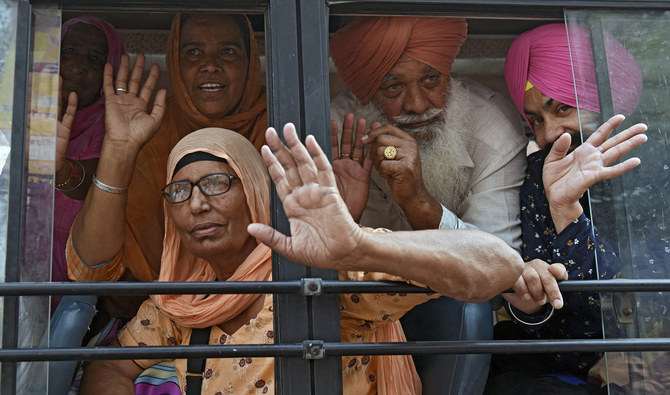
Sikh pilgrims wave from a bus before leaving to Pakistan for Vaisakhi, a spring harvest festival for Sikhs and Hindus, in Amritsar on April 12, 2022. (AFP)
Short Url
Updated 14 April 2022
Follow

Over 2,000 Indian Sikhs to perform Vaisakhi harvest rituals in Hasan Abdal today

  • Thousands of Sikhs will perform the cleansing ritual of ashnan, or bathing, at the festival
  • Gurdawara Panja Sahib shrine on outskirts of Islamabad is one of Sikhism’s holiest sites

ISLAMABAD: Over 2,000 Sikh pilgrims arrived in Pakistan from India this week to attend the annual Vaisakhi harvest festival, with the main ceremony of the New Year's celebration as well as critical day in the formation of the Sikh religion to be held at the Gurdawara Panja Sahib shrine outside Islamabad today, Thursday.

Thousands of Sikhs will perform the cleansing ritual of ashnan, or bathing, at the event in the town of Hasan Abdal. 

The shrine is one of Sikhism’s holiest sites and it is believed that the handprint of the founder of the religion, Guru Nanak, is imprinted on a boulder there. Vaisakhi is also meant to mark the day when Gobind Singh, the 10th and final prophet, established the discipline of Khalsa, through which the faithful can aspire to the ultimate state of purity.

Sikhs are a small minority in Muslim-majority Pakistan, but many Sikh holy sites ended up in the country after the 1947 partition from India following independence from Britain.

Many Sikhs also see Pakistan as the place where their religion began: the founder of Sikhism, Guru Nanak, was born in 1469 in a small village near the eastern Pakistani city of Lahore.

“Whenever we come to Pakistan, the land of our gurus, we feel very happy and relaxed ... this time too, we have come here with a lot of love for the people of Pakistan,” Sardar Arvinder Singh, the leader of a Sikh group that arrived in Pakistan, told media at the Wagah border crossing on Tuesday, adding that he was thankful to the Pakistan government for issuing visas in such large numbers.

Delhi Gurdwara Management Committee chief Sardar Sukhbeer Singh said Pakistan and India shared the “same culture” and Sikhs always “felt comfortable” in Pakistan.

“The arrangements made by the Pakistan government for us are impressive,” he added.

The Pakistan High Commission in New Delhi this year issued visas to 2,200 pilgrims out of whom 2,044, including women, crossed into Pakistan via Wagah to attend the festival on Tuesday. After having food at Wagah, the pilgrims left for Hasan Abdal on special buses and trains with escorts from the Railways Police, district police and other law enforcement agencies. They reached the town by 8pm.

“Due to security issues, the pilgrims were not allowed to get off the trains on their way to Hasanabdal,” a spokesperson for Railways told media on Tuesday. “Similarly, they wouldn’t be allowed to get off the trains or other transport whenever they are travelling in Pakistan during their trip.”

Around 400 Railways policemen have been deployed for the security of the pilgrims.

“Special commandos and snipers have also been deployed at each railway station, especially Wagah, Lahore, Hasanabdal and Nankana Sahib,” Pakistan’s Dawn newspaper reported.


No casualties as blast derails Jaffar Express train in Pakistan’s south

Updated 26 January 2026
Follow

No casualties as blast derails Jaffar Express train in Pakistan’s south

  • Passengers were stranded and railway staffers were clearing the track after blast, official says
  • In March 2025, separatist militants hijacked the same train with hundreds of passengers aboard

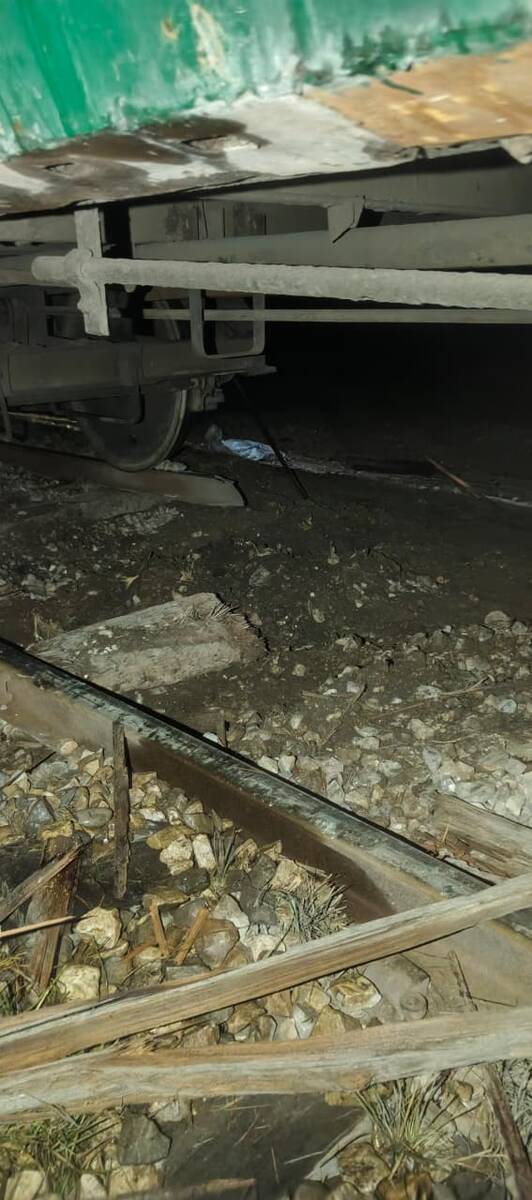
QUETTA: A blast hit Jaffar Express and derailed four carriages of the passenger train in Pakistan’s southern Sindh province on Monday, officials said, with no casualties reported.

The blast occurred at the Abad railway station when the Peshawar-bound train was on its way to Sindh’s Sukkur city from Quetta, according to Pakistan Railways’ Quetta Division controller Muhammad Kashif.

No group immediately claimed responsibility for the bomb attack, but passenger trains have often been targeted by Baloch separatist outfits in the restive Balochistan province that borders Sindh.

“Four bogies of the train were derailed due to the intensity of the explosion,” Kashif told Arab News. “No casualty was reported in the latest attack on passenger train.”

The Jaffar Express stands derailed near Abad Railway Station in Jacobabad following a blast on January 26, 2026. (AN Photo/Saadullah Akhtar)

Another railway employee, who was aboard the train and requested anonymity, said the train was heading toward Sukkur from Jacobabad when they heard the powerful explosion, which derailed power van among four bogies.

“A small piece of the railway track has been destroyed,” he said, adding that passengers were now standing outside the train and railway staffers were busy clearing the track.

In March last year, fighters belonging to the Balochistan Liberation Army (BLA) separatist group had stormed Jaffar Express with hundreds of passengers on board and took them hostage. The military had rescued them after an hours-long operation that left 33 militants, 23 soldiers, three railway staff and five passengers dead.

The passenger train, which runs between Balochistan’s provincial capital of Quetta and Peshawar in the country’s northwest, had been targeted in at least four bomb attacks last year since the March hijacking, according to an Arab News tally.

The Jaffar Express stands derailed near Abad Railway Station in Jacobabad following a blast on January 26, 2026. (AN Photo/Saadullah Akhtar)

Pakistan Railways says it has beefed up security arrangements for passenger trains in the province and increased the number of paramilitary troops on Jaffar Express since the hijacking in March, but militants have continued to target them in the restive region.

Balochistan, Pakistan’s southwestern province that borders Iran and Afghanistan, is the site of a decades-long insurgency waged by Baloch separatist groups who often attack security forces and foreigners, and kidnap government officials.

The separatists accuse the central government of stealing the region’s resources to fund development elsewhere in the country. The Pakistani government denies the allegations and says it is working for the uplift of local communities in Balochistan.