

Saudi Arabia expresses support for humanitarian aid mechanism for Lebanon

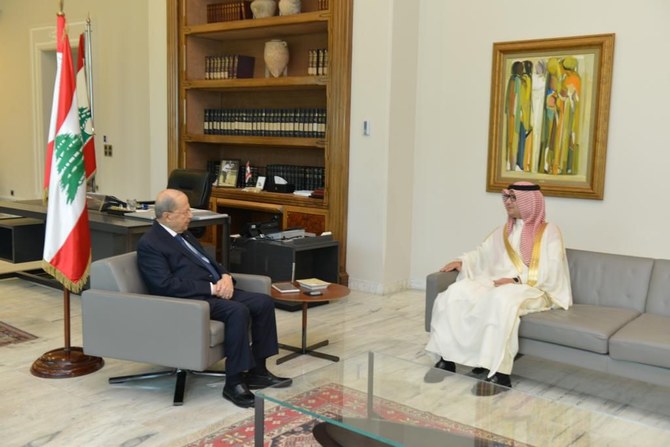
Lebanon’s President Michel Aoun receives Saudi Arabia’s Ambassador to Beirut Walid Bukhari at the Baabda Palace on Wednesday. (SPA)
Short Url
Updated 13 April 2022
Follow

Saudi Arabia expresses support for humanitarian aid mechanism for Lebanon

  • Saudi envoy tells Lebanese president the Kingdom is “keen on helping the Lebanese people”
  • Walid Bukhari, Michel Aoun also discuss boosting bilateral ties

BEIRUT: Saudi Arabia has expressed its support for the people of Lebanon and its desire to bolster ties between the two nations following the return of its envoy to Beirut.

Walid Bukhari, the Saudi ambassador to Lebanon, told Lebanese President Michel Aoun on Wednesday that “the Kingdom is keen on helping the Lebanese people during difficult circumstances and strengthening relations between the two countries.”

According to the president’s media office, the two men discussed bilateral relations and Bukhari told Aoun about “the mechanism of the Saudi-French joint fund aimed at providing humanitarian support and achieving stability and development in Lebanon.”

Saudi Arabia, Kuwait and other Gulf states recalled their ambassadors from Lebanon in October in protest against insulting statements made by former Information Minister George Qordahi regarding the war in Yemen.

Bukhari last met Aoun in March 2021. That meeting took place after a failed attempt to form a government led by former Premier Saad Hariri and the exchange of accusations of disrupting the process between Hariri and Aoun.

Since returning to Beirut, Bukhari has held talks with religious authorities, current and former prime ministers and interior ministers, foreign diplomats and other politicians.

Kuwaiti Ambassador Abdul-Al Sulaiman Al-Qenaei has also returned to Beirut. He said after meeting Prime Minister Najib Mikati on Wednesday that “restoring diplomatic relations and the return of ambassadors indicate the success of the Kuwaiti initiative.”

He added that both Lebanon and the Gulf states had mutually agreed that their long history was above everything else and that “what happened is in the past and the return of ambassadors will lead to further rapprochement and cooperation that benefit the brotherly countries.”

Wednesday’s developments coincided with the 47th anniversary of the start of the civil war in Lebanon. Hariri tweeted: “The suffering of the Lebanese is repeated in different forms.”

Meanwhile, the joint parliamentary committees were unable to approve a draft Lebanese capital control law on Wednesday.

Ibrahim Kanaan, chair of the Finance and Budget Committee, said: “We are making amendments to the current draft.”

Politicians have failed to pass the law since 2019 when Lebanon descended into a financial crisis that has paralyzed its banking system and frozen depositors out of their US dollar accounts.

Formal capital controls are a policy recommendation of the International Monetary Fund, from which Lebanon hopes to secure an aid package.

Lawmaker Bilal Abdullah said the draft contained “defects and needs amendments.”

He told Arab News: “The conditions of the IMF are harsh … How will we face people if the flour and medicines are no longer subsidized? What is the point of competing for parliamentary seats in a bankrupt country?

“Some people are preventing any progress toward the country’s recovery plan. However, some are forgetting that the country is bankrupt, and we must not stop negotiations with the IMF.”

Pressure is mounting on last week’s preliminary agreement between an IMF team and Lebanese authorities to implement the fund’s conditions to prevent a complete financial collapse.

The Depositors Outcry Association protested in Beirut against the draft capital control law. Alaa Khorshid, its head, said: “We cannot accept the theft of our money followed by the enactment of a law to protect the thieves.”

In another development, the US Department of State’s report about human rights in Lebanon referred to reliable information about “serious political interference with the judiciary and judicial affairs and imposing severe restrictions on the freedom of expression and media, including violence, threats of violence, arrests, unjustified prosecutions against journalists, censorship and the existence of laws criminalizing defamation, severe restrictions on internet freedom and the forced return of refugees to a country where their lives or freedom are threatened.”

The report mentioned “the presence of serious high-level and widespread official corruption” and added that “government officials enjoyed a measure of impunity for human rights abuses, including evading or influencing judicial processes.”

The report also cited “unofficial detention facilities by the terrorist Hezbollah party and Palestinian militias.”


Israel to partially reopen Gaza’s Rafah crossing

Updated 56 min 31 sec ago
Follow

Israel to partially reopen Gaza’s Rafah crossing

  • Reopening comes amid ongoing violence in the Palestinian territory
  • Gaza’s civil defense agency says dozens killed in Israeli attacks on Saturday

RAFAH, Palestinian Territories: Israel is set to partially reopen the Rafah crossing between the war-devastated Gaza Strip and Egypt on Sunday, following months of urging from humanitarian organizations, though access will be limited to the movement of people.

The reopening comes amid ongoing violence in the Palestinian territory, with Gaza’s civil defense agency reporting dozens killed in Israeli attacks on Saturday, while the Israeli military said it was retaliating against ceasefire violations.

The Rafah crossing is a vital gateway for both civilians and aid, but has remained closed since Israeli forces seized control of it in May 2024 during the war with Hamas, aside from a brief and limited reopening in early 2025.

Israel had previously said it would not reopen the crossing until the remains of Ran Gvili — the last Israeli hostage held in Gaza — were returned.

His remains were recovered days ago and he was laid to rest in Israel on Wednesday.

“The Rafah Crossing will open this coming Sunday (February 1st) in both directions, for limited movement of people only,” COGAT, an Israeli defense ministry body overseeing civil affairs in the occupied Palestinian territories, said on Friday.

Entry and exit “will be permitted in coordination with Egypt, following prior security clearance of individuals by Israel, and under the supervision of the European Union mission,” it added.

However, key details remain unclear, including how many people will be allowed to cross and whether those seeking to return to Gaza will be permitted entry.

A source at the border told AFP that Sunday would be largely devoted to preparations and logistical arrangements.

The crossing is set to open on Sunday on a trial basis to allow the passage of wounded individuals, ahead of a regular reopening scheduled for Monday, three sources at the crossing said.

However, no agreement has yet been reached on the number of Palestinians permitted to enter or exit, the sources added, noting that Egypt plans to admit “all Palestinians whom Israel authorizes to leave” the territory.

“Every day that passes drains my life and worsens my condition,” said Mohammed Shamiya, 33, who suffers from kidney disease and requires dialysis treatment abroad.

“I’m waiting every moment for the opening of the Rafah land crossing.”

Anxious wait

Safa Al-Hawajri, who has received a scholarship to study overseas, is also eagerly awaiting the reopening on Sunday.

“I’m waiting in the hope of fulfilling my ambition, which is tied to the reopening of the crossing,” said Hawajri, 18.

“I hope to be able to travel as soon as it opens.”

Located on Gaza’s southern border with Egypt, Rafah is the only crossing into and out of the territory that does not pass through Israel.

The crossing lies in an area held by Israeli forces following their withdrawal behind the so-called “Yellow Line” under the terms of a US-brokered ceasefire that came into effect on October 10.

Israeli troops still control more than half of Gaza, while the rest remains under Hamas authority.

The ceasefire has now entered its second phase and calls for reopening the crossing following the release or return of all Israeli hostages held by Palestinian militants.

Hamas had called for its full reopening in both directions after the remains of Gvili were brought back to Israel.

The reopening is expected to facilitate the entry of a 15-member Palestinian technocratic body, the National Committee for the Administration of Gaza (NCAG), established to oversee the day-to-day governance of the territory’s 2.2 million residents.

The committee is to operate under the supervision of the so-called “Board of Peace” chaired by US President Donald Trump.

The NCAG, headed by former Palestinian Authority deputy minister Ali Shaath, is expected to enter the Gaza Strip once the Rafah crossing reopens.

Violence continued ahead of the crossing’s reopening.

At least 32 people, including children, were killed on Saturday in Israeli air strikes in Gaza, reported the civil defense agency, which operates as a rescue force under the Hamas authority.

Israel’s military said the strikes were retaliation for an incident on Friday in which eight Palestinian fighters exited a tunnel in the city of Rafah, which it said violated the ceasefire.