

Palestinian father of 3 gunned down by Israeli forces in West Bank

1 / 2
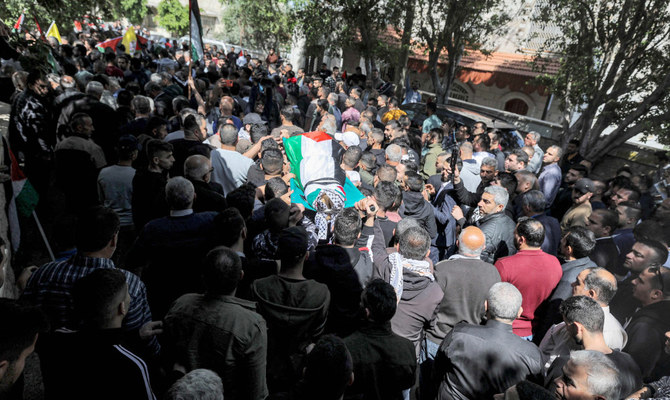
Mourners carry the body of Palestinian lawyer Mohammed Assaf during his funeral in the village of Kafr Laqif near Qalqilya in the northwest of the occupied West Bank on April 13, 2022. (AFP)
2 / 2
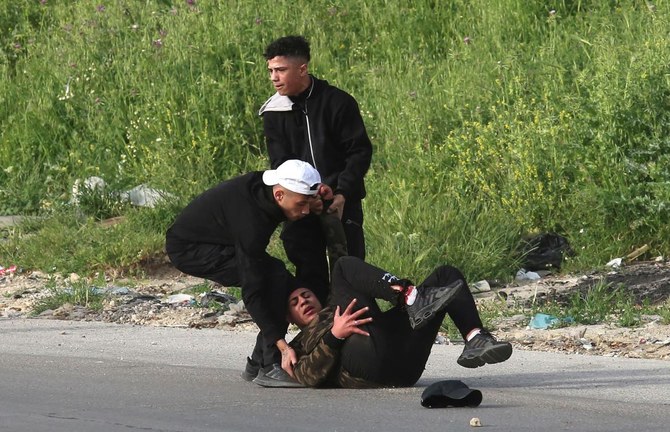
Palestinians help an injured youth during clashes with Israeli security forces on a raid to look for wanted Palestinians in Nablus city in the occupied West Bank. (File/AFP)
Short Url
Updated 13 April 2022
Follow

Palestinian father of 3 gunned down by Israeli forces in West Bank

  • Mohammed Assaf, 34, killed while driving through Nablus
  • Dozens more hurt as violent clashes continue during Ramadan

RAMALLAH: Israeli forces shot and killed a Palestinian man and injured dozens more in the West Bank city of Nablus on Wednesday, the Palestinian Health Ministry said.

Mohammed Assaf, 34, secretary of the Fatah movement in the village of Kafr Laqif near Qalqilya, was killed while driving through the area as Israeli forces were launching raids in Nablus and the surrounding towns, officials said.

His death was the latest in a wave of Israeli-Palestinian violence that erupted as Muslims mark the holy month of Ramadan.

Ahmed Jibril, director of the Red Crescent in Nablus, told the Palestinian news agency Wafa that four civilians were hit by live rounds, one of whom was struck in the chest and is in a serious condition.

Eight others were hit by rubber-coated metal bullets, including one who sustained an eye injury, while 47 had breathing difficulties after inhaling tear gas fumes during clashes with occupation forces in Beita, south of Nablus.

Nine young men also suffered bruising after being knocked over by Israeli patrol vehicles.

Israeli forces invaded Beita, Al-Lubban Al-Sharqiya and Urif, south of Nablus, and the eastern area of Nablus to protect the settlers who stormed Joseph’s Tomb.

The soldiers searched several houses in the towns and arrested five people.

Condemning the Israeli excesses, Palestinian Prime Minister Mohammad Shtayyeh said “occupation soldiers continue to murder for the sake of murder, with a license granted by the prime minister of the occupying state, Naftali Bennett, without the slightest regard for international laws and norms.”

He added: “The martyr, Assaf, the father of three children, was shot in the chest while he was in Nablus this morning.”

Also on Wednesday, three young men were injured by live rounds and a fourth was arrested when Israeli special forces stormed the Kadoorie University campus in Tulkarm.

Witnesses said that an undercover unit shot an employee of a private security company at the university and wounded another.

Less than a week after the Tel Aviv shooting attack, the Israeli army and its internal security agency, Shin Bet, expanded their operations in the West Bank to other cities and towns.

While Bennett has given the Israeli security forces a free hand in the West Bank and East Jerusalem, fear remains palpable on Israeli streets with police, border guards and reservists deployed in large numbers at train stations in central Tel Aviv and Clock Square in the center of Jaffa where the premier lives.

There have been enhanced security checks in shopping malls and train stations by private security guards, and some civilians have been seen carrying weapons in anticipation of an attack.

The situation is the same in western Jerusalem. In the Damascus Gate area, Israeli forces can be seen wearing protective helmets in preparation to tackle any security threats.


Lebanon’s government approves a deal to transfer Syrian prisoners back to Syria

Updated 30 January 2026
Follow

Lebanon’s government approves a deal to transfer Syrian prisoners back to Syria

  • Lebanon and Syria have a complicated history with grievances on both sides
  • A key obstacle to warming relations has been the fate of about 2,000 Syrians in Lebanese prisons

BEIRUT: Lebanon’s Cabinet on Friday approved an agreement to transfer Syrian prisoners serving their sentences in Lebanon back to their home country.
The issue of prisoners has been a sore point as the neighboring countries seek to recalibrate their relations following the ouster of former Syrian President Bashar Assad in a lightning offensive by Islamist-led insurgents in December 2024. Former insurgent leader Ahmad Al-Sharaa is now Syria’s interim president.
Lebanon and Syria have a complicated history with grievances on both sides. Many Lebanese resent the decades-long occupation of their country by Syrian forces that ended in 2005. Many Syrians resent the role played by the Lebanese militant group Hezbollah when it entered Syria’s civil war in defense of Assad’s government.
A key obstacle to warming relations has been the fate of about 2,000 Syrians in Lebanese prisons, including some 800 held over attacks and shootings, many without trial. Damascus had asked Beirut to hand them over to continue their prison terms in Syria, but Lebanese judicial officials said Beirut would not release any attackers and that each must be studied and resolved separately.
The deal approved Friday appeared to resolve that tension. Lebanese Information Minister Paul Morcos said other issues remain to be resolved between the two countries, including the fate of Lebanese believed to have been disappeared into Syrian prisons during Assad’s rule and the demarcation of the border between the two countries.
Lebanon’s Deputy Prime Minister Tarek Mitri told reporters after the Cabinet meeting that about 300 prisoners would be transferred as a result of the agreement.
Protesters gathered in a square below the government palace in downtown Beirut ahead of the Cabinet vote to call for amnesty for Lebanese prisoners, including some who joined militant groups fighting against Assad in Syria. Some of the protesters called for the release of Sunni cleric Ahmad Al-Assir, imprisoned for his role in 2013 clashes that killed 18 Lebanese army soldiers.
“The state found solutions for the Syrian youth who are heroes and belong to the Syrian revolution who have been imprisoned for 12 years,” said protester Khaled Al- Bobbo. “But in the same files there are also Lebanese detainees. ... We demand that just as they found solutions for the Syrians, they must also find solutions for the people of this country.”