PARIS: French President Emmanuel Macron and his far-right challenger traded barbs on Monday as they began a final fortnight of campaigning ahead of a run-off vote set to be much closer than their 2017 contest.
After a first round of voting on Sunday, Macron came top with 27.85 percent, while far-right leader Marine Le Pen finished second at 23.15 percent, final results showed on Monday.
As the top two finishers, they advanced to a second round scheduled for April 24.
Far-left candidate Jean-Luc Melenchon came close to qualifying for the run-off after a late surge gave him a score of just under 22 percent.
The Macron-Le Pen duel is a replay of the 2017 election final from which Macron emerged victorious with 66 percent. This time, however, polls suggest it will be a closer contest.
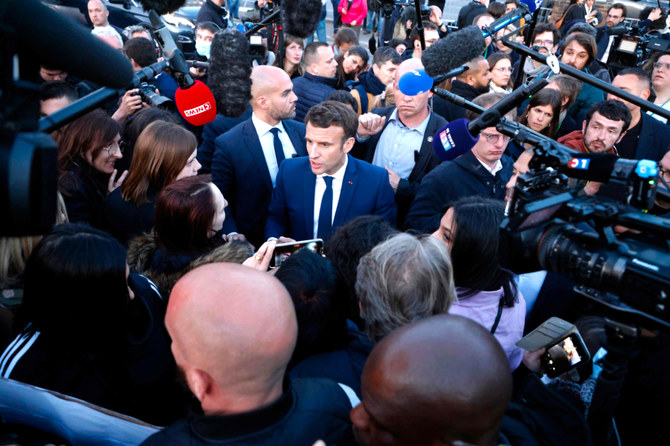
Making an aggressive start to the next phase of the campaign, Macron headed to deprived former mining and steel-making areas of northern France that have become Le Pen strongholds.
“I’m not going to pretend nothing happened, I have heard the message from those who voted for the extremes, including those who voted for Ms Le Pen,” Macron told a scrum of journalists who followed him in Denain.
“I realize that people will vote for me to stop her, but I want to convince people. So I may possibly round out my project” with more social welfare measures, he said.
Macron later said he was prepared to raise the state pension age from 62 to 64 — rather than 65 as his campaign program pledged — to avoid “too many tensions” and “build a consensus.”
In an interview with the Voix du Nord newspaper, he called Le Pen a “demagogue,” saying she was “someone who said to people what they want to hear at the moment they want to hear it.”
Le Pen met with her campaign team Monday morning before heading to visit a cereal farmer in the central Yonne region, which placed her first in Sunday’s vote.
Returning to the main priority of French people — and the focus of all her campaigning — she accused Macron of doing too little to help voters with the rising cost of living.
“Anticipating events is absolutely essential. At the moment, we’re improvising,” she said, before repeating her promises to slash taxes on food and fuel.
The arch-nationalist, 53, also denied that she planned for France to leave the European Union, saying instead she wanted to “change the structure” of the 27-member club.
Polls gauging second-round voting intentions mostly point to around 53 percent for Macron and 47 percent for Le Pen.
But one poll by the Ifop-Fiducial group suggested Macron could have only a razor-thin win with 51 percent versus 49 percent.
While opponents accuse her of being divisive and racist, Le Pen has sought to project a more moderate image in this campaign and has focused on voters’ daily worries over inflation.
Both candidates will now scramble to woo voters of their defeated first-round rivals.
“We’re going to have to win over the French people who didn’t vote for Emmanuel Macron in the first round,” government spokesman Gabriel Attal told the France Inter broadcaster on Monday.
In an early boost for the president, Communist Party candidate Fabien Roussel, Socialist Anne Hidalgo, Yannick Jadot of the Greens and right-wing Republicans candidate Valerie Pecresse said they would vote for him to prevent the far-right leader coming to power.
Melenchon told his supporters not to give a “single vote” to Le Pen, but he stopped short of backing Macron directly.
“If Macron wants to convince our voters, he’s going have to work for it,” said Melenchon’s campaign director, Manuel Bompard.
Meanwhile Le Pen’s far-right rival Eric Zemmour, who garnered just over seven percent on Sunday, threw his weight behind her.
A pivotal moment in the next stage of the campaign will come on April 20 when the two candidates take part in a live TV debate, just like five years ago when a better-prepared Macron won the day.
But this time will be different, said political scientist Brice Teinturier.
Macron, he said, “is no longer the new candidate representing a kind of freshness” while Le Pen “is no longer the person people automatically reject.”
Macron is expected to target her past admiration for Russian leader Vladimir Putin, an explosive issue during the Russian invasion of Ukraine.
“Marine Le Pen is the candidate for depending on Russia,” Macron told the Voix du Nord.
The candidates from France’s traditional parties of government — the Socialists and the Republicans — suffered humiliating defeats.
Sunday’s vote spelled disaster for Hidalgo, the Socialist mayor of Paris, who won only 1.75 percent, a historic low for the party.
The vote for Pecresse’s Republicans collapsed to 4.78 percent from 20 percent in 2017.
On Monday, Pecresse admitted her campaign finances, which included five million euros ($5.5 million) of her own money, were in a “critical” state, and called for donations from supporters.
Public campaign spending reimbursements are drastically reduced for candidates who fail to reach five percent.
Abstention on Sunday hit 26 percent, a sharp increase from the first round in 2017.


![]()

France’s Macron, Le Pen trade barbs ahead of run-off
Short Url
https://arab.news/nj6ff
France’s Macron, Le Pen trade barbs ahead of run-off


Latest updates


© 2026 SAUDI RESEARCH & PUBLISHING COMPANY, All Rights Reserved And subject to Terms of Use Agreement.