


France’s Macron and Le Pen head for cliffhanger April 24 election runoff

French leader Emmanuel Macron and his strongest challenger Marine Le Pen qualified on Sunday for a presidential election runoff on April 24. (File/AFP)
Short Url
Updated 11 April 2022
Follow

France’s Macron and Le Pen head for cliffhanger April 24 election runoff

  • Ifop pollsters predicted a very tight runoff, with 51 percent for Macron and 49 percent for Le Pen
  • Not for two decades has a French president won a second term

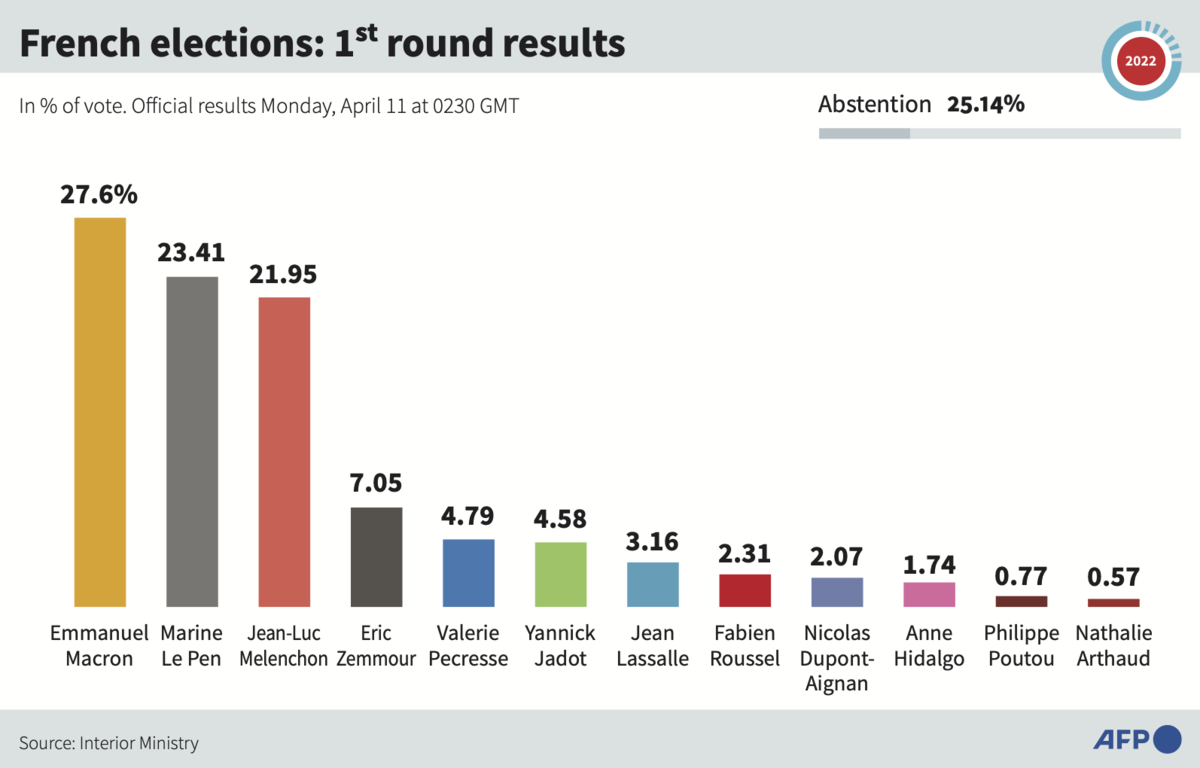
PARIS: French leader Emmanuel Macron and challenger Marine Le Pen qualified on Sunday for what promises to be a very tightly fought presidential election runoff on April 24, pitting a pro-European economic liberal against a far-right nationalist.
With partial results putting Macron in first place ahead of Le Pen after the first-round voting, other major candidates admitted defeat. Except for another far-right candidate, Eric Zemmour, they all urged voters to block the far-right in the second round.
But after five years in power in which his abrasive style has upset many, while Le Pen succeeded in softening her image, Macron will have to fight hard to win back disgruntled voters. He cannot take it for granted that voters will rally around a traditional anti-far right front.
“Nothing is decided, and the battle we will wage in the next 15 days will be decisive for France and Europe,” Macron told supporters, urging all voters to rally behind him on April 24th to stop the far-right from ruling the European Union’s second-largest economy.
Ifop pollsters predicted a very tight runoff, with 51 percent for Macron and 49 percent for Le Pen. The gap is so tight that victory either way is within the margin of error.
Other pollsters offered a slightly bigger margin in favor of Macron, with up to 54 percent. But that was in any case much narrower than in 2017, when Macron beat Le Pen with 66.1 percent of the votes.
Le Pen, who had eaten into Macron’s once-commanding 10-point poll lead in recent weeks thanks to a campaign focused on cost-of-living issues said she was the one to protect the weak and unite a nation tired of its elite.
“What will be at stake on April 24 is a choice of society, a choice of civilization,” she told supporters, who chanted “We will win!” as she told them: “I will bring order back to France.”
Macron, meanwhile, told supporters waving French and EU flags: “The only project that is credible to help purchasing power is ours.”

'Disastrous'
With 96 percent of the votes counted for Sunday’s first round, Macron garnered 27.41 percent of the votes and Le Pen 24.03 percent. A near total count of the vote was expected for later in the night.
A Le Pen victory on April 24 would be a similar jolt to the establishment as Britain’s Brexit vote to leave the European Union (EU) or Donald Trump’s 2017 entry into the White House.
France would lurch from being a driving force for European integration to being led by a euro-skeptic who is also suspicious of the NATO military alliance.
While Le Pen has ditched past ambitions for a “Frexit” or to haul France out of the euro zone’s single currency, she envisages the EU as a mere alliance of sovereign states.
Conservative candidate Valerie Pecresse warned of “disastrous consequences” if Macron lost, while the Socialists’ Anne Hidalgo urged supporters to vote for him “so that France does not fall into hatred.”
“Not one vote for Le Pen!” added hard-left candidate Jean-Luc Melenchon, who, according to the estimates, placed third with around 20 percent of the votes.
But they all also had very harsh words for Macron and some of the very unpopular policies of his first mandate as well as an abrasive style that has put off many voters.
“Emmanuel Macron played with fire,” Pecresse told supporters.

'Pay attention'
Zemmour acknowledged disagreements with Le Pen, but said Macron was a worse choice.
Barely a month ago, Macron seemed on course for a comfortable re-election that, riding high in polls thanks to strong economic growth, a fragmented opposition and his statesman role in trying to avert war in Ukraine on Europe’s eastern flank.
But he paid a price for late entry into the campaign during which he eschewed market walkabouts in provincial France in favor of a single big rally outside Paris. A plan to make people work longer also proved unpopular, enabling Le Pen to narrow the gap.
Le Pen, an open admirer of Russian President Vladimir Putin until his invasion of Ukraine, had for months toured towns and villages across France. She focused on cost-of-living issues troubling millions and tapped into anger toward rulers.
“Marine Le Pen knew how to talk to people about their more concrete problems. During the next two weeks he (Macron) will have to pay more attention to what is happening in France, take a diplomatic break,” said Adrien Thierry, a 23-year old Macron supporter.
As the vote count progressed, Melenchon’s score rose to close to Le Pen’s, with 21.57 percent of the votes, while none of the others were in the double-digits, leading some supporters to briefly hope for a change in the final line-up, which eventually seemed out of reach.


Blacklisted naphtha tanker from Russia enters Venezuelan waters while another diverts, ship data shows

Updated 56 min 28 sec ago
Follow

Blacklisted naphtha tanker from Russia enters Venezuelan waters while another diverts, ship data shows

  • Under U.S. sanctions related to Russia, the ship has a different sanctions profile than Skipper, the tanker that was seized by the U.S. on December 10

HOUSTON: A tanker subject to U.S. sanctions carrying some 300,000 barrels of naphtha from Russia entered Venezuelan waters late ​on Thursday, while another began redirecting course in the Atlantic Ocean, ship tracking data showed, a reflection of diverging last-minute decisions by ship owners after President Donald Trump ordered a "blockade" of oil tankers under sanctions bound for the OPEC country earlier this week.
The move ramped up pressure on Venezuelan president Nicolas Maduro by targeting the country's main source of income and followed the seizure by the U.S. of an oil tanker off the coast of Venezuela earlier in December.
Vessels that were not subject to sanctions began setting sail on Wednesday from Venezuelan waters after a week's pause, helping drain the country's mounting crude stocks.

HIGHLIGHTS

• Trump's 'blockade' aims to halt sanctioned oil tankers to Venezuela

• Hyperion's sanctions profile differs from seized Skipper tanker

• Venezuela condemns US actions as violating international law

Gambia-flagged medium tanker Hyperion docked on Friday at Amuay ‌Bay on Venezuela's ‌western coast, according to LSEG ship tracking data. It loaded near ‌Murmansk ⁠in ​Russia in ‌late November.
Under U.S. sanctions related to Russia, the ship has a different sanctions profile than Skipper, the tanker that was seized by the U.S. on December 10.
The U.S. can only seize vessels outside of its jurisdiction, or vessels that aren't heading to or from the country, if Washington has placed them under sanctions for links to groups it designates as terrorist, said David Tannenbaum, a director at consulting firm Blackstone Compliance Services that specializes in sanctions and anti-money laundering compliance.
Skipper, formerly called the Adisa, was under sanctions for what the U.S. says was involvement in Iranian oil trading that generated ⁠revenue for Iranian groups it has designated as foreign terrorist organizations.
With the Hyperion, though, sanctions were imposed to reduce Russian revenues from energy because of ‌its war with Ukraine.
"The Hyperion doesn't have known ties to ‍terrorism, and therefore unless they can prove it's subject ‍to the jurisdiction of the U.S., Washington can't grab it extraterritorially," said Tannenbaum, who previously worked with the ‍U.S. Treasury's Office of Foreign Assets Control that administers and enforces economic and trade sanctions.

REDIRECTS AND U-TURNS
The Angola-flagged Agate, another medium tanker under sanctions that loaded in Russia and had been sailing toward the Caribbean, was seen redirecting on Friday, according to LSEG ship tracking. The vessel was pointing towards Africa, but had not yet signaled a new destination.
Oman-flagged Garnet, also under sanctions ​and loaded in Russia, continued on its track, signaling the Caribbean as its destination on Friday.
Benin-flagged tanker Boltaris, under sanctions and carrying some 300,000 barrels of Russian naphtha bound for Venezuela, made ⁠a U-turn earlier this month and was heading for Europe without having discharged, according to LSEG vessel monitoring data.
Two very large crude carriers not subject to sanctions set sail for China on Thursday from Venezuela, according to sources familiar with Venezuela's oil export operations, marking only the second and third tankers unrelated to Chevron to depart the country since the U.S. seized Skipper.
The American oil major, which has continued to ship Venezuelan crude under a U.S. authorization, exported a crude cargo on Thursday bound for the U.S., LSEG data showed.
Secretary of State Marco Rubio on Friday said the U.S. was not concerned about the four vessels that sailed from Venezuela on Thursday, as those were not ships under sanctions.
"Sanctioned boats, we have the capabilities necessary to enforce our laws. We'll have a judicial order, we'll execute on those orders and there's nothing that will impede us from being able to do that," Rubio said.
Venezuela's government ‌called Trump's blockade a "grotesque threat" in a statement on Tuesday, saying it violates international law, free commerce and the right of free navigation.