

Pakistan ramps up eradication efforts against cow disease after Saudi ban on meat exports

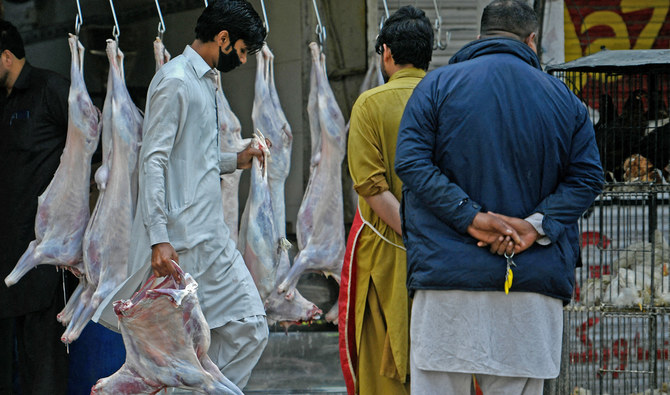
A butcher carries goat meat at a market in Islamabad, Pakistan. on April 9, 2020. (AFP/File)
Short Url
Updated 11 April 2022
Follow

Pakistan ramps up eradication efforts against cow disease after Saudi ban on meat exports

  • Pakistani diplomats in Riyadh say the disease is limited to certain areas of Sindh province
  • A local meat exporter to the kingdom says temporary ban will not adversely impact business

KARACHI: Pakistan has geared up diplomatic efforts to mitigate the impact of a temporary ban on meat exports by Saudi Arabia after an outbreak of lumpy skin disease (LSD) among animals in Sindh which prompted the authorities to launch a major vaccination program, officials said on Sunday.

Last week, the Saudi foreign ministry said in a letter the kingdom had decided to impose a temporary ban on importing bovine from Pakistan due to the disease as a “precautionary measure for public interest.”

Pakistani officials said, however, they were confident the ban would soon be removed since the authorities were taking all necessary measures to eradicate the disease.

“This disease is limited to some areas in Sindh and other areas are safe,” Azhar Ali Dahar, minister (trade and investment) at the Pakistan embassy in Riyadh, told Arab News. “The Saudi authorities have put a temporary ban and they are closely monitoring this issue.”

“Now, the government of Pakistan has officially requested [its] trade mission [in Riyadh] to brief the Saudi Food and Drug Authority that other areas and provinces are safe,” he continued. “The animal quarantine department is ensuring safe slaughtering as per Saudi standards for export to Saudi Arabia. Therefore, the Saudi government must lift ban on red meat from Pakistan from safe areas.”

Last September, The Organic Meat Company (TOMCL), a Karachi-based export firm, secured a $1 million contract to supply frozen boneless meat to the kingdom for 10 months. Under the contract the company had to export 250 metric tons of meat during the course of the contract.

“The shipments are still moving out and still being cleared,” Faisal Husain, CEO and founder of TOMCL, told Arab News.

He said his company adopted all standard operating procedures (SOPs) to ensure the health of animals at the facilities before slaughtering them for export.

“Health certificates themselves are confirmation of the SOPs and quality standards on bovine/ovine issued by relevant government quarantine departments,” he said. “In any case, if a foreign authority requires further validation from our relevant ministries, it is their right to have it.”

Asked about the impact of the ban, he said it would not affect the company’s overall performance.

“For our company specifically, contract-based frozen boneless meat to Saudi Arabia is less than 2.5 percent of our total volume. This should not affect adversely the company’s performance,” he added.

In Pakistan, LSD was first detected in November last year in Jamshoro district of Sindh province.

The disease has so far affected about 35,415 cows in Sindh province and killed 389 of them. However, 20,746 animals have also recovered from the disease, according to the official data shared on April 10.

“We have increased the vaccination of animals in Sindh province and inoculated 324,298 animals by Sunday,” Dr. Nazeer Hussain Kalhoro, director general of the provincial livestock department, told Arab News.

Confident to contain the disease, the authorities in Sindh said they had vaccinated 136,233 animals in the last two days alone and were planning to target four million animals through is immunization campaign within two months.

“LSD is like the coronavirus,” Kalhoro said. “Until 80 percent of animal population is not vaccinated, it will continue to pose a threat. We are targeting to vaccinate four million animals by [the Muslim festival of] Eid [in which animals are sacrificed].”

According to the Sindh livestock department, LSD cases are only reported in cows, not buffaloes or other animals.

It also maintains the disease has not affected any humans.

LSD is a viral disease which was first observed as an epidemic in Zambia in 1929. The virus is transmitted by blood-feeding insects, such as mosquitoes and ticks.

The virus causes fever, enlarged superficial lymph nodes and multiple nodules on the skin and mucous membranes of animals.


Pakistan likely to import around 7 million cotton bales this year as local production nearly halves

Updated 5 sec ago
Follow

Pakistan likely to import around 7 million cotton bales this year as local production nearly halves

  • Pakistan produced 5.3 million cotton bales by mid-December against 10 million targeted, government data shows
  • While the imports may ensure smooth supply of raw material, they may put pressure on foreign exchange reserves

KARACHI: Pakistan is likely to import around 7 million cotton bales this year owing to a decline of nearly half the annual target set by the Federal Committee on Agriculture (FCA), industry stakeholders said on Tuesday.

Pakistan’s cotton production stood at 5.3 million bales each weighing 170 kilograms as of Dec. 15, according to state-run Pakistan Central Cotton Committee (PCCC) data. The FCA had set a target of 10.2 million bales in April.

Karachi Cotton Brokers Forum (KCBF) Chairman Naseem Usman Osawala sees the country’s cotton production declining by 46 percent this season, compared to the FCA target.

“The country is expected to produce about 5.5 million bales this year,” he told Arab News, adding Pakistan would have to import around 7 million bales to meet requirement of its textile industry which consumes about 12 million bales a year.

The country had sown cotton over 2.002 million hectares, which was down by 11 percent from the targeted 2.26 million hectares.

Muhammad Waqas Ghani, head of research at Karachi-based JS Global Capital brokerage firm, said the South Asian country is likely to miss its cotton output target of 10 million bales.

“At the current rate of arrival, the output can reach 7 million bales at its best,” he added.

Cotton is a raw material for Pakistan’s largest textile industry and was the worst hit crop by climate-induced floods earlier this year.

Osawala said Pakistan’s cotton production has been falling because of an increasing number of sugar mills being established in the country’s cotton-producing regions.

Courts in Pakistan have been issuing significant rulings to bar the establishment of sugar mills in the designated cotton belt areas of the Punjab province. In 2018, the Supreme Court ordered relocation of three sugar mills from cotton-producing districts in southern Punjab to protect the crop.

Since cotton prices are low in the international market, textile millers would go for more imports, according to the KCBF chairman.

On Dec. 22, the price of cotton in the New York market stood at as much as 65.85 cents per pound, 1.64 cents lower than last year, according to the PCCC data.

Osawala said Pakistan’s increasing textile imports are also “hurting local cotton production.”

According to the Pakistan Bureau of Statistics’ (PBS) July-November data, the country had imported raw cotton, synthetic fiber, synthetic and artificial silk yarn and worn clothing worth $2.82 billion, 5 percent more than the imports during the same period last year.

Speaking of the impact of Pakistan’s falling cotton production, Kamran Arshad, chairman of All Pakistan Textile Mills Association (APTMA), said the millers would have to import “a lot of cotton” this year.

“I think approximately 7-7.5 million bales will have to be imported this year,” he said.

The textile and apparel sector is Pakistan’s largest exporter, accounting for more than half of the country’s overall exports and contributing around 8.5 percent of the gross domestic product (GDP) by employing nearly 40 percent of the industrial labor force. But high energy costs and outdated infrastructure among other factors continue to slow growth and leave the country trailing regional peers.

In the last fiscal year, Pakistan imported as much as 6.2 million cotton bales each weighing 220 kilograms, mostly from Brazil and the United States, according to KCBF Chairman Arshad.

Shankar Talreja, head of research at Karachi-based Topline Securities, said Pakistan is likely to import cotton worth $1.2 billion this year “considering the requirement.”

“The full-year import of cotton is likely to remain over $1 billion,” Talreja said.

Economic experts say while importing more cotton would ensure smooth supply of raw material to Pakistan’s textile sector, it may put pressure on the country’s foreign exchange reserves that rose to $15.9 billion last week after the International Monetary Fund (IMF) released a $1.2 billion tranche under Pakistan’s $7 billion loan program.