

Al-Aqsa worshippers enjoy peaceful Friday prayer amid Tel Aviv attack tensions

1 / 2
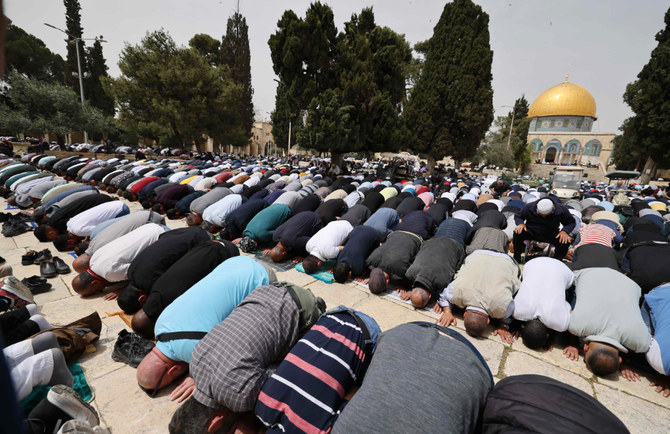
Palestinian Muslim worshippers attend Ramadan Fridays prayers near the Dome of the Rock mosque in the al-Aqsa mosque compound in the Old City of Jerusalem on April 8, 2022. (AFP)
2 / 2
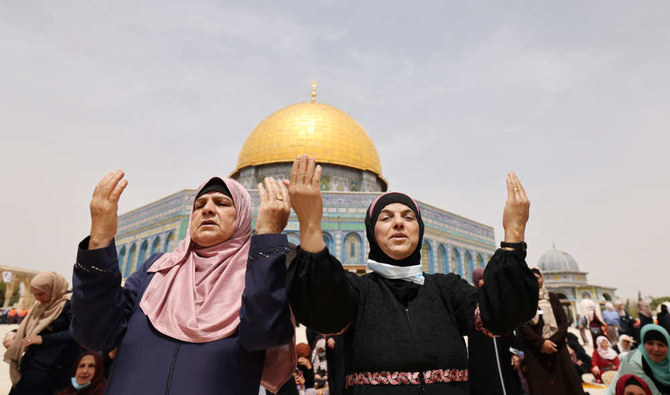
Thousands of Muslims from the West Bank and Israel flocked to the mosque early in the morning after passing through Israeli military checkpoints at the entrances to Jerusalem. (AP)
Short Url
Updated 09 April 2022
Follow

Al-Aqsa worshippers enjoy peaceful Friday prayer amid Tel Aviv attack tensions

  • Palestinian gunman who shot dead two at a bar was killed in Jaffa in exchange of fire
  • The recent attacks in Israel constitute a ‘pivotal shift,’ with attackers switching from knives to guns, ‘which causes more victims and spreads a state of terror in the Israeli street’

RAMALLAH: About 50,000 Palestinians peacefully performed the first Friday prayer of Ramadan at Al-Aqsa Mosque amid tightened Israeli security procedures in the wake of Thursday’s Tel Aviv violence that left two Israelis killed.

Four of the 15 people injured in the attack are in a serious condition, according to Israeli medical sources.

Thousands of Israeli citizens and Palestinians from the West Bank flocked to the mosque early in the morning after passing through Israeli military checkpoints at the entrances to Jerusalem.

About 3,000 Israeli policemen were deployed throughout East Jerusalem, the Old City and at the gates leading to the mosque. There was no untoward incident.

Ikrima Sabri, the imam at Al-Aqsa, praised the worshipers who came to the mosque from far away places facing Israeli checkpoints and urged Muslims to pray at Al-Aqsa regularly, with special emphasis on the nightly taraweeh prayer.

HIGHLIGHT

President Abbas said the cycle of violence confirms that ‘permanent, comprehensive and just peace is the shortest and correct way to provide security and stability for the Palestinians, Israelis and people of the region.’

Ibrahim Al-Anbawi, 53, from the Anata refugee camp near Jerusalem, told Arab News that the prayer took place “quietly and without tension.” There were fewer worshippers because of Thursday’s Tel Aviv attack and fears of consequences, he added.

Al-Anbawi, who offers Friday prayers at Al-Aqsa every week, said the sermon was confined to religiosity, without any reference to the current political situation to avoid stirring up feelings.

Meanwhile, the Tel Aviv shooting attack in which a Palestinian gunman shot dead two people at a bar continues to cast a shadow over life in both the West Bank and Israel.

Palestinian President Mahmoud Abbas condemned the attack and stressed the dangers of “continuing the repeated incursions into Al-Aqsa Mosque and the provocative actions of extremist settler groups.”

However, the attack was praised by several Palestinian factions and much of the public.

The officers found the shooter hiding near a mosque in Jaffa, just south of Tel Aviv, Israel’s Shin Bet security agency said. During an exchange of fire, the attacker was killed, the agency added.

A son of a retired Palestinian security officer, attacker Ra’ad Hazem, 29, was from the Jenin refugee camp in the north of the West Bank.

A high-ranking Palestinian security officer, who preferred anonymity because he is not authorized to talk to the media, told Arab News that the recent attacks in Israel constituted a “pivotal shift,” with attackers switching from knives to guns, “which causes more victims and spreads a state of terror in the Israeli street.”

He said these attacks “reflect the state of anger in the hearts of the Palestinians against the continued Israeli oppression and the absence of any political or economic horizon.”

Palestinian factions said the Tel Aviv attack represented a natural response to the “crimes of the Israeli occupation and the continuation of its violations in occupied Jerusalem and Al-Aqsa Mosque.”

Thirteen Israelis have been killed, and more than 20 others wounded in four attacks carried out by Palestinians in less than a month.

The Israeli Channel 12 said the demand for psychological help in the country has increased tenfold over the past two weeks after the Beersheba and Tel Aviv strikes.

Condemning the attack, Israeli Premier Naftali Bennett said: “Our war on deadly terrorism is long and difficult, but we will win it.”

Israeli Foreign Minister Yair Lapid said: “We will fight terrorism together, strike the resistance fighters wherever they hide, find their senders and collaborators anywhere, and not rest until calm returns to the streets.”

In contrast, Israeli Defense Minister Benny Gantz said: “We will expand our operations against the wave of attacks. The price we will exact from the perpetrators of the attacks and their senders will be heavy.”

Gantz said that Israel arrested 200 Palestinians, and “if necessary, we will arrest thousands more.”

Abbas said the killing of Palestinian and Israeli civilians “only leads to a further deterioration of the situation, as we all strive to achieve stability, especially during the holy month of Ramadan, and the upcoming Christian and Jewish holidays.”

Abbas warned against “exploiting this condemned incident to carry out attacks against our Palestinian people.”

He stressed “the danger of the continued and repeated incursions into Al-Aqsa and the provocative actions of extremist settler groups everywhere.”

He said the cycle of violence confirms that “permanent, comprehensive and just peace is the shortest and correct way to provide security and stability for the Palestinians, Israelis and people of the region.”

Gantz praised Abbas’s condemnation of the attack.


US military transfers first 150 Daesh detainees from Syria to Iraq

Updated 57 min 23 sec ago
Follow

US military transfers first 150 Daesh detainees from Syria to Iraq

  • Transfer follows Syrian government forces taking control of Al-Hol camp from SDF
  • US Central Command says up to 7,000 detainees could be transferred to Iraqi-controlled facilities

AL-HOL, Syria: The US military said Wednesday it has started transferring detainees from the Daesh group being held in northeastern Syria to secure facilities in Iraq.
The move came after Syrian government forces took control of a sprawling camp, housing thousands of mostly women and children, from the US-backed Syrian Democratic Forces, or SDF, which withdrew as part of a ceasefire. Troops on Monday seized a prison in the northeastern town of Shaddadeh, where some Daesh detainees escaped and many were recaptured, state media reported.
The Kurdish-led SDF still controls more than a dozen detention facilities holding around 9,000 Daesh members.
US Central Command said the first transfer involved 150 Daesh members, who were taken from Syria’s northeastern province of Hassakah to “secure locations” in Iraq. The statement said that up to 7,000 detainees could be transferred to Iraqi-controlled facilities.
“Facilitating the orderly and secure transfer of Daesh detainees is critical to preventing a breakout that would pose a direct threat to the United States and regional security,” said Adm. Brad Cooper, CENTCOM commander. He said the transfer was in coordination with regional partners, including Iraq.
US troops and their partner forces detained more than 300 Daesh operatives in Syria and killed over 20 last year, the US military said. An ambush last month by Daesh militants killed two US soldiers and one American civilian interpreter in Syria.
An Iraqi intelligence general told The Associated Press that an agreement was reached with the US to transfer 7,000 detainees from Syria to Iraq. He said that Iraqi authorities received the first batch of 144 detainees Wednesday night, after which they will be transferred in stages by aircraft to Iraqi prisons.
The general, who spoke on condition of anonymity because he was not authorized to speak to the media, said the Daesh members who will be transferred to Iraq are of different nationalities. He said they include around 240 Tunisians, in addition to others from countries including Tajikistan and Kazakhstan and some Syrians.
“They will be interrogated and then put on trial. All of them are commanders in Daesh and are considered highly dangerous,” the general said. He added that in previous years, 3,194 Iraqi detainees and 47 French citizens have been transferred to Iraq.

Regional threat

The Daesh group was defeated in Iraq in 2017, and in Syria two years later, but the group’s sleeper cells still carry out deadly attacks in both countries. The SDF played a major role in defeating Daesh.
Tom Barrack, the US envoy to Syria, said in a statement on Tuesday that the SDF’s role as the primary anti-Daesh force “has largely expired, as Damascus is now both willing and positioned to take over security responsibilities.”
He added that the “recent developments show the US actively facilitating this transition, rather than prolonging a separate SDF role.”
Syria’s Foreign Ministry welcomed the transfer of detainees, calling it “an important step to strengthen security and stability.”
Earlier on Wednesday, a convoy of armored vehicles with government forces moved into the Al-Hol camp following two weeks of clashes with the SDF, which appeared closer to merging into the Syrian military, in accordance with government demands.
At its peak in 2019, some 73,000 people were living at Al-Hol. Their number has since declined with some countries repatriating their citizens.
The camp is still home to some 24,000, most of them women and children. They include about 14,500 Syrians and nearly 3,000 Iraqis. Some 6,500 others, many of them loyal Daesh supporters who came from around the world to join the extremist group, are separately held in a highly secured section of the camp.
The Syrian government and the SDF announced a new four-day truce on late Tuesday after a previous ceasefire broke down.