

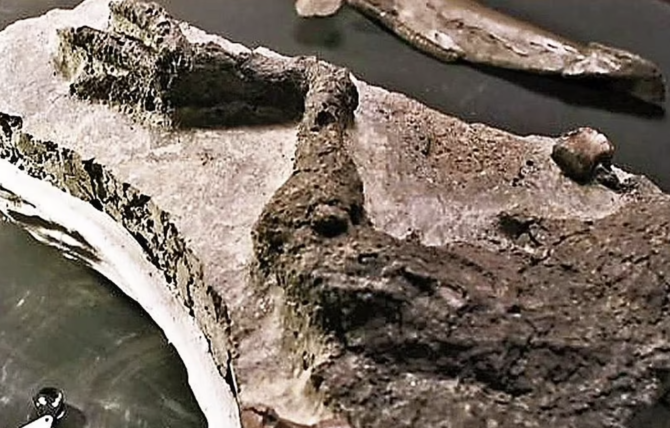
Palaeontologists unearth fossil from the day dinosaurs wiped out by asteroid 66 million years ago

Palaeontologists unearthed the fossil of a Thescelosaurus leg — a small herbivorous dinosaur. (Screenshot/BBC)
Short Url
Updated 08 April 2022
Follow

Palaeontologists unearth fossil from the day dinosaurs wiped out by asteroid 66 million years ago

  • Experts believe the limb, complete with skin, was “ripped off” when the asteroid hit

LONDON: The fossilized remains of a dinosaur believed to have been killed on the day a massive asteroid destroyed much of life on Earth 66 million years ago has been discovered.

Palaeontologists unearthed the fossil of a Thescelosaurus leg — a small herbivorous dinosaur — near a fragment of the plummeting asteroid, known as the Chicxulub Event, which killed it.

Experts believe the limb, complete with skin, was “ripped off” when the asteroid hit and caused a catastrophic, global flash flood and the creature is thought to have been “buried on the day of impact,” Daily Mail reported.

The leg was found alongside a series of discoveries at the Tanis fossil site in North Dakota, and a new BBC documentary fronted by Sir David Attenborough will reveal the findings.

“This is the most incredible thing that we could possibly imagine here, the best case scenario, the one thing that we always wanted to find in this site and here we've got it,” University of Manchester palaeontologist Robert DePalma, who made the discoveries, told the BBC.

“Here we've got a creature that was buried on the day of impact – we didn't know at that point yet if it had died during the impact but now it looks like it probably did,” he added. 

The findings were reported by the BBC after it was granted exclusive access, along with Attenborough, to the site for the documentary.


Researchers find 10,000-year-old rock art site in Sinai

Updated 21 sec ago
Follow

Researchers find 10,000-year-old rock art site in Sinai

  • The natural rock shelter’s ceiling features numerous red-pigment drawings of animals and symbols, as well as inscriptions in Arabic and Nabataean
  • Some engravings reflect the lifestyles and economic activities of early human communities

CAIRO: Archeologists have discovered a 10,000-year-old site with rock art in Egypt’s Sinai Peninsula, the country’s Ministry of Tourism and Antiquities said.
The previously unknown site on the Umm Irak Plateau features a 100-meter-long rock formation whose diverse carvings trace the evolution of human artistic expression from prehistoric times to the Islamic era.
The Supreme Council of Antiquities “has uncovered one of the most important new archeological sites, of exceptional historical and artistic value,“the ministry said in a statement.
Its chronological diversity makes it “an open-air natural museum,” according to the council’s secretary-general, Hisham El-Leithy.
The natural rock shelter’s ceiling features numerous red-pigment drawings of animals and symbols, as well as inscriptions in Arabic and Nabataean.
Some engravings “reflect the lifestyles and economic activities of early human communities,” the ministry said.
Inside, animal droppings, stone partitions, and hearth remains confirm that the shelter was used as a refuge for a long time.
These “provide further evidence of the succession of civilizations that have inhabited this important part of Egypt over the millennia,” Tourism and Antiquities Minister Sherif Fathi said.
He described the discovery as a “significant addition to the map of Egyptian antiquities.”
The site is located in southern Sinai, where Cairo is undertaking a vast megaproject aimed at attracting mass tourism to the mountain town of Saint Catherine, a UNESCO World Heritage site and home to Bedouin who fear for their ancestral land.