

Dependent on Russia for armaments, India ramps up domestic production

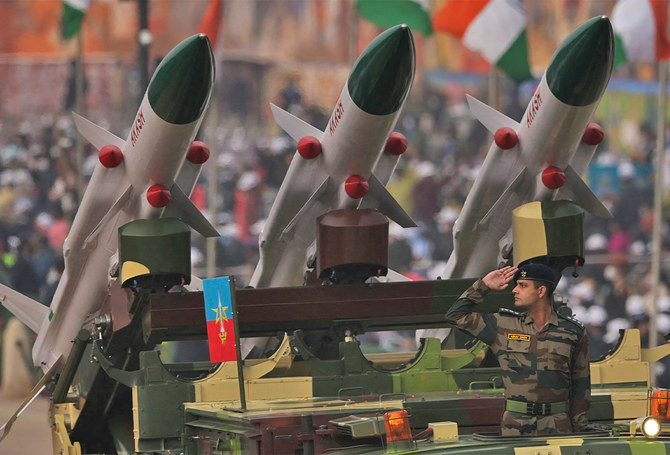
A soldier salutes next to an Akash missile system during India's 73rd Republic Day parade at the Rajpath in New Delhi, India, on January 26, 2022. (AFP/File Photo)
Short Url
Updated 07 April 2022
Follow

Dependent on Russia for armaments, India ramps up domestic production

  • In 2022-23 budget, 68 percent of India’s capital defense procurement to be local
  • Country has world’s second-largest army

NEW DELHI: India is ramping up domestic production of complex military equipment, the country’s defense minister said on Thursday.

The South Asian nation is heavily dependent on Russia for more than half of its armaments.

With the world’s second-largest army, fourth-largest air force and seventh-largest navy, India has for decades been largely dependent on arms imports, especially from Russia, which in the 1990s contributed 80 percent of its defense equipment.

The one-source dependence dropped significantly with the entry of US and European producers into the Indian market in the 2000s, but Moscow still remains a key player in the field, supplying an estimated 55 percent of India’s military hardware.

International sanctions imposed on Russia following its invasion of Ukraine since late February have sparked doubts about future imports.

“Our main goal is to promote self-reliance and export in defense,” Defense Minister Rajnath Singh said as he released a list of military equipment that will be produced domestically.

The list contains 101 items, including complex defense systems, tanks, sensors, rockets, multi-role helicopters, patrol vessels, anti-ship missiles, anti-radiation missiles and other supplies of war used by the Indian Armed Forces, which Singh added “were earlier only imported.”

The Ministry of Defense said in a statement that weapons and platforms from the list will be procured from local sources within the next five years. It also estimated that the orders will be worth more than $38 billion.  

India has been working on decreasing its dependence on military imports from one source for the past few years.

“The significant acquisition of Western platforms in the past five-seven years has diluted that percentage or brought down the share of Russian weapons in the Indian defense market,” Nandan Unnikrishnan, distinguished fellow at New Delhi-based think tank Observer Research Foundation, told Arab News.

He added that the indigenization of production was also contributing to the fact.

India’s Defense Ministry has already identified a “positive indigenization list” of more than 300 military items since May last year. The newest list contains the most expensive and complex equipment so far.

The government said in the 2022-23 budget that 68 percent of India’s capital defense procurement would be directed at local manufacturers.

In West Bengal, community iftars offer space for inclusivity, solidarity

Updated 5 sec ago
Follow

In West Bengal, community iftars offer space for inclusivity, solidarity

  • Know Your Neighbor initiative for Muslims, Hindus and Christians started in Kolkata in 2017
  • This year’s iftars promote women, social workers and grassroots activists from various groups

NEW DELHI: During Ramadan, a special iftar initiative in India’s West Bengal brings together different groups from the state’s diverse society to build mutual trust and strengthen neighborly bonds.

Islam has been present in Bengal since the 13th century. Muslims, who make up nearly a third of the state’s  population of 100 million people, have for centuries made significant contributions to Bengali socio-linguistic identity and culture.a

But for the past decade their heritage in the state has been undermined, accompanied by tensions and riots ignited by the rise of majoritarian Hindu right-wing narratives across India.

To address the situation, a group of Bengali Muslims and Hindus started the Know Your Neighbor initiative in 2017. During the fasting month, among the events they organize is “Dosti ki Iftar,” or “Iftar of Friendship,” which brings together representatives of the region’s various religious and social groups.

This year, for the first time, one such iftar was held specifically for women, with the aim of creating a safe and open space to exchange views, address stereotypes and foster female-led unity.

“Women from many sections of the society are more marginalized than others ... Among us are Hindus, Muslims, Christians as well,” Tody Mazumdar, sociology student and Know Your Neighbor member, told Arab News.

“We want to oppose the current narrative, or the current propaganda, that is being spread so rapidly about Bengal having only one identity. We want to give a clear message that we are a diverse cultural and religious group known as Bengalis, and we all stay together, and we all eat together.”

The event, hosting a few dozen women from different religious and caste groups, was co-organized by students at Deeniyat Muallima College in Santragachi in the metropolitan area of Kolkata.

Among them was Shruti Ghosh, a dancer and theatre artist, for whom being a part of the iftar was a way of building resilience against divisive politics and policies.

“Iftar, of course, is a part of Ramadan ... but it’s also about sharing food. And food is very important in terms of cultural preservation, in terms of expressing your identity, asserting your identity. Moreover, food is something we enjoy. We sit with food, talk, exchange ideas, and share memories. So much happens over food,” she said.

“That is very important for me ... to come together, particularly in these trying times, where we have so much violence and intolerance being unleashed, and hatred being generated in society.”

This week, another iftar will be hosted in a historical setting at the Basri Shah Masjid, the oldest mosque of Kolkata, and next week another will gather grassroots activists working in different sectors of civil society.

Sabir Ahamed, the founder of Know Your Neighbor, hopes it will help make the social groups they represent engage more and better.

“We are bringing the experience of iftar to them to bridge the gap between different communities,” he said. “We are planning more iftars at different locations to promote harmony and coexistence.”

They are also sending a message.

“It’s like a neighbor-to-neighbor call, and we can stay together and talk with each other freely, without any judgment or without any social boundaries. Ramadan means sharing and caring, so we spread our love towards everyone. We can sit together as Indians, as humans,” Siddiqa Tabassum, director of Deeniyat Muallima College, told Arab News.

“It’s a little step, but small steps can do miracles.”