

India condemns killings in Ukraine’s Bucha, calls for international probe

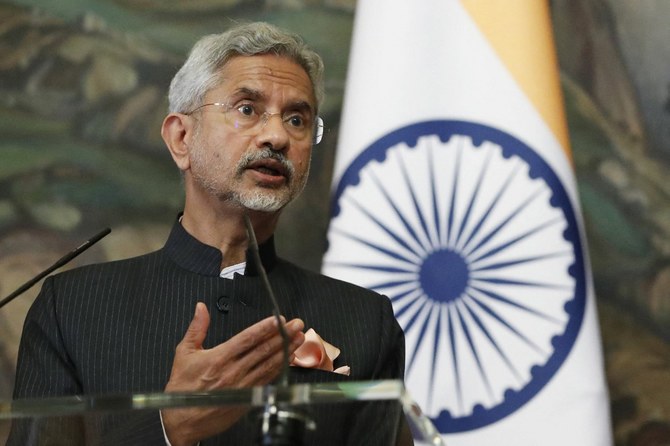
Indian Foreign Minister Subrahmanyam Jaishankar told lawmakers during Wednesday’s parliamentary address that India was “deeply disturbed by the reports.” (File/AFP)
Short Url
Updated 06 April 2022
Follow

India condemns killings in Ukraine’s Bucha, calls for international probe

  • New Delhi has repeatedly called for end to violence, but abstained from UN resolutions condemning Russia
  • International rights groups recorded “apparent war crimes” by Russian forces in Bucha and other sites

NEW DELHI: India’s foreign minister condemned the killing of civilians in the Ukrainian town of Bucha and called for an independent investigation on Wednesday amid international calls for further sanctions against Russia.

Since Russia’s invasion of Ukraine on Feb. 24, its troops have repeatedly hit civilian sites with airstrikes and artillery, raising international concerns over war crimes.

As Russian forces retreat from the outskirts of the Ukrainian capital, some of the strongest evidence of atrocities came to light this week from the Kyiv suburb of Bucha: mass graves and dead civilians on the streets — some corpses with bound hands and gunshot wounds to the head, others apparently mowed down by heavy vehicles.

Following the accounts from Bucha, the EU proposed new sanctions against Russia and several more European states have expelled Russian diplomats.

Indian Foreign Minister Subrahmanyam Jaishankar told lawmakers during Wednesday’s parliamentary address that India was “deeply disturbed by the reports.”


He said: “Many honorable members (of Parliament) brought up the incidents, the happenings in Bucha. We strongly condemn the killings which have taken place there. This is an extremely serious matter, and we support the call for an independent investigation.”

Moscow has since denied targeting civilians, despite overwhelming evidence shown by Ukrainian authorities, the international media and rights groups. Human Rights Watch and Amnesty International have said they had documented “apparent war crimes” by Russian forces in Bucha and other sites.

India has repeatedly called for an end to the violence in Ukraine but has abstained from various UN resolutions on the war as it attempts to balance diplomatic ties with the West and Moscow — its main supplier of defense technology.

Neither Jaishankar nor India’s permanent representative to the UN, who on Tuesday evening also called for an independent probe into the Bucha killings, have directly condemned Russia.

Indian officials have also avoided using the terms “invasion” or “war” in reference to Russia’s assault on Ukrainian territory.

“This is keeping the Russian sensitivities in mind because Russia is not calling it a war,” Prof. Harsh V. Pant, head of strategic studies at the New Delhi-based Observer Research Foundation, told Arab News.

“From India’s vantage point, keeping Russia in good humor is important for its own operational requirement, which is defense,” he said, adding that India wanted to balance the position of another superpower: China.

India-China ties have significantly deteriorated since April 2020, when tensions on the border in the northern Himalayan region of Ladakh led to a continuing standoff and the deployment of tens of thousands of extra troops to the area.

“India wants a channel of communication opened with Russia,” Pant said. “There are certain things India will have to do to make sure that Russia does not feel completely isolated and marginalized, because that would mean the Russia-China axis would grow even stronger.”

However, he added that recent developments are demonstrating an evolution in India’s position.

Facing Western pressure, Jaishankar last week called for respect for the UN Charter during a meeting with his Russian counterpart Sergey Lavrov in New Delhi.

“Gradually, India is moving towards a position where it is saying that all countries, including Russia, have to follow the UN Charter, international law and territorial integrity,” Pant said. “Once this massacre has unfolded, it made it difficult for India to take any other position.”


Philippines signs free trade pact with UAE

Updated 58 min 42 sec ago
Follow

Philippines signs free trade pact with UAE

  • UAE deal is Philippines’ fourth free trade pact, after South Korea, Japan, and EFTA
  • Business body warns of uneven gains if domestic safeguard mechanisms insufficient

MANILLA: The Philippines signed on Tuesday a comprehensive economic partnership agreement with the UAE, its first such deal with a Middle Eastern nation.

The Philippines and the UAE first agreed to explore a free trade pact in February 2022 and formalized the process with terms of reference in late 2023. Negotiations started in May 2024 and were finalized in 2025.

The CEPA signing was witnessed by President Ferdinand R. Marcos Jr. who led the Philippine delegation to Abu Dhabi.

“The CEPA is the Philippines’ first free trade pact with a Middle Eastern country, marking a milestone in expanding the nation’s global trade footprint,” Marcos’s office said.

“The agreement aims to reduce tariffs, enhance market access for goods and services, increase investment flows, and create new opportunities for Filipino professionals and service providers in the UAE.”

The UAE is home to some 700,000 Filipinos, the second-largest Filipino diaspora after Saudi Arabia.

With bilateral trade worth about $1.8 billion, it is also a key trading partner of the Philippines in the Middle East, and accounted for almost 39 percent of Philippine exports to the region in 2024.

The Philippine Department of Trade and Industry earlier estimated it would lead to at least 90 percent liberalization in tariffs and give the Philippines wider access to the GCC region.

“Preliminary studies indicate the CEPA could boost Philippine exports to the UAE by 9.13 percent, generate consumer savings, and strengthen overall trade linkages with the Gulf region,” Marcos’s office said.

The Philippine Chamber of Commerce and Industry-Makati expects the pact to bring stronger trade flows, capital and technology for renewable energy, infrastructure, food, and water security projects as long as domestic policy supports it.

“CEPA can serve as a trade accelerator and investment catalyst for the Philippines,” Nunnatus Cortez, the chamber’s chairman, told Arab News.

The pact could result in “expanding exports, attracting capital, diversifying economic partners, upgrading industries, and supporting long-term growth — provided the country actively supports exporters and converts provisions into concrete commercial outcomes,” said Cortez.

“The main downside risk of CEPA lies in domestic readiness. Without strong industrial policy, MSME (Micro, Small and Medium Enterprises) support, safeguard mechanisms, and export development, CEPA could lead to import dominance, uneven gains, fiscal pressure, and limited structural transformation.”

The deal with the UAE is the Philippines’ fourth bilateral free trade pact, following agreements with South Korea, Japan, and the European Free Trade Association, which comprises Iceland, Liechtenstein, Norway, and Switzerland.