

HRW accuses Greek authorities of abusing asylum seekers

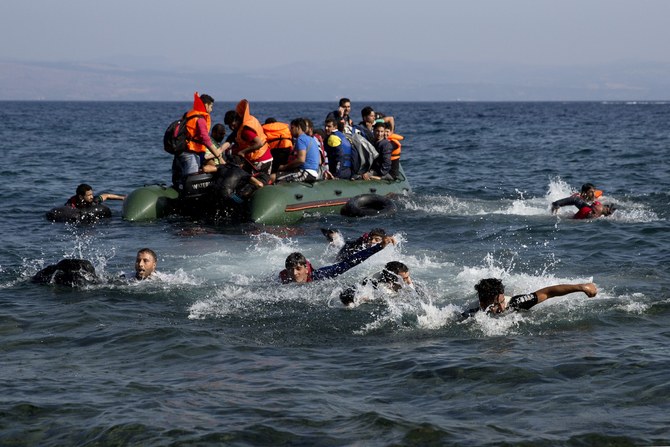
Migrants whose boat stalled at sea while crossing from Turkey to Greece swim toward the shore of the island of Lesbos, Greece, Sept. 20, 2015. (AP Photo)
Short Url
Updated 07 April 2022
Follow

HRW accuses Greek authorities of abusing asylum seekers

  • Human Rights Watch urges European Commission to start legal proceedings against govt
  • ‘Greece welcomes Ukrainians as ‘real refugees’ but conducts cruel pushbacks on Afghans and others’

LONDON: Greek security forces are robbing and stripping asylum seekers before turning them over to third-country nationals to be expelled across the Turkish border, according to Human Rights Watch.

In a 29-page report published on Thursday, HRW urged the European Commission to commence legal proceedings against the Greek government for its treatment of asylum seekers and use of proxies in “illegal” pushbacks at its borders.

“Greece welcomes Ukrainians as ‘real refugees’ but conducts cruel pushbacks on Afghans and others fleeing war and violence,” said Bill Frelick, HRW’s refugee and migrant rights director.

“This double standard is a mockery of purported shared European values of equality, rule of law, and human dignity.

“The Commission should urgently open legal proceedings and hold the Greek government accountable for violating EU laws prohibiting collective expulsions.”

Compounding claims of double standards was the assertion of Greece’s Migration Minister Notis Mitarachi to Parliament on March 1 that Ukrainians are “real refugees.”

He later took to Twitter to double down on his assertion, tweeting that he “rightly described them” as “real refugees … that is what international law says, not the ideologies of the left,” inferring that those crossing the border with Turkey are not real refugees.

Based on the testimonies of 26 Afghan migrants and asylum seekers, the HRW report alleged that the violations were being committed by Greek police along the border with Turkey at the Evros River.

Of those interviewed, 23 said they were pushed back, with multiple testimonies that the process involved being stripped and robbed by police before being turned over to “masked men” who dumped them in the “frigid” river.

A 28-year-old former Afghan army commander and an 18-year-old Afghan told HRW that they had managed to talk with the masked men, identifying them as Arabs and Pakistanis.

The 28-year-old said: “The boat driver said, ‘We are … here doing this work for three months and then they give us … a document. With this, we can move freely inside Greece and then we can get a ticket for … another country’.”

Greek Maj. Gen. Dimitrios Mallios denied the report’s allegations, saying: “Police agencies and their staff will continue to operate in a continuous, professional, lawful and prompt way, taking all necessary measures to effectively manage refugee/migration flows.”

This is done “in a manner that safeguards on the one hand the rights of the aliens and on the other hand the protection of citizens especially in the first line border regions,” he added.

HRW said the Greek government “routinely denies” allegations of illegal pushbacks as either “fake news” or “Turkish propaganda.”

Pushbacks violate multiple human rights norms, including the prohibition of collective expulsion under the European Convention on Human Rights, the right to due process in the International Covenant on Civil and Political Rights, the right to seek asylum under EU asylum law and the EU Charter of Fundamental Rights, and the principle of nonrefoulement under the 1951 Refugee Convention.

Frelick said: “There can be no denying that the Greek government is responsible for the illegal pushbacks at its borders and using proxies to carry out these illegal acts does not relieve it of any liability.”


Malawi suffers as US aid cuts cripple health care

Updated 6 sec ago
Follow

Malawi suffers as US aid cuts cripple health care

LILONGWE: A catastrophic collapse of health care services in Malawi a year after US funding cuts is undoing a decade of progress against HIV/AIDS, providers warn, leaving some of the most vulnerable feeling like “living dead.”
In the impoverished southern Africa country, the US government’s decision to slash foreign aid in January 2025 has led to significant cuts in HIV treatments, a spike in pregnancies and a return to discrimination.
Chisomo Nkwanga, an HIV-positive man who lives in the northern town of Mzuzu, told AFP that the end of US-funded specialized care was like a death sentence.
After his normal provider of life-saving antiretroviral therapy (ART) vanished due to budget cuts, he turned to a public hospital.
“The health care worker shouted at me in front of others,” Nkwanga recalled. “They said, ‘You gay, you are now starting to patronize our hospitals because the whites who supported your evil behavior have stopped?’“
“I gave up,” he said, trembling. “I am a living dead.”
More than one million of aid-dependent Malawi’s roughly 22 million people live with HIV and the United States previously provided 60 percent of its HIV treatment budget.
Globally, researchers estimate that hundreds of thousands of preventable deaths have been caused by the Trump administration’s dismantling of US foreign aid, which has upended humanitarian efforts to fight HIV, malaria and tuberculosis in some of the world’s poorest regions.

- Lay offs, panic -

In Malawi, the drying up of support from USAID and the flagship US anti-HIV program, PEPFAR, has left a “system in panic,” said Gift Trapence, executive director of the Center for the Development of People (CEDEP).
“The funding cut came on such short notice that we couldn’t prepare or engage existing service providers,” Trapence told AFP.
“We had to lay off staff... we closed two drop-in centers and maintained two on skeleton staff,” he said.
“We did this because we knew that if we closed completely, we would be closing everything for the LGBTI community.”
The Family Planning Association of Malawi (FPAM) non-government organization, a cornerstone of rural health care, has been forced to ground the mobile clinics that served as the only medical link for remote villages.
“We had two big grants that were supporting our work, particularly in areas where there were no other service providers,” said executive director Donald Makwakwa.
“We are likely to lose out on all the successes that we have registered over the years,” he said.
A resident of a village once served by FPAM told AFP there had been an explosion in unplanned pregnancies when the family planning provider stopped work.
“I know of nearly 25 girls in my village who got pregnant when FPAM suspended its services here last year,” said Maureen Maseko at a clinic on the brink of collapse.

- Progress undone -

For over a decade, Malawi’s fight against AIDS relied on “peer navigators” and drop-in centers that supported people with HIV and ensured they followed treatment.
With the funding for these services gone, the default rate for people taking the HIV preventative drug PrEP hit 80 percent in districts like Blantyre, according to a report by the CEDEP.
“This is a crisis waiting to happen,” the report quoted former district health care coordinator Fyness Jere as saying.
“When people stop taking PrEP, we increase the chances of new HIV infections... we are undoing a decade of progress in months,” she said.
Trapence noted that without specialized support, thousands of patients had simply disappeared from the medical grid.
“We lost everything, including the structures that were supporting access... treatment and care,” he said.