



DUBAI: It’s going to be a busy year for the young UAE-based Palestinian poet Farah Chamma. Chamæleon — a poetry and electronic music project Chamma founded with the Brazilian producer Liev — is set to perform at festivals in Portugal and Holland, while her solo show, “Poems without Bread,” is to launch in Dubai before the summer. She’s also recording a second season of “Maqsouda,” a Sowt-produced podcast with the Lebanese poet Zeina Hashem Beck. And, if that’s not enough, she’s also performing at the Festival Poésie Moteur in Belgium on April 9.
“It’s too much,” Chamma says with a laugh. “This is why I’m overwhelmed. But I’m trying to go with the flow and find the right time for everything.” That means working remotely with Liev, who is based in São Paulo, and trying to imagine how Chamæleon’s debut EP, “Uncanny Valley (Vol 1),” will work on stage. It also means balancing her full-time job at Sharjah’s House of Wisdom with a spoken-word career that has been integral to her life since she was a teenager.
Chamma first burst onto the scene as a 16-year-old at The Poeticians, a Dubai-based poetry group founded by the Palestinian filmmaker and writer Hind Shoufani. It was her online performances of “How Must I Believe?” and “The Nationality,” however, that catapulted the then-19-year-old onto the global stage and set the tone for much of what would follow. Now her new solo show, “Poems without Bread,” will bring together much of Chamma’s colloquial work in a single performance. The show will feature 10 pieces, including her latest, “Falastini Ana,” which was released as an animated video on YouTube last October.
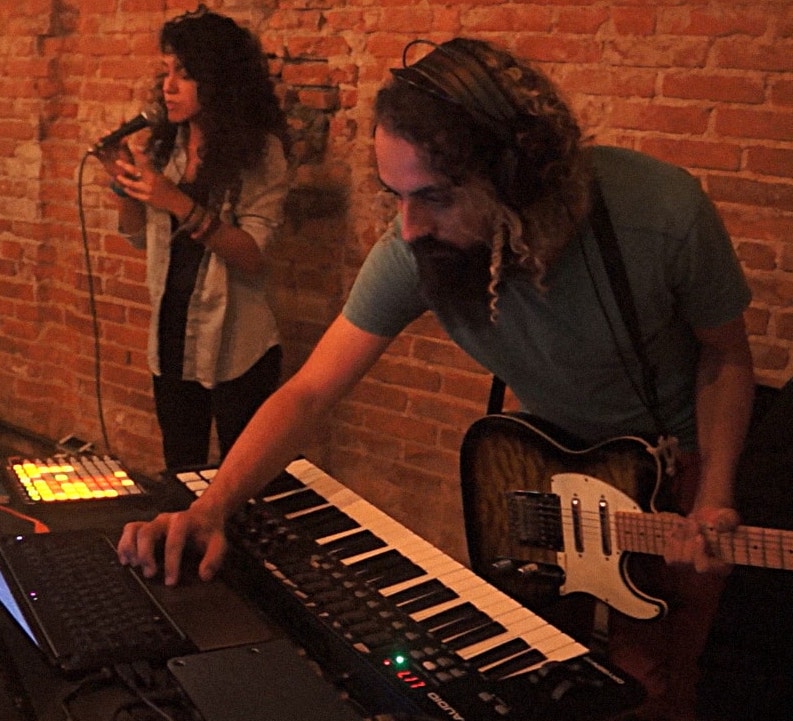
Music is playing an increasingly important role in Chamma’s work. (Supplied)
Created by the Palestinian artist Ahmed Khalidi and accompanied by music written and performed by Maruan and Ismael Betawi, “Falastini Ana” was originally commissioned by Action for Hope and is in many ways indicative of how Chamma’s poetry about Palestine has changed.
“It feels more like my story now,” she says. “It feels more like the Palestine in my daily life. And one of the shifts has been that the nostalgia has changed. The nostalgia is becoming more tangible.”
Although the bulk of her poetry has focused on Palestine, the themes of Chamma’s work are broad. Sexuality, emotions and social justice all feature strongly, while a perpetual questioning drives much of her writing. “It’s not just Palestine — but Palestine is core because it happens to be where I’m from. I miss it, I talk about it, I have family from there, it just comes up more. But I really think it’s about freedom in all its forms. How do you free yourself from everything? Even sexuality is about freedom. It’s always about people being well in their bodies, in their minds, in their land and I just filter out all that other noise, you know?”
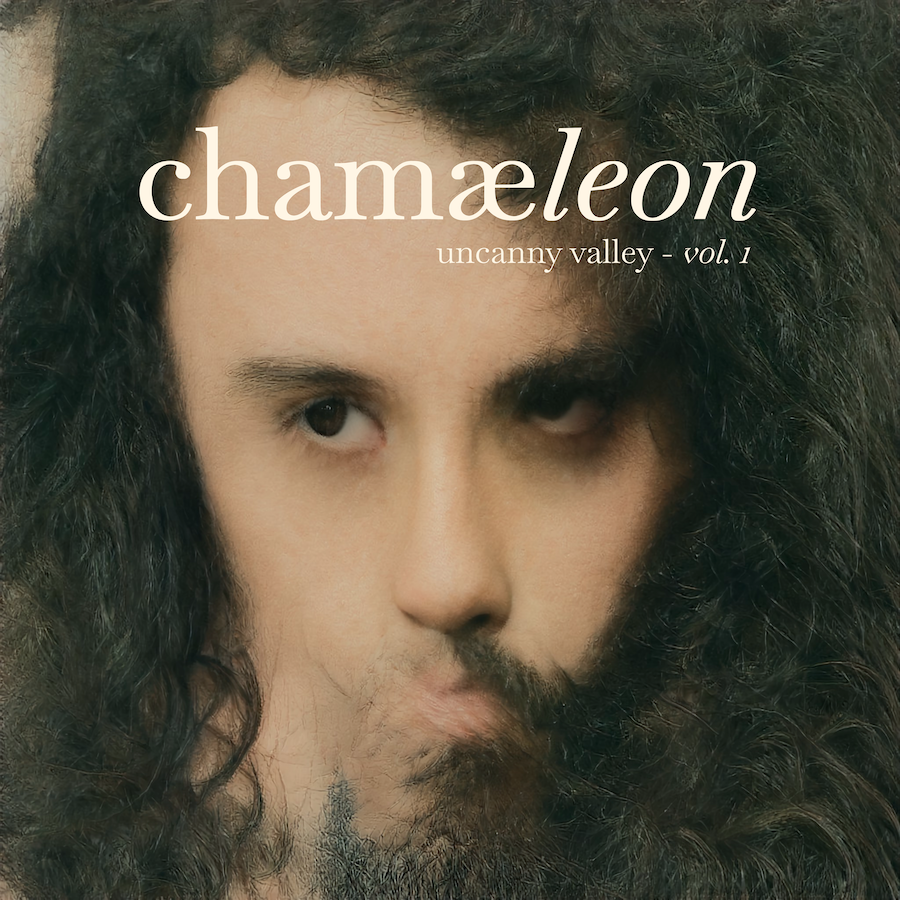
Chamæleon is a poetry and electronic music project Chamma founded with the Brazilian producer Live. (Supplied)
Music is playing an increasingly important role in Chamma’s work. With Chamæleon, which explores the intersections between spoken word and musical textures, the sounds are electronic and ambient. With the Betawi brothers, they are more traditional — the poetry is performed in the Palestinian dialect and set largely to oud and violin. Both projects have added elements of visuals or animation.
“It was never intentional,” explains Chamma, who was born in Dubai and lives in Sharjah. “The poetry was not written to be set to music, but I think it started with the most obvious instrument in Arabic poetry — the oud. But that wasn’t enough, so we started experimenting. I think rap really helped me understand rhythm, poetry and music. Music works because it enhances the experience. And I don’t think it’s about poetry set to music. I’m starting to see it as a genre in itself. It’s a musical experience.
“This is why it’s enjoyable, because it doesn’t give more weight to one element over the other, unless you really want to give weight to the words at a particular moment,” she continues. “It’s about how the whole thing sounds and it’s so much more freeing to enjoy the sound of everything, rather than thinking of it as a poem set to music. I don’t think it’s an accompaniment any more. It feels like a marriage of both elements.”
Chamæleon’s debut EP was released in February and an album with the Betawi brothers is currently being cooked. “There’s momentum now and I’m very content with what’s happening,” says Chamma with a smile. “With these two groups I’m completely comfortable and safe. And we’re thriving together.”


