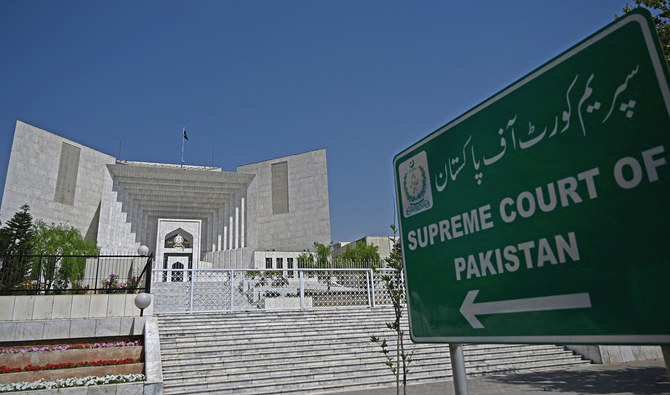
ISLAMABAD: Pakistan's Supreme Court is meeting for the fourth time today, Thursday, to rule on the legality of political maneuvers that led Prime Minister Imran Khan to dissolve the national assembly last weekend and call for fresh elections.
Khan was due last Sunday to face a no-confidence vote tabled by the opposition in the National Assembly. But Qasim Suri, the deputy speaker of parliament, a member of Khan’s Pakistan Tehreek-e-Insaf party, threw out the motion, saying it was part of a foreign conspiracy and thus unconstitutional. He used Article 5 of the constitution, which deals with loyalty to the state, to make his case.
The president then dissolved the lower house of parliament on Khan’s advice.
The Supreme Court has since been hearing a case against the government moves filed by the opposition. The panel of five judges has not said when it will give a ruling but it could order parliament to be reconstituted, call for elections or bar Khan from power if he is found to have violated the constitution. The court could also decide that it cannot intervene in parliamentary affairs.
“The court doesn’t have authority to review the speaker’s ruling,” Lawyer Ali Zafar said at Wednesday’s hearing, adding that parliament could not comment on a case pending before the courts and the courts should likewise not interfere in parliamentary proceedings.
“Any direction from the parliament will be trespassing of the authority [of the court],” he said, adding that any direction to the speaker would mean giving direction to parliament.
The chief justice remarked that according to the petitioners, the court could review parliamentary proceedings in case there was a violation of the constitution.
“Your point is interesting that even if a ruling of the speaker is wrong, it enjoys a privilege,” he added, saying that what the speaker had done was “unprecedented” apart from the significance of Article 69, which says proceedings in parliament shall not be called in question on the ground of any irregularity of procedure.
“This will have many negative consequences if allowed to happen,” the chief justice said, adding that the no-confidence motion was about to be adopted on the day of voting when the deputy speaker gave his ruling that it was unconstitutional.
Zafar replied: “The court should leave the matter to the public instead of interfering [in parliamentary proceedings].”
The chief justice remarked that the judges would respect the sanctity of the parliament but the Supreme Court could interfere if there was a violation of the constitution.
Earlier, Pakistan Tehreek-e-Insaf (PTI) counsel Babar Awan raised legal points to justify the speaker’s ruling and the subsequent dissolution of the National Assembly, saying there was a foreign conspiracy to topple Khan.
“We want to know about the conspiracy before handing down judgment,” the chief justice said. “Apparently the deputy speaker’s ruling contains allegations instead of facts.”
The chief justice questioned if the deputy speaker could give such a ruling without revealing evidence and facts: “This is the constitutional point in which the court has to give its verdict.”
Bandial also asked Awan about the minutes of a March 31 National Security Committee’s meeting that reviewed a “blatant interference” in Pakistan’s domestic affairs by a foreign power.
Pakistan’s military, whose army, navy and air force chiefs were present at the NSC meeting, is facing growing calls by the opposition to clarify its position on the veracity of Khan’s complaints about a foreign conspiracy against him.
Khan has said the plot to dislodge him was being orchestrated by the United States, which the State Department and the White House have denied.
AFP adds: The court could decide that the National Assembly is responsible for its own rules and regulations, and the refusal of the deputy speaker to hold a vote is a matter for lawmakers to settle.
However, some legal analysts argue it is an issue for the court: according to the constitution, the prime minister cannot ask the president to dissolve the assembly if a no-confidence vote is pending.
Still, the court could decide the decision to refuse the vote effectively meant the matter was no longer pending, sending the issue back to the assembly, which would mean the dissolution likely stands.
In this case, the ruling would effectively nullify the subsequent decision to dissolve parliament, so lawmakers could be ordered to reconvene and Khan would almost certainly be booted out of office.
There is precedent, however.
In 1988, Muhammad Khan Junejo appealed to the court after the assembly was dissolved by then-president General Zia-ul-Haq, who had taken power in a military coup years earlier.
It agreed his government had been dissolved unconstitutionally, but ruled that since elections had been announced, it was best to move on.
No date has been set for elections in the current crisis, but a similar ruling could emerge.
Also, in 1993, the court ruled president Ghulam Ishaq Khan had illegally dissolved the assembly -- then with Nawaz Sharif as prime minister.
Although the government resumed business, it lasted less than two months before being dissolved again.
If the court rules nothing untoward happened, it seems likely all subsequent actions would also stand and Pakistan would go to polls within 90 days.


![]()

Pakistan Supreme Court meets for fourth time today to rule on political crisis
Short Url
https://arab.news/89hkw
Pakistan Supreme Court meets for fourth time today to rule on political crisis
- Court could decide parliament responsible for its own rules, speaker's refusal to hold no-trust vote for lawmakers to settle
- Some legal analysts argue PM cannot ask president to dissolve assembly if a no-confidence vote pending
Latest updates


© 2026 SAUDI RESEARCH & PUBLISHING COMPANY, All Rights Reserved And subject to Terms of Use Agreement.