Pakistan’s Sindh starts inoculating cattle as lumpy skin disease spreads to Punjab

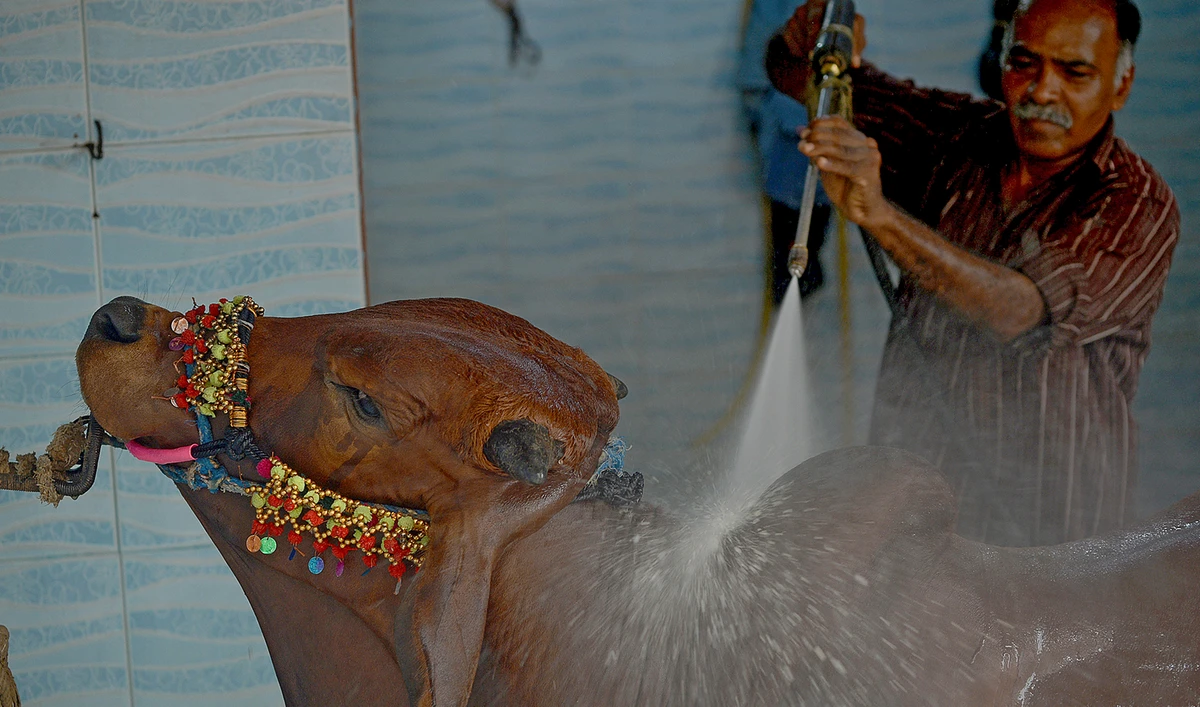
A man washes a cow for a customer at a car service station ahead of the Muslim festival of Eid al-Adha in Karachi, Pakistan, on July 14, 2021. (AFP/File)
Short Url
Updated 07 April 2022
Follow

Pakistan’s Sindh starts inoculating cattle as lumpy skin disease spreads to Punjab

  • The disease was first reported in Jamshoro district in November and has since affected over 33,000 animals
  • The Sindh administration has received the first tranche of 1.1 million vaccines from Turkey to deal with the disease

KARACHI: Authorities in Pakistan’s Sindh province have kicked off an inoculation drive for cows after lumpy skin disease (LSD) affected thousands of these animals while killing hundreds, though cattle farmers said on Wednesday the disease had now spread to the country’s Punjab province.
First observed in 1929 in Zambia, LSD is a viral infection that causes fever and multiple nodules on the skin and mucous membrane of animals. The disease is transmitted by bloodsucking insects like ticks and mosquitoes and can also prove fatal. Doctors say it does not affect humans.
LSD was first reported in Pakistan’s Jamshoro district in Sindh last November. Since then, 33,483 animals have been infected in the province while 339 have died.
On Saturday, authorities said they had imported 1.1 million doses of vaccine ordered from a Turkish company.
“The Sindh government took immediate action and swiftly imported vaccines which are now administered to cows in Karachi and other parts of the province,” said Shakir Umar Gujjar, president of the Dairy and Cattle Farmers Association, adding the disease was, however, spreading to Punjab now, especially in districts adjacent to Sindh.
“We hope we will soon be able to take control of the disease in Sindh, but similar administrative action is also required in Punjab,” he told Arab News.
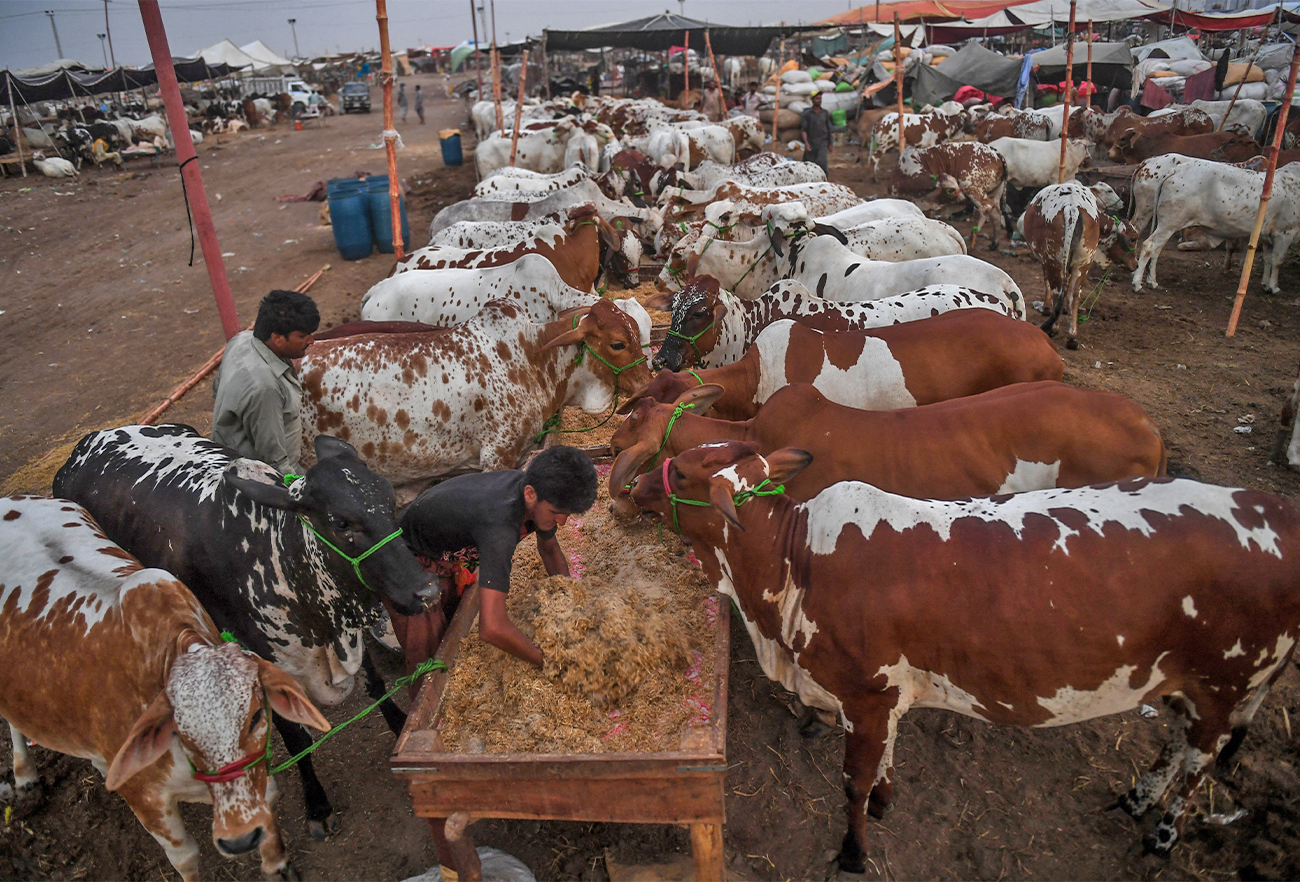


A trader feeds the cows at a cattle market in Karachi, Pakistan, on July 10, 2020. (AFP/File)

Dr. Nazeer Hussain Kalhoro, director general of livestock in the Sindh administration, said an order of 3.8 million doses was placed through a Lahore-based company, Huzaifa international, after the Drug Regulatory Authority of Pakistan (DRAP) allowed six local firms to import the vaccine.
He added the first tranche arrived on Saturday.
“The vaccine, which cost Sindh government Rs250 per dose, is administered free of cost,” he told Arab News while hoping the disease would soon be eradicated.
Kalhoro said a comprehensive plan had been made to inoculate livestock in the province, adding that arrangements had also been made to store vaccines at the required temperature.
Asked about the gravity of the situation, Gujjar said it was more serious than officials were willing to acknowledge.
“The official figures are always underreported,” he said. “But even these numbers have created panic and severely affected the sale of dairy products.”
Gujjar said the daily sale of five million liters of milk in Karachi had been reduced by 60 percent, adding that only 25 percent of average meat was sold in the city.
“There is gradual improvement now, especially in the sale of milk,” he continued. “Once the vaccination drive is complete, we will move toward normalcy.”
Cross-border clash breaks out between Pakistan and Afghanistan amid rising tensions

Updated 6 sec ago
Follow

Cross-border clash breaks out between Pakistan and Afghanistan amid rising tensions

  • Border residents say exchange of fire in the Chaman border sector lasted nearly two hours
  • Both governments issue competing statements blaming the other for initiating the violence

ISLAMABAD: Pakistan and Afghanistan witnessed yet another border clash, according to officials in both countries who spoke in the early hours of Saturday, with each side accusing the other of launching “unprovoked” attacks.

Fighting erupted in Pakistan’s southwestern Chaman border sector, with an AFP report saying that residents on the Afghan side of the frontier reported the exchange of fire began at around 10:30 p.m. (1800 GMT) and continued for roughly two hours.

The incident underscored how tensions remain high between the neighbors, who have seen deadly clashes in recent months despite several rounds of negotiations mediated by Qatar and Türkiye that resulted in a tenuous truce in October.

“There has been unprovoked firing by Afghan Taliban elements in the Chaman Sector which is a reckless act that undermines border stability and regional peace,” said a Pakistani security official on condition of anonymity.

“Pakistani troops responded with precision, reinforcing that any violation of our territorial integrity will be met with immediate and decisive action,” he continued.

The official described Pakistan’s response as “proportionate and calibrated” that showed “professionalism even in the face of aggression.”

“The Chaman Sector exchange once again highlights the need for Kabul to rein in undisciplined border elements whose actions are destabilizing Afghanistan’s own international standing,” he added.

Relations between Pakistan and Afghanistan have grown increasingly bitter since the Taliban seized power in Kabul following the withdrawal of international forces in August 2021.

Islamabad accuses the Taliban administration of sheltering anti-Pakistan militant groups such as the Baloch Liberation Army (BLA) and Tehreek-e-Taliban Pakistan (TTP), which have carried out deadly attacks in its western provinces bordering Afghanistan, targeting civilians and security forces.

The Taliban deny the charge, saying Pakistan’s internal security challenges are its own responsibility.

The Pakistani security official said his country remained “committed to peaceful coexistence, but peace cannot be one-sided.”

“Attempts to pressure Pakistan through kinetic adventurism have repeatedly failed and will continue to fail,” he said. “The Chaman response has reaffirmed that message unmistakably.”

He added that Pakistan’s security forces were fully vigilant and that responsibility for any escalation “would solely rest with those who initiated unprovoked fire.”

Mosharraf Zaidi, spokesman for Pakistan’s prime minister, also commented on the clashes in a social media post, saying the Afghan Taliban had “resorted to unprovoked firing along the border.”

“An immediate, befitting and intense response has been given by our armed forces,” he wrote.

https://x.com/mosharrafzaidi/status/1997025600775786654?s=46&t=JVxikSd5wyl9Y96OwifS5A

Afghan authorities, however, blamed Pakistan for the hostilities.

“Unfortunately, tonight, the Pakistani side started attacking Afghanistan in Kandahar, Spin Boldak district, and the forces of the Islamic Emirate were forced to respond,” Taliban spokesman Zabihullah Mujahid said on X.

https://x.com/zabehulah_m33/status/1997018198508818891?s=48&t=x28vcP-XUuQ0CWAu-biScA

Border clashes that began in October have killed dozens of people on both sides.

The latest incident comes amid reports of back-channel discussions between the two governments, although neither has publicly acknowledged such talks.