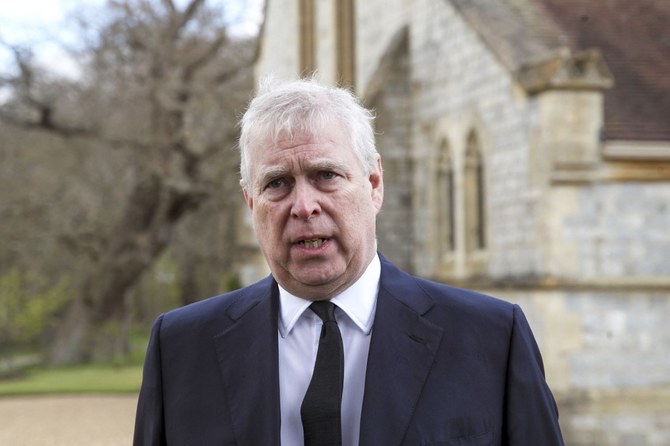
Prince Andrew’s $1.3m gift facilitated by Libyan gun-runner

Short Url
Updated 03 April 2022
Follow

Prince Andrew’s $1.3m gift facilitated by Libyan gun-runner

  • Duke of York gifted money by Selman Turk, who allegedly stole from Turkish millionairess
  • Tarek Kaituni reportedly organized meetings between prince and Muammar Gaddafi

LONDON: The alleged fraudster who gifted Prince Andrew more than £1 million ($1.3 million) was introduced to him by a convicted Libyan gun smuggler.

The UK’s Telegraph newspaper disclosed that the Duke of York was introduced to Selman Turk by Libyan Tarek Kaituni in 2019.

After their summer meet, they quickly established a friendship, with the duke attending dinners at Turk’s London home.

Kaituni had a longer link with Prince Andrew, which he boasted about to other connections. He had reportedly organized meetings between the duke and the late Libyan leader Muammar Gaddafi and attended the wedding of the duke’s daughter, Princess Eugenie, in 2018.

Turk quickly used his introduction to the duke to organize payments to him and his family, including £225,000 to his ex-wife Sarah Ferguson and £25,000 to Princess Eugenie.

It has been recently alleged that Turk amassed his wealth through fraudulent means, stealing the cash from Nebahat Evyap Isbilen, a 77-year-old Turkish millionairess, who passed $87 million to Turk, trusting him to move it out of Turkey as she fled political persecution. 

Turk and Kaituni held meetings with Prince Andrew in London on at least two occasions after the former was introduced to the duke.

One of these meetings included a dinner hosted at Turk’s apartment in South Kensington, London, on Dec. 5, 2019, where the prince was introduced to investors.

Turk shared photos with friends of him and Kaituni being entertained in what royal experts determine to be Frogmore House, the royal residence in Windsor Great Park, in February 2020.

Prince Andrew’s links with Kaituni, who has US citizenship, extend to 2005. Kaituni was convicted after attempting to smuggle a machine gun from Holland to France that same year.

Four years later, the Libyan gifted Princess Beatrice an £18,000 necklace at her 21st birthday party in Spain in August 2009, months before the duke allegedly warmed up a British company on his behalf.

Prince Andrew and Turk have been pictured together in public just once: At the Pitch@Palace event in November 2019, where Turk was awarded a People’s Choice award for his “digital bank” Heyman AI.

Soon after this event, Isbilen paid £750,000 directly to the duke. It is understood that she needed to send this “gift” to secure her passport.

The Telegraph reported that Isbilen was told by Turk that Prince Andrew would intervene in the case of her husband, a politician imprisoned in Turkey. He was allegedly arrested in 2016 after the failed coup to remove President Recep Tayyip Erdogan. 

But a transcript of phone calls obtained by the Telegraph unveils how Turk told an official from Isbilen’s private bank Hampden & Co. on Nov. 14, 2019, that the payment was a gift for Princess Beatrice’s wedding.

When banking director Stephen Buckland asked why the sum was so large, Turk said: “Wedding — so basically wedding — so for the cost of the wedding.” He later said: “Wedding gift, so basically it’s a gift to the bride.”

Buckland later asked Prince Andrew’s legal adviser Amanda Thirsk to confirm if the payment was a gift for the cost of the wedding or a gift to Princess Beatrice.

She replied: “I mean, I’m not sure it makes much difference, does it? I think it’s a gift for the wedding. What she and her family decide to do with it is really to do with them, isn’t it?”

Isbilen has now suggested that the £750,000 transfer could be connected to the award Turk won at the Pitch@Palace event.

In court documents, Ibsilen has said she “suspects that the payment was made for some purpose connected with the banking business.”

A spokeswoman for the duke of York told the Telegraph: “We will not be commenting on an ongoing legal matter.” Turk did not respond to the Telegraph’s requests for comment.


Bangladesh sets February date for first vote since 2024 mass uprising

Updated 5 sec ago
Follow

Bangladesh sets February date for first vote since 2024 mass uprising

  • At least 1,400 protesters were killed in violent crackdown under ex-PM Hasina’s rule
  • Interim government promises ‘all necessary support’ for upcoming elections

DHAKA: Bangladesh will hold national elections on Feb. 12, its chief election commissioner has announced, setting the timeline for the nation’s first vote since a student-led uprising that ousted long-serving Prime Minister Sheikh Hasina.

Hasina, whose Awami League party-led government was marred by allegations of human rights violations, rigged elections and corruption, was removed from office in August last year after 15 uninterrupted years in power.

Bangladesh has since been led by interim leader Muhammad Yunus, a Nobel Prize-winning economist, who took over governance after Hasina fled to India, where she is now in self-exile.

In a televised address on Thursday, chief election commissioner A.M.M. Nasir Uddin confirmed the voting date to elect 300 lawmakers and said a national referendum on political reforms would also be held on the same day.

“It’s a relief for the voters; it’s a relief for the country. It’s a relief for the investors, it’s a relief for the development partners and for the political parties and the people who did a massive job in July 2024 by sacrificing their lives and limbs to oust a tyranny,” said Prof. A.S.M. Amanullah, political analyst and vice chancellor of the National University in Dhaka.

Mass protests that broke out in 2024 began in early July as peaceful demonstrations, triggered by the reinstatement of a quota system for the allocation of civil service positions.

Two weeks later, they were met with a communications blackout and a violent crackdown by security forces.

A special tribunal in Dhaka found Hasina guilty of allowing lethal force to be used against the protesters, at least 1,400 people of whom died, according to estimates from the UN’s human rights office.

After a months-long trial, she was sentenced to death in November for crimes against humanity.

The February elections will take place in the aftermath of Hasina’s reign, with the Yunus-led administration banning all activities of Awami League, meaning the former ruling party would not be able to join the race next year.

Minor political tensions now revolve around the more than 40 million voters of the Awami League, as the public speculate “how they would move, in which party they would support or whether they would remain silent,” Amanullah said.

“(But) if you consider other than Awami League, if we consider the other political parties, I think the other political parties are sufficient, you know, to make the next poll participatory, and free and fair.”

Bangladesh last held elections in January 2024, which saw Hasina return to office for a fourth consecutive term. That vote was boycotted by the country’s main opposition parties, which accused her administration of rigging the polls.

“There is a growing demand within the society and in the community that they would cast their first vote after almost 15, 16 years. And that would be an (occasion) of big national celebration,” Amanullah said.

In February, more than 127.6 million Bangladeshis will be eligible to cast their vote. It will be Bangladesh’s 13th election since the country gained independence in 1971.

The long-awaited election process now begins with the filing of nominations from Dec. 12 to 29, which will then be reviewed over the following six days. The last date for withdrawing nominations is Jan. 20.

After the voting date was announced, Yunus pledged to “provide all necessary support” to encourage festivity, participation and fairness in the upcoming polls.

“After the historic mass uprising (last year), the country is now moving toward a new path,” he said in a statement. “This election and referendum will consolidate that trajectory, prioritize the will of the people and further strengthen the foundation of a new Bangladesh.”

For Malaika Nur, a 24-year-old Dhaka University student who took part in the 2024 protests, the elections are an opportunity for young people to formally take part in politics.

“Young people have been showing much interest in politics since July 2024. They showed us how the youth can reshape a country’s political condition. If they have a few seats in the parliament, it can be a game-changer for the future of politics in Bangladesh,” she said.

“I hope this election will be different from the last three elections held in the previous regime. There will be a festive mood, people will cast their valuable votes and will get to choose their representative … I hope the elected government will ensure safety and basic rights of every citizen, and will hold fair elections in the future and will not become another fascist.”