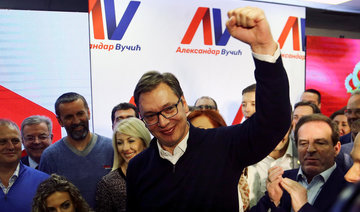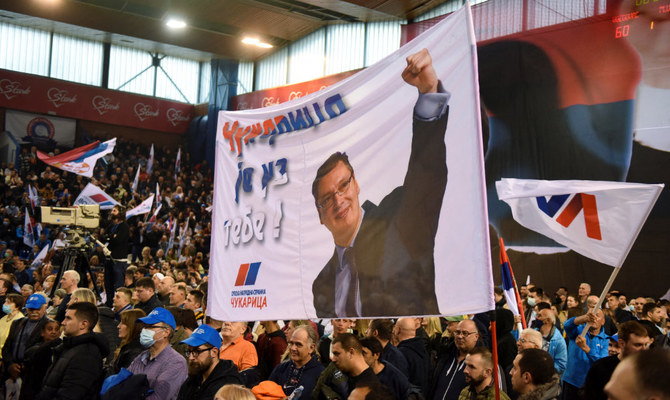

BELGRADE: Serbians will vote on Sunday in presidential and parliamentary elections that pit incumbent President Aleksandar Vucic and his Progressive Party (SNS) against an opposition pledging to fight corruption and improve environmental protection.
Vucic is running for a second five-year term on a promise of peace and stability at the time of Russia’s invasion of Ukraine, which has put Serbia under pressure from the West to choose between its traditional ties with Moscow and aspirations to join the European Union (EU).
Voting for Serbia’s estimated 6.5 million electorate opens at 0500 GMT and closes at 1800 GMT.
Polls show Vucic, a conservative, on course to win in the first round, ahead of Zdravko Ponos, a retired army general who is the candidate for the pro-European and centrist Alliance for Victory coalition.
A poll by Faktor Plus pollster published in the Blic daily on Wednesday saw the SNS winning with 53.6 percent of the vote. The Alliance for Victory was second with 13.7 percent and Vucic’s coalition partner, the Socialists, third with 10.2 percent. A grouping of environmentalists would get 4.7 percent of votes, above the 3 percent threshold required to win seats in parliament, the poll showed.
The opposition largely boycotted a parliamentary election last year, allowing SNS and its allies to secure 188 seats in the 250-seat parliament.
SHADOW OF WAR
Russia’s Feb. 24 invasion of Ukraine has had a big impact on campaigning in Serbia, which is still recovering from the Balkan wars and isolation of the 1990s.
Serbia is almost entirely dependant on Russian gas, while its army maintains ties with Russia’s military.
The Kremlin is also supporting Belgrade’s opposition to the independence of Kosovo, Serbia’s predominantly Albanian former southern province.
Although Serbia backed two United Nations resolutions condemning Russia’s invasion of Ukraine, it refused to impose sanctions against Moscow.
Bojan Klacar, head of the CeSID pollster, said the war forced a swing from the main campaign topics such as corruption, the environment and the rule of law.
“The electorate is now seeking answers to their concerns regarding economic stability, living standards and political stability,” Klacar told Reuters earlier this week.
A veteran politician who served as information minister in 1998 under former strongman Slobodan Milosevic, Vucic had transformed from a nationalist firebrand to a proponent of EU membership, but also of military neutrality and ties with Russia and China.
Ponos has accused Vucic of using the war in Ukraine in his campaign to try to capitalize on people’s fears.
Opposition and rights watchdogs also accuse Vucic and his allies of an autocratic style of rule, corruption, nepotism, controlling the media, attacks on political opponents and ties with organized crime. Vucic and his allies have repeatedly denied that.