

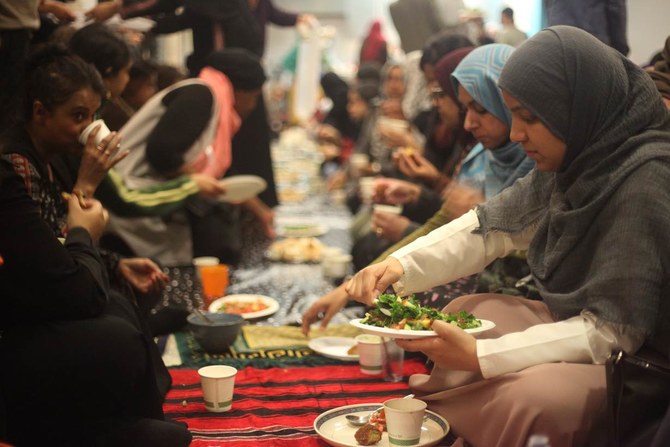
Charities warn half of British Muslims will struggle to eat during Ramadan

Short Url
Updated 02 April 2022
Follow

Charities warn half of British Muslims will struggle to eat during Ramadan

  • About 50% of UK’s 3.37m Muslims live in poverty, opposed to 18% of general population
  • Expert tells Muslims to give zakat payments to needy people within their communities

LONDON: A charity has warned that as many as half of Muslims living in the UK will struggle to feed their families during Ramadan.

Islamic Relief said it and other groups had seen an uptick in food bank use since the start of the COVID-19 pandemic, which had been exacerbated by the subsequent increase in the cost of living.

The additional cost of living to the average family in the UK is expected to reach around £1,000 ($1,311) in 2022, according to research from the Resolution Foundation.

On Friday, UK Business Secretary Kwasi Kwarteng said: “While no government can control the global factors pushing up the cost of everyday essentials, we will absolutely act wherever we can to mitigate rising costs.”

It estimated, meanwhile, that around 1.6 million Muslims live in poverty in the world’s fifth-largest economy, compared to 18 percent of the general population.

“Families across the UK will be suffering as a result of record rates of inflation as well as increasing energy prices due to the war in Ukraine,” said Tufail Hussain, director of Islamic Relief UK.

“We urgently call on the UK government to … take the bold actions necessary to avoid pushing families into destitution. This is especially important as Muslim families begin to observe the holy month of Ramadan.

“Many will be fasting from sunrise to sunset and there is a real risk that families will not have enough food or will go without to feed their children,” he added.

UK broadcaster Sky News interviewed mother-of-three Bushra Begum, from east London, who said her home, which shares a kitchen and bathroom with other families, was infested with rats and didn’t have working heating.

“They (the rats) come in during the night. Not just one, two or three. I have no choice but to stay here, rent is so high,” she said.

“Sometimes my children want to use the bathroom but they have to keep waiting because other people are using it.

“Even here, we give my husband’s entire salary to cover the rent for just this single room, and now they are increasing the bills for electricity. It has become so difficult.”

Fahim Dahya, logistics manager at Sufra NW10 food bank in London, told Sky News: “The bills are not going to hit until the end of this month, so we are bracing ourselves for a big explosion.

“After the pandemic hit, within a couple of months, we had a 400 percent increase (in users). It used to be a calming experience — people would come, get some food, have a chat. We’d talk to them and find out about their situation, try to offer help. Now, they’re just feeling anxiety and uncertainty,” he added.

One expert has asked British Muslims to give their zakat payments to the needy within their own communities this Ramadan.

Sohail Hanif, chief executive of the UK’s National Zakat Foundation, said: “One of the key things is that zakat should be spent within the area where you live.

“Within the UK there are a lot of families struggling. We’re really seeing it now.”


Geoeconomic confrontation tops global risks in 2026: WEF report

Updated 20 min 53 sec ago
Follow

Geoeconomic confrontation tops global risks in 2026: WEF report

  • Also armed conflict, extreme climate, public polarization, AI
  • None ‘a foregone conclusion,’ says WEF’s MD Saadia Zahidi

DUBAI: Geoeconomic confrontation has emerged as the top global risk this year, followed by state-based armed conflict, according to a new World Economic Forum report.

The Global Risks Report 2026, released on Wednesday, found that both risks climbed eight places year-on-year, underscoring a sharp deterioration in the global outlook amid increased international competition.

The top five risks are geoeconomic confrontation (18 percent of respondents), state-based armed conflict (14 percent), extreme weather events (8 percent), societal polarization (7 percent) and misinformation and disinformation (7 percent).

The WEF’s Managing Director Saadia Zahidi said the report “offers an early warning system as the age of competition compounds global risks — from geoeconomic confrontation to unchecked technology to rising debt — and changes our collective capacity to address them.

“But none of these risks are a foregone conclusion.”

The report assesses risks across three timeframes: immediate (2026); short-to-medium term (next two years); and long term (next 10 years).

Economic risks show the largest overall increase in the two-year outlook, with both economic downturn and inflation jumping eight positions.

Misinformation and disinformation rank fifth this year but rise to second place in the two-year outlook and fourth over the 10-year horizon.

The report suggests this reflects growing anxiety around the rapid adoption of artificial intelligence, with adverse outcomes linked to AI surging from 30th place in the two-year timeframe to fifth in the 10-year outlook.

Uncertainty dominates the global risk outlook, according to the report.

Surveyed leaders and experts view both the short- and long-term outlook negatively, with 50 percent expecting a turbulent or stormy global environment over the next two years, rising to 57 percent over the next decade.

A further 40 percent and 32 percent, respectively, describe the outlook as unsettled across the two- and 10-year timeframes, while just 1 percent anticipate a calm global outlook in either period.

Environmental risks ease slightly in the short-term rankings. Extreme weather fell from second to fourth place and pollution from sixth to ninth. Meanwhile, critical changes to Earth systems and biodiversity loss dropped seven and five positions, respectively.

However, over the next decade, environmental threats re-emerge as the most severe, with extreme weather, biodiversity loss, and critical changes to Earth systems topping the global risk rankings.

Looking ahead over the next decade, around 75 percent of respondents anticipate a turbulent or stormy environmental outlook, making it the most pessimistic assessment across all risk categories.

Zahidi said that “the challenges highlighted in the report underscore both the scale of the potential perils we face and our shared responsibility to shape what comes next.”

Despite the gloomy outlook, Zahidi signaled a positive shift in global cooperation.

 “It is also clear that new forms of global cooperation are already unfolding even amid competition, and the global economy is demonstrating resilience in the face of uncertainty.”

Now in its 21st year, the Global Risks Report highlights a core message: global risks cannot be managed without cooperation.

As competition intensifies, rebuilding trust and new forms of collaboration will be critical, with the report stressing that today’s decisions will shape future outcomes.

The report was released ahead of WEF’s annual meeting, which will be held in Davos from Jan. 19 to 23.