

Yemen talks focus on aid, care for wounded and opening of roads

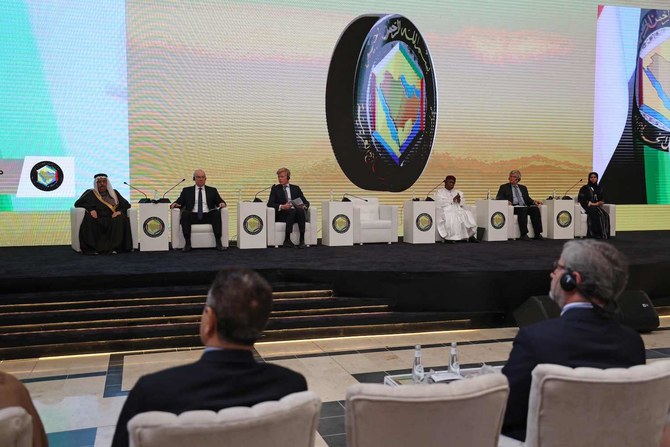
A conference on Yemen's devastating war is hosted by the Gulf Cooperation Council in Riyadh on March 30, 2022. (AFP)
Short Url
Updated 31 March 2022
Follow

Yemen talks focus on aid, care for wounded and opening of roads

  • Houthis escalate conflict, kidnap several academics, say reports
  • GCC and coalition committed to ceasefire despite violations by the Iran-backed militia

RIYADH: The GCC-sponsored Yemeni peace talks continued on Thursday in Riyadh with discussions held on opening corridors for humanitarian aid, medical care for the wounded and disabled, and removing barricades blocking roads between the war-ravaged country’s cities.

The talks, which started on Wednesday and will end on April 7, has brought together hundreds of Yemeni politicians, tribal leaders, current and former military and security officials, non-governmental organizations, and Islamic scholars. The Houthis have refused to attend the gathering which also saw the participants discuss economic development, security and press freedom issues.

Abdul Kareem Shaiban, an MP, said his discussion group focused on ways to improve the humanitarian situation in Yemen, including providing medical care for the growing numbers of injured and disabled, and opening corridors to allow aid organizations to enter the country’s cities.

He said Yemen should ensure that all relief efforts assist in ensuring sustainable development in the country, rather than promoting a dependence on food consignments that would “create a begging society.”

The Iran-backed Houthis have refused to participate in the conference and seek direct talks with Saudi Arabia. They have also demanded the lifting of what they have termed a “blockade” on Sanaa airport and restrictions on the Hodeidah seaport.

To create the conditions for successful peace talks, the Coalition to Restore Legitimacy in Yemen on Tuesday night announced it would halt all military operations in Yemen, including airstrikes, during the talks and the month of Ramadan. It has urged the Houthis to agree to these peace efforts.

However, the Houthis have reportedly exploited the coalition’s ceasefire by intensifying attacks on the government-controlled central city of Marib and the northern province of Hajjah, sparking fierce battles with loyalists.

Yemen’s Defense Ministry and local media reports said on Thursday that army troops pushed back a Houthi offensive in Bani Hassan area, north of Hajjah’s Abes district.

At the same time, Yemen’s army’s chief of staff said on Thursday that the army is committed to stopping hostilities on the ground in line with the coalition’s declaration, despite the Houthi violations.

“From our long experience, we know that the aggressive and terrorist Iranian militia will not abide by any agreement or call for peace since it (peace) will threaten its existence,” Lt. Gen. Sagheer bin Aziz said on Twitter.

The Houthi escalation on the ground came as Yemeni politicians and human rights activists slammed the movement for abducting three Yemeni academics and activists who were heading to Riyadh to attend the talks.

Local media and relatives said the Houthis abducted Hamud Al-Awdi, an octogenarian professor of sociology at Sanaa University, and activists Abdul Rahman Al-Olifi and Khaled Shouaib, in the province of Ibb while they were heading to government-controlled areas before flying to Riyadh.

The three men had been given permission by the Houthi authority in Sanaa and alerted the movement’s leaders about their travel.

Relatives said the Houthis transferred them from Ibb to the intelligence detention center in Sanaa and barred their families from visiting or contacting them.

Khaled Al-Ruwaishan, a former Yemeni culture minister and an outspoken writer, said the Houthis’ abduction of the three men contradicted their latest commitment to swap hundreds of prisoners with the Yemeni government.

“While we were waiting for you to release hundreds, according to your announcement two days ago, you arrested a prominent academic who is over 80 years old!” Al-Ruwaishan wrote on his Facebook page, referring to Al-Awdi.


Trump claims Iran working on missiles that could hit US

Updated 31 min 14 sec ago
Follow

Trump claims Iran working on missiles that could hit US

  • Trump says his preference is diplomacy, but would never allow Tehran to have a nuclear weapon

WASHINGTON: US President Donald Trump on Tuesday claimed Iran is seeking to develop missiles that can strike the United States and accused Tehran of working to rebuild a nuclear program that was targeted by American strikes last year.

The United States and Iran are engaged in high-stakes negotiations over Iran’s atomic program and other issues including missiles, with Trump saying he prefers diplomacy but is willing to use force if talks fail.

“They’ve already developed missiles that can threaten Europe and our bases overseas, and they’re working to build missiles that will soon reach the United States of America,” Trump said during his State of the Union address.

In 2025, the US Defense Intelligence Agency said Iran could potentially develop a militarily viable intercontinental ballistic missile by 2035 “should Tehran decide to pursue the capability,” but did not say if it had made such a decision.

Tehran currently possesses short- and medium-range ballistic missiles with ranges that top out at about 1,850 miles (3,000 kilometers), according to the US Congressional Research Service.

The continental United States is more than 6,000 miles from Iran’s western tip.

Washington and Tehran have concluded two rounds of talks aimed at reaching a deal on Iran’s nuclear program to replace the agreement that Trump tore up during his first term in office.

 ‘Preference’ is diplomacy

The United States has repeatedly called for zero uranium enrichment by Iran but has also sought to address its ballistic missile program and support for armed groups in the region — demands Iran has rejected.

Iran has also repeatedly rejected that it is pursuing nuclear weapons.

Trump ordered strikes on three Iranian nuclear sites last year, claiming afterward that Tehran’s atomic program was obliterated.

On Tuesday, he said Iran wants “to start all over again,” and that it is “at this moment again pursuing their sinister nuclear ambitions.”

Trump has sent a massive US military force to the Middle East, deploying two aircraft carriers as well as more than a dozen other ships, a large number of warplanes and other assets to the region.

He has repeatedly threatened to strike Iran if negotiations fail to reach a new agreement. Talks with Tehran are currently set to continue on Thursday.

“My preference is to solve this problem through diplomacy but one thing is certain: I will never allow the world’s number one sponsor of terror, which they are by far, to have a nuclear weapon,” Trump said.

The US president’s speech primarily focused on domestic issues, making no mention at all of China — Washington’s primary military and economic rival — and only briefly referring to Russia.

Trump said he was working to end the bloody conflict between Russia and Ukraine, and repeated his inaccurate claim that he had brought eight other wars to an end since returning to office in January 2025.

He also hailed NATO’s decision to spend five percent of gross domestic product on defense — a move made under heavy pressure from Trump and his administration.