

Explainer: How does the no-confidence vote work in Pakistan

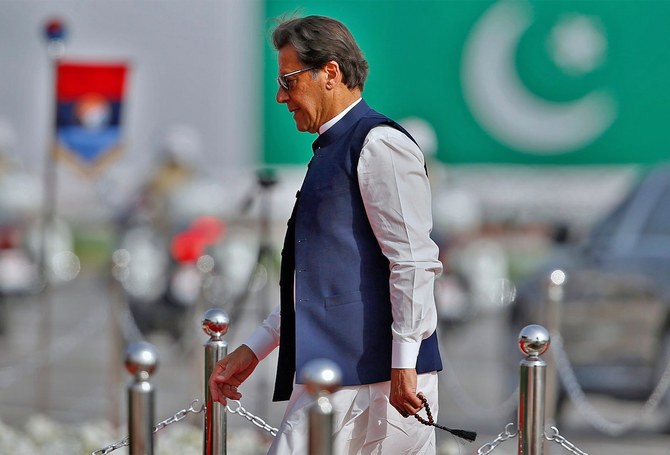
Pakistan Prime Minister Imran Khan arrives to attend the parade on Pakistan Day in Islamabad, Pakistan, on March 31, 2022. (AP)
Short Url
Updated 31 March 2022
Follow

Explainer: How does the no-confidence vote work in Pakistan

  • If Khan loses vote, parliament can function until its tenure ends in August 2023, after which an election is due within 60 days
  • There will be vote in National Assembly to elect a new PM to serve until 2023 or who can call a general election immediately 

ISLAMABAD: Pakistani opposition political parties have introduced a no-confidence vote in parliament seeking the ouster of Prime Minister Imran Khan, largely on accusations of economic mismanagement.
The bid to oust Khan got a boost on Wednesday when a key government ally said it reached a pact with the opposition and then quit Khan’s ruling coalition. read more
Khan’s ouster is likely to bring another round of instability in the nuclear armed country, in which the military has a long record of intervening in politics.

HOW DOES THE NO-CONFIDENCE VOTE WORK
Under the constitution, a prime minister is elected by a majority of the lower house National Assembly, which has 342 members.
A candidate needs a majority of legislators, 172, to vote for him to become prime minister. That is the same number of votes against him in a no-confidence vote needed to oust him and dissolve his cabinet.
So Khan could survive a no-confidence vote even if he got fewer votes than the opposition but only if the latter did not get the 172 votes that make up a majority in the 342-seat house.

WHAT HAPPENS AFTER THE VOTE?
If Khan loses the vote, parliament can continue to function until its five-year tenure ends in August 2023, after which a general election is due within 60 days.
There will be a vote in the National Assembly to elect a new prime minister to serve until then. Candidates can be put forward by any party with legislators in the assembly.
The new prime minister can, however, call a general election immediately, without waiting until 2023.
Some constitutional analysts say the assembly can be dissolved and a general election held if no candidate can secure a majority of votes to become the prime minister.

WHAT IS THE TIMELINE OF THE VOTE?
Opposition parties filed the no-confidence motion in early March, and it was presented and tabled before the National Assembly on Monday.
The speaker of the National Assembly has to carry out the vote no sooner than three days and no later than seven days after the motion is tabled.
The earliest the vote can happen is Thursday. The latest, by most accounts, is Monday.

IS THE VOTE CLOSE?
Khan faces a tight vote. He became prime minister after his party, the Pakistan Tehreek-e-Insaaf (PTI), won the most seats in the 2018 general elections.
However, the PTI did not have a simple majority by itself and had to form a coalition with other parties.
The PTI has 155 members and Khan crossed the 172-vote threshold to be elected prime minister in 2018 with the help of coalition partners. The PTI-led coalition increased its numbers over the past three years.

WHAT IS KHAN’S STRATEGY?
Khan has ordered all PTI legislators to remain absent from the assembly on the day of the vote to mitigate any chance of dissidents secretly supporting the motion to remove him.
Absenteeism would not hurt Khan’s cause because he doesn’t need to win; he just needs to ensure that the opposition cannot get the 172 votes needed to pass the no-confidence motion.
Khan has also filed a petition in the courts seeking lifetime electoral bans against on those found to have broken ranks, in a bid to dissuade potential dissidents.


Pakistan joins 22 Muslim states, OIC to condemn Israeli FM’s visit to Somaliland

Updated 08 January 2026
Follow

Pakistan joins 22 Muslim states, OIC to condemn Israeli FM’s visit to Somaliland

  • Israeli Foreign Minister Gideon Saar visited breakaway African region of Somaliland on January 6
  • Muslim states urge Israel to withdraw Somaliland recognition, respect Somalia’s sovereignty

ISLAMABAD: A joint statement by Pakistan, 22 other Muslim states and the Organization of Islamic Cooperation (OIC) on Thursday condemned Israeli Foreign Minister Gideon Saar’s recent visit to Somaliland as a violation of the African nation’s territorial integrity and sovereignty.

Saar’s visit to Somaliland capital Hargeisa on Jan. 6 followed Israel’s move last month to recognize Somaliland, a breakaway region from Somalia, as an independent country. The move drew a sharp reaction from Muslim states, including Pakistan, who said it was in contravention of the UN Charter and international norms. 

Several international news outlets months earlier reported that Israel had contacted Somaliland over the potential resettlement of Palestinians forcibly removed from Gaza. Muslim countries fear Israel’s recognition of the breakaway region could be part of its plan to forcibly relocate Palestinians from Gaza to the region. 

“The said visit constitutes a clear violation of the sovereignty and territorial integrity of the Federal Republic of Somalia, and undermines established international norms and the United Nations Charter,” the joint statement shared by Pakistan’s foreign office, read. 

The joint statement was issued on behalf of 23 Muslim states, including Saudi Arabia, Bangladesh, Pakistan, Egypt, Iraq, Iran, Palestine, Jordan, Kuwait, Türkiye, Oman and others. 

It reaffirmed support for Somalia’s territorial integrity and sovereignty, pointing out that respect for international law and non-interference in the internal affairs of sovereign states was necessary for regional stability. 

“Encouraging secessionist agendas are unacceptable and risk exacerbating tensions in an already fragile region,” the statement said. 

The joint statement urged Israel to revoke its recognition of the breakaway region. 

“Israel should fully respect Somalia’s sovereignty, national unity and territorial integrity and honor its obligations in compliance with international law, and demand immediate revocation of the recognition issued by Israel,” the statement read.

Somaliland broke away from Somalia unilaterally in 1991 as a civil war raged in the country. Somaliland has its own constitution, parliament and currency, a move that has infuriated Somalia over the years as it insists the region is part of its territory.