

Pakistan opposition seeks PM’s resignation after government ally quits coalition

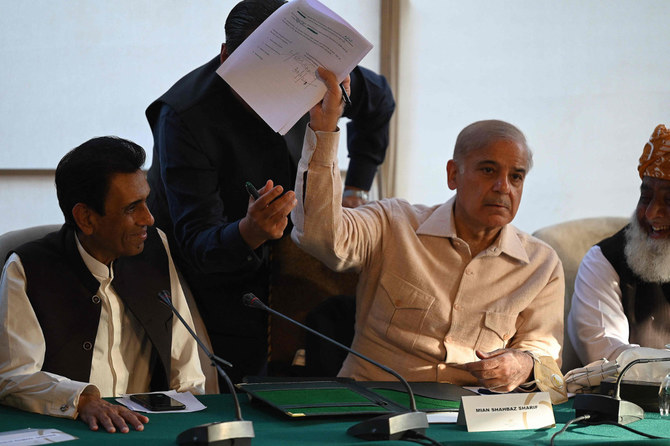
Pakistan's opposition leader Shahbaz Sharif (2R) displays an agreement signed on March 30, 2022 between government coalition MQM-Pakistan and opposition party PPP ahead of a parliamentary no-confidence vote. (Aamir Qureshi / AFP)
Short Url
Updated 30 June 2022
Follow

Pakistan opposition seeks PM’s resignation after government ally quits coalition

  • Without MQM-P, Imran Khan’s party has fallen short of 172 votes needed to retain power
  • Pakistani PM facing parliamentary no-confidence vote expected in comings days

ISLAMABAD: Pakistan’s joint opposition on Wednesday asked Prime Minister Imran Khan to resign after a major coalition partner formally announced the withdrawal of its support for the government, resulting in the ruling Tehreek-e-Insaf party losing its majority in the national assembly.

The Muttahida Qaumi Movement-Pakistan struck a deal with the opposition Pakistan People’s Party and signaled it would vote against Khan in a no-confidence vote expected to take place in early April.

Khan, a former cricket star, is facing his toughest political challenge since assuming office in 2018 as the opposition tabled a no-confidence motion against him in the National Assembly on Monday, amid accusations he has mismanaged the economy and governed poorly. 

The MQM-P has seven lawmakers in the National Assembly, pushing the opposition’s tally to 175 in the 342-member National Assembly, or three votes more than the number required to topple Khan’s administration.

“We are with you in this change, and hope this will help bring positive change in the lives of the people,” Dr. Khalid Maqbool Siddiqui, convener of the MQM-P, said during a joint press conference with opposition leaders.

Earlier the party’s two federal ministers resigned from their Cabinet portfolios to join the opposition ranks.

“The prime minister should set a new tradition by tendering his resignation after losing the majority,” Shehbaz Sharif, leader of the opposition in the National Assembly, said during a joint news conference with other politicians who want to oust Khan.

The opposition alliance has also nominated Sharif, president of the Pakistan Muslim League-Nawaz, for the coveted premiership slot after Khan’s exit.

PPP chairman, Bilawal Bhutto-Zardari, also demanded the PM’s resignation, saying he had lost the majority and confidence of the house.

“The prime minister isn’t left with any option,” he said, adding that voting on the no-confidence motion could be held even on Friday if Khan decided not to step down.

“Today, MQM Pakistan has joined the opposition ranks. Shehbaz Sharif has rightly given (Khan) a challenge in the spirit of statesmanship to resign.”

Maulana Fazlur Rehman of the Jamiat-e-Ulama-e-Islam party, another key member of the opposition, said the joint opposition aim was to “achieve prosperity and stability in the country.”

“We’ll work for it,” he added. “We want to become a nation.”


UN experts concerned by treatment of Palestine Action-linked hunger strikers

Updated 26 December 2025
Follow

UN experts concerned by treatment of Palestine Action-linked hunger strikers

  • Eight prisoners awaiting trial for alleged offences connected to the group have taken part in the protest

LONDON: UN human rights experts have raised concerns about the treatment of prisoners linked to Palestine Action who have been on hunger strike while on remand, warning it may breach the UK’s international human rights obligations.

Eight prisoners awaiting trial for alleged offences connected to the group have taken part in the protest, reported The Guardian on Friday.

Among them are Qesser Zuhrah and Amu Gib, who were on hunger strike at HMP Bronzefield from Nov. 2 to Dec. 23, and Heba Muraisi, held at HMP New Hall. Others include Teuta Hoxha, Kamran Ahmed and Lewie Chiaramello, who has refused food on alternate days due to diabetes.

Zuhrah and Gib temporarily resumed eating this week because of deteriorating health but said they plan to resume the hunger strike next year, according to Prisoners for Palestine.

In a statement issued on Friday, UN special rapporteurs, including Gina Romero and Francesca Albanese, said the handling of the prisoners was alarming.

“Hunger strike is often a measure of last resort by people who believe that their rights to protest and effective remedy have been exhausted. The state’s duty of care toward hunger strikers is heightened, not diminished,” they said.

Three of the prisoners were in hospital at the same time on Sunday, with Ahmed admitted on three occasions since the hunger strike began.

The experts said: “Authorities must ensure timely access to emergency and hospital care when clinically indicated, refrain from actions that may amount to pressure or retaliation, and respect medical ethics.”

Prisoners for Palestine has alleged that prison staff initially denied ambulance access for Zuhrah during a medical emergency last week, with hospital treatment only provided after protesters gathered outside the prison.

“These reports raise serious questions about compliance with international human rights law and standards, including obligations to protect life and prevent cruel, inhuman or degrading treatment,” the experts said, adding: “Preventable deaths in custody are never acceptable. The state bears full responsibility for the lives and wellbeing of those it detains. Urgent action is required now.”

Families and supporters have called for a meeting with Justice Secretary David Lammy, while lawyers claim the Ministry of Justice has failed to follow its own policy on handling hunger strikes.

Government officials are understood to be concerned about the prisoners’ condition but cautious about setting a wider precedent.