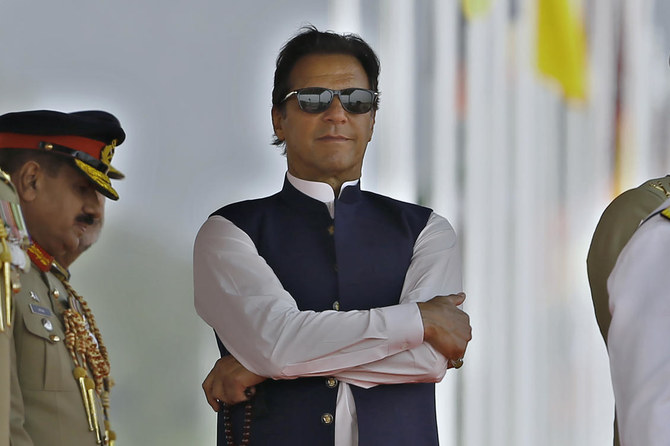
ISLAMABAD: Pakistan Prime Minister Imran Khan’s future looked increasingly in doubt Wednesday after a key coalition partner switched allegiance ahead of a parliamentary no-confidence vote this weekend.
No prime minister in the country’s history has seen out a full term, and Khan is facing the biggest challenge to his rule since being elected in 2018, with opponents accusing him of economic mismanagement and foreign-policy bungling.
“He will fight until the last over and the last ball,” Interior Minister Sheikh Rashid Ahmed told reporters, using a cricket analogy to describe Khan — one of the sport’s all-time international greats before he entered politics.
Officials said earlier that Khan would address the nation on state TV Wednesday night, but that was later postponed without a reason or new schedule given.
Debate on the no-confidence motion is due to start Thursday, leaving Khan scrambling to keep his own Pakistan Tehreek-e-Insaf (PTI) members on side — as well as a slew of minority parties.
On paper the PTI and coalition partners have 176 seats in the 342-member assembly, but on Wednesday the Muttahida Qaumi Movement (MQM-P) said its seven lawmakers would vote with the opposition, which has a combined 163 seats.
More than a dozen PTI lawmakers have also indicated they will cross the floor, although party leaders are trying to get the courts to prevent them from voting on Sunday.
In the past, Pakistan parties have also resorted to physically preventing lawmakers from voting against key legislation by blocking access to the national assembly, leading to cat-and-mouse chases and even accusations of kidnapping.
Senior MQM-P leader Faisal Subzwari tweeted Wednesday that his party had finalized an agreement with the opposition, led by the Pakistan People Party (PPP) and Pakistan Muslim League (PML-N).
Hours later, MQM-P heavyweight Syed Amin-Ul-Haque announced his resignation as tech minister in Khan’s cabinet.
The PML-N and PPP dominated national politics for decades until Khan forged a coalition against the usually feuding dynastic groups.
He was elected after promising to sweep away decades of entrenched corruption and cronyism, but has struggled to maintain support with inflation skyrocketing, a feeble rupee and crippling debt.
Some analysts say Khan has also lost the crucial support of the military — claims both sides deny — and Pakistan’s army is key to political power.
There have been four military coups — and at least as many unsuccessful ones — since independence in 1947, and the country has spent more than three decades under army rule.
If Khan loses next week’s vote, a new government could be headed by PML-N’s Shehbaz Sharif, the brother of former prime minister Nawaz Sharif, who has not returned since being released from jail to get medical treatment abroad.
Also given a senior role will likely be the PPP’s Bilawal Bhutto Zardari, son of assassinated former prime minister Benazir Bhutto and ex-president Asif Zardari.
One card up Khan’s sleeve could be to call an early election — the next one must be held before October 2023.
“The best option in this situation would have been fresh elections to enable the new government to handle economic, political and external problems faced by the country,” said political analyst Talat Masood, a retired general.
“The country is heading toward something unpredictable... where there is going to be a lot of chaos and problems.”
Hassan Askari, another political analyst, agreed.
“The long-term political repercussion of the evolving situation will be instability, continued conflict in politics and inability to cope with economic challenges that Pakistan is currently facing,” he said.
Khan has railed against his domestic opponents for weeks, but on Sunday told a rally in the capital that a “foreign conspiracy” was also plotting his removal.
“We have been threatened in writing but we will not compromise on national interests,” he said, without offering evidence or details.


Pakistan PM’s future in doubt as coalition ally switches sides
https://arab.news/4nwwk
Pakistan PM’s future in doubt as coalition ally switches sides

- No prime minister in the country's history has seen out a full term
- Khan is facing the biggest challenge to his rule since being elected in 2018, with opponents accusing him of economic mismanagement and foreign-policy bungling


A month on, flood-struck Aceh still reels from worst disaster since 2004 tsunami
- Aceh accounts for almost half of death toll in Sumatra floods that struck in November
- Over 450,000 remain displaced as of Friday, as governor extended state of emergency
JAKARTA: Four weeks since floodwaters and torrents of mud swept across Aceh province, villages are still overwhelmed with debris while communities remain inundated, forced to rely on each other to speed up recovery efforts.
The deadly floods and landslides, triggered by extreme weather linked to Cyclone Senyar, hit the provinces of North Sumatra, West Sumatra and Aceh in late November.
Aceh, the westernmost province of Indonesia, was the worst-hit. Accounting for almost half of the 1,137 death toll, a month later more than 450,000 people are still unable to return to their homes, as many struggle to access clean water, food, electricity and medical supplies.
“We saw how people resorted to using polluted river water for their needs,” Ira Hadiati, Aceh coordinator for the Medical Emergency Rescue Committee, or MER-C, told Arab News on Friday.
Many evacuation shelters were also lacking toilets and washing facilities, while household waste was “piling up on people’s lawns,” she added.
In many regions, people’s basic needs “were still unmet,” said Annisa Zulkarnain, a volunteer with Aceh-based youth empowerment organization Svara.
“Residents end up helping each other and that’s still nowhere near enough, and even with volunteers there are still some limitations,” she told Arab News.
Volunteers and aid workers in Aceh have grown frustrated with the central government’s response, which many have criticized as slow and ineffective.
And Jakarta continues to ignore persistent calls to declare the Sumatra floods a national disaster, which would unlock emergency funds and help streamline relief efforts.
“It seems like there’s a gap between the people and the government, where the government is saying that funds and resources have been mobilized … but the fact on the ground shows that even to fix the bridges, it’s been ordinary people working together,” Zulkarnain said.
After spending the past two weeks visiting some of the worst-affected areas, she said that the government “really need to speed up” their recovery efforts.
Aceh Gov. Muzakir Manaf extended the province’s state of emergency for another two weeks starting Friday, while several district governments have declared themselves incapable of managing the disasters.
Entire villages were wiped out by the disastrous floods, which have also damaged more than 115,000 houses across Aceh, along with 141 health facilities, 49 bridges, and over 1,300 schools.
The widespread damage to roads and infrastructure continue to isolate many communities, with residents traveling for hours on foot or with motorbikes in search of basic supplies.
“Even today, some areas are still inundated by thick mud and there are remote locations still cut off because the bridges collapsed. For access, off-road vehicles are still required or we would use small wooden boats to cross rivers,” Al Fadhil, director of Geutanyoe Foundation, told Arab News.
“From our perspective, disaster management this time around is much worse compared to how it was when the 2004 tsunami happened.”
When the Indian Ocean earthquake and tsunami struck in 2004, Aceh was the hardest-hit of all, with the disasters killing almost 170,000 people in the province.
But MER-C’s Hadiati said that the impact of the November floods and landslides is “more extensive and far worse than the tsunami,” as 18 Acehnese cities and regencies have been affected — about twice more than in the 2004 disaster.
As Friday marks 21 years since the cataclysmic tsunami, Fadhil said the current disaster management was “disorganized,” and lacked leadership and coordination from the central government, factors that played a crucial role after 2004.
“The provincial and district governments in Aceh, they’ve now done all they could with what they have,” he said.
“But their efforts stand against the fact that there’s no entry of foreign aid, no outside support, and a central government insisting they are capable.”


