ISLAMABAD: The Pakistani Taliban on Wednesday announced it would launch a Ramadan offensive against security forces, after claiming an attack which the military said killed at least six of its soldiers.
The Tehreek-e-Taliban Pakistan (TTP), a separate movement that shares common roots with the militants that took power in Afghanistan last year, have stepped up attacks in recent months.
The government held a series of talks with the militants late last year before an agreed truce collapsed.
The spring offensive will begin on the first day of the Muslim holy month of Ramadan, starting on Sunday or Monday, and will target security forces and their collaborators, Mohammad Khorasani, spokesman for TTP militant group said in a statement.
"This operation will include martyrdom (suicide) operations, ambush attacks, mine operations, counter-attacks, target attacks, laser and sniper operations," he added.
The TTP are pressuring the government to allow militants to return to their hometowns with impunity after foreign fighters were told by the Afghan Taliban to leave Afghanistan.
A spring offensive is a rare move by the TTP.
It comes after the country's armed forces said militants attempted to storm a compound in the border region near Afghanistan, killing at least six Pakistani troops.
The attack was claimed by TTP, who said they had killed or wounded more than 30 soldiers.
The militants often exaggerate their gains, while the military's public relations department also plays down losses or delays reporting them.
The announcement came as Prime Minister Imran Khan was facing a no-confidence vote -- the biggest challenge to his power since becoming leader in 2018.
Pakistan's restive border region has long been a stronghold for groups such as the TTP, which operates across the porous boundary with Afghanistan.
The group plunged the country into a period of horrific violence after forming in 2007, before a major crackdown in 2014 forced them into hiding across the border.
But since the Taliban's takeover of Kabul, the local group has become emboldened and carried out dozens of such attacks on Pakistan's soil.
The TTP and Islamabad agreed to a truce in November.
But it failed on December 10, with the hardliners accusing the government of violating the terms of the truce.


Pakistani Taliban announce Ramadan offensive against security forces

https://arab.news/4cukm
Pakistani Taliban announce Ramadan offensive against security forces

- The government held a series of talks with the militants late last year before an agreed truce collapsed
- The TTP wants Pakistan to allow militants to return to their hometowns Afghan Taliban asked foreign fighters to leave

Pakistan reports current account surplus in Jan. owing to improved trade, remittances
- Pakistan’s exports crossed the $3 billion mark in Jan. as the country received $3.5 billion in remittances
- Last month, IMF urged Pakistan to accelerate pace of structural reforms to strengthen economic growth
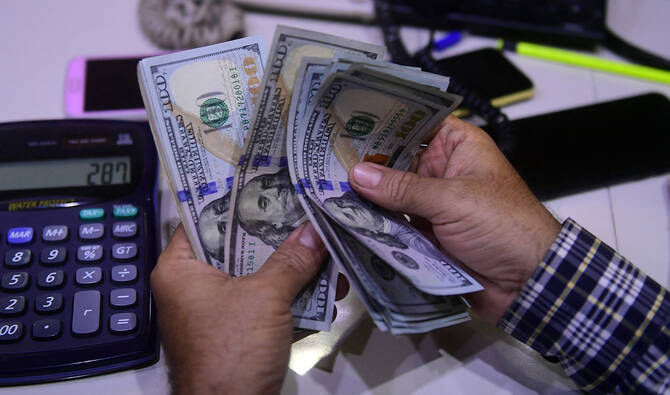
ISLAMABAD: Pakistan recorded a current account surplus of more than $120 million in January, the country’s finance adviser said on Tuesday, attributing it to improved trade balance and remittance inflows.
Pakistan’s exports rebounded in January 2026 after five months of weak performance, rising 3.73 percent year on year and surging 34.96 percent month on month, according to data released by the country’s statistics bureau.
Exports crossed the $3 billion mark for the first time in January to reach $3.061 billion, compared to $2.27 billion in Dec. 2025. The country received $3.5 billion in foreign remittances in Jan. 2026.
Khurram Schehzad, an adviser to the finance minister, said Pakistan reported a current account surplus of $121 million in Jan., compared to a current account deficit of $393 million in the same month last year.
“Improved trade balance in January 2026, strong remittance inflows, and sustained momentum in services exports (IT/Tech) continue to reinforce the country’s external account position,” he said on X.
Pakistan has undergone a difficult period of stabilization, marked by inflation, currency depreciation and financing gaps, and international rating agencies have acknowledged improvements after Islamabad began implementing reforms such as privatizing loss-making, state-owned enterprises (SOEs) and ending subsidies as part of a $7 billion International Monetary Fund (IMF) loan program.
Late last month, the IMF urged Pakistan to accelerate the pace of these structural reforms to strengthen economic growth.
Responding to questions from Arab News at a virtual media roundtable on emerging markets’ resilience, IMF’s director of the Middle East and Central Asia Jihad Azour said Islamabad’s implementation of the IMF requirements had been “strong” despite devastating floods that killed more than 1,000 people and devastated farmland, forcing the government to revise its 4.2 percent growth target to 3.9 percent.
“What is important going forward in order to strengthen growth and to maintain the level of macroeconomic stability is to accelerate the structural reforms,” he said at the meeting.
Azour underlined Pakistan’s plans to privatize some of the SOEs and improve financial management of important public entities, particularly power companies, as an important way for the country to boost its capacity to cater to the economy for additional exports.
“This comes in addition to the effort that the authorities have made in order to reform their tariffs, which will allow the private sector of Pakistan to become more competitive,” the IMF official said.


