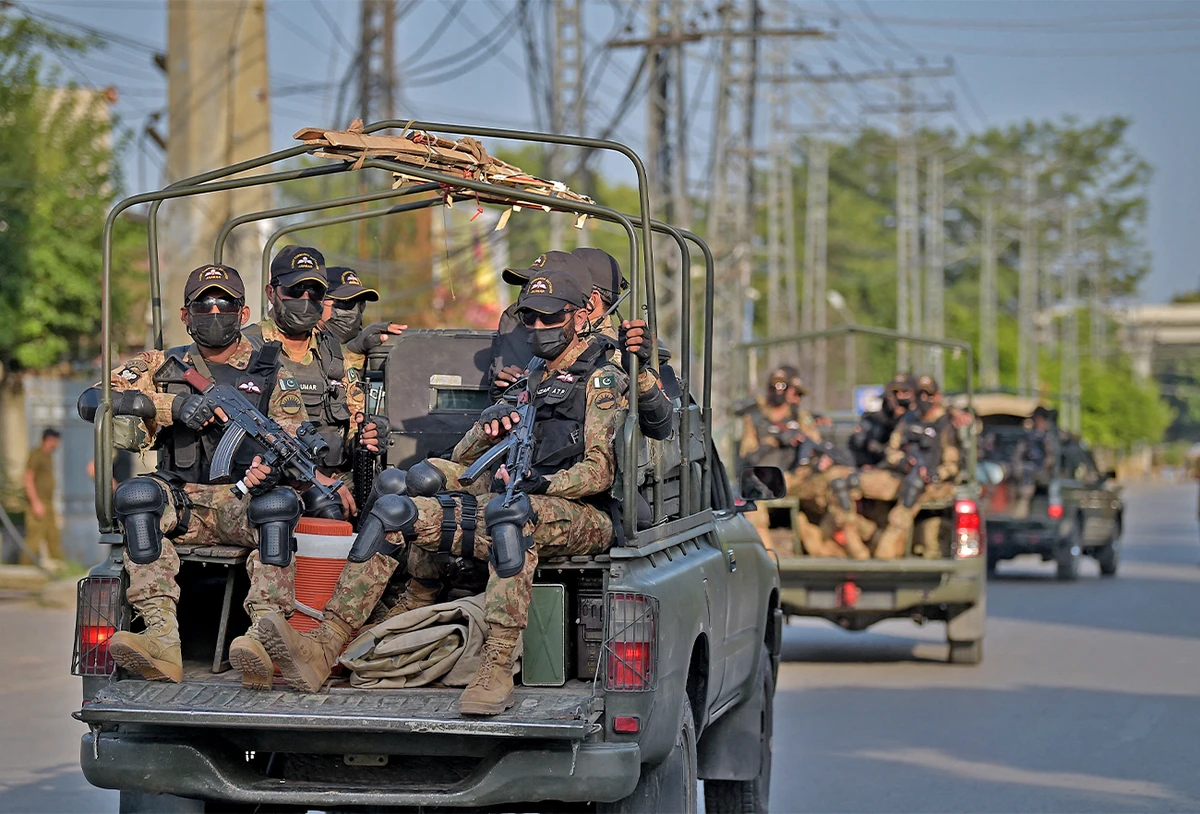
ISLAMABAD: The Pakistani Taliban on Wednesday announced it would launch a Ramadan offensive against security forces, after claiming an attack which the military said killed at least six of its soldiers.
The Tehreek-e-Taliban Pakistan (TTP), a separate movement that shares common roots with the militants that took power in Afghanistan last year, have stepped up attacks in recent months.
The government held a series of talks with the militants late last year before an agreed truce collapsed.
The spring offensive will begin on the first day of the Muslim holy month of Ramadan, starting on Sunday or Monday, and will target security forces and their collaborators, Mohammad Khorasani, spokesman for TTP militant group said in a statement.
"This operation will include martyrdom (suicide) operations, ambush attacks, mine operations, counter-attacks, target attacks, laser and sniper operations," he added.
The TTP are pressuring the government to allow militants to return to their hometowns with impunity after foreign fighters were told by the Afghan Taliban to leave Afghanistan.
A spring offensive is a rare move by the TTP.
It comes after the country's armed forces said militants attempted to storm a compound in the border region near Afghanistan, killing at least six Pakistani troops.
The attack was claimed by TTP, who said they had killed or wounded more than 30 soldiers.
The militants often exaggerate their gains, while the military's public relations department also plays down losses or delays reporting them.
The announcement came as Prime Minister Imran Khan was facing a no-confidence vote -- the biggest challenge to his power since becoming leader in 2018.
Pakistan's restive border region has long been a stronghold for groups such as the TTP, which operates across the porous boundary with Afghanistan.
The group plunged the country into a period of horrific violence after forming in 2007, before a major crackdown in 2014 forced them into hiding across the border.
But since the Taliban's takeover of Kabul, the local group has become emboldened and carried out dozens of such attacks on Pakistan's soil.
The TTP and Islamabad agreed to a truce in November.
But it failed on December 10, with the hardliners accusing the government of violating the terms of the truce.
Pakistani Taliban announce Ramadan offensive against security forces
https://arab.news/4cukm
Pakistani Taliban announce Ramadan offensive against security forces
- The government held a series of talks with the militants late last year before an agreed truce collapsed
- The TTP wants Pakistan to allow militants to return to their hometowns Afghan Taliban asked foreign fighters to leave
Pakistan, UK launch £10 million higher education partnership
- Pak-UK Education Gateway second phase expands climate research, scholarships, university exchanges
- First phase was launched in 2018 and delivered 165 partnerships, 2,000 joint studies and £5 million in grants
ISLAMABAD: Pakistan’s Higher Education Commission (HEC) and the British Council have launched the £10 million second phase of the Pak-UK Education Gateway, the HEC said on Monday, a joint initiative aimed at deepening collaboration between universities in both countries on research, mobility and higher-education reform.
The program, funded equally by the HEC and the British Council, builds on a partnership launched in 2018 and seeks to strengthen institutional ties between Pakistani and British universities, focusing on shared challenges including climate change, skills development and economic growth.
Education cooperation has become an increasingly important pillar of broader Pakistan-UK relations, as both countries look to expand academic mobility, research collaboration and international recognition of qualifications at a time when higher-education systems face pressure to respond to climate risks, labor-market shifts and funding constraints.
“This £10 million partnership is set to deepen collaboration between UK and Pakistani universities on critical issues like Climate Change and Mobility. A true system-to-system commitment,” the HEC said in an X post.
According to the British Council and HEC, the first phase of the Pak-UK Education Gateway supported 165 institutional partnerships, generated around 2,000 joint research papers and awarded £5 million in research grants. Officials say the second phase aims to build on that foundation as part of a longer-term effort to internationalize Pakistan’s higher-education sector.
“Education is the building block of growth and prosperity. Our work on education in Pakistan supports people throughout their lives: from helping reform education policy at the school level, to our strong partnership in higher education,” British High Commissioner Jane Marriott said in a statement.
“This next phase builds on our already strong relationship, and will unlock opportunities to help both our higher education sectors thrive.”
Opportunities under the second phase include increased funding for scholarships, joint research grants and faculty exchanges, alongside a Start-Up Challenge Fund to support Pakistan-UK university collaborations pursuing commercial opportunities and access to new markets.
The program will also focus on leadership and governance reforms within Pakistan’s higher-education system, including quality assurance, improved campus accessibility for people with disabilities, and greater participation of women in senior leadership roles. It further aims to expand opportunities for Pakistani students to study UK-accredited courses without leaving their home cities, alongside a commitment to mutual recognition of qualifications.
Pakistan’s Minister for Federal Education and Professional Training Khalid Maqbool Siddiqui said the initiative had already delivered concrete results since its launch in 2018, calling education “the bridge that connects people, cultures, and futures.”
Acting HEC Chairperson Nadeem Mahbub described the Gateway as a system-to-system partnership rather than a stand-alone program, noting that it had benefited institutions and students in both countries.