

Major peace talks between Yemeni factions begin in Riyadh

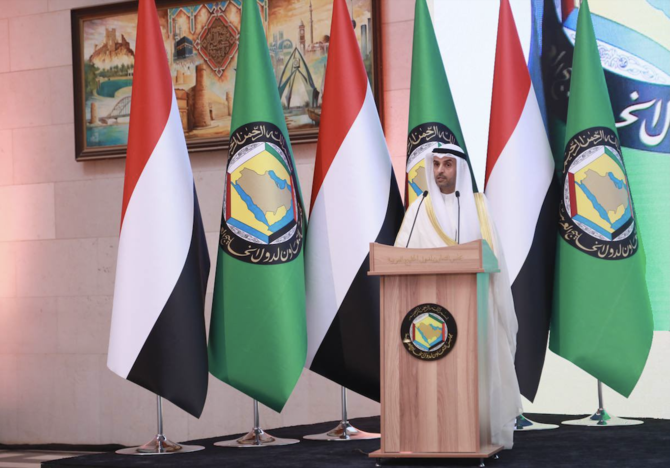
Nayef Falah Al-Hajraf, secretary-general of the GCC, urged participants to set aside their differences. (@GCCSG)
Short Url
Updated 30 March 2022
Follow

Major peace talks between Yemeni factions begin in Riyadh

  • GCC secretary-general, US and UN envoys urge end to conflict by Ramadan
  • Houthis refuse to attend, escalate conflict in various provinces, say reports  

RIYADH: The most comprehensive peace talks involving Yemen’s warring factions kicked off on Wednesday in Riyadh as the Coalition to Restore Legitimacy in Yemen announced a truce that is hoped would help end the devastating conflict.

Hundreds of Yemeni politicians, tribal leaders, and current and former military and security officials, took part in the conference. The Houthis have refused to attend the GCC-initiated talks.

Opening the conference, Nayef Falah Al-Hajraf, secretary-general of the GCC, urged the participants to set aside their differences and find a comprehensive solution to end the war.

He stressed that the Gulf bloc would back the outcomes.

“The success of the Yemeni-Yemeni consultations is not an option but a duty that requires everyone to (bear) the national responsibility and to reject all causes of division and internal disparities,” Al-Hajraf said, hailing the coalition’s quick response to the GCC demand for a truce.

The coalition on Tuesday night announced it would halt military operations in Yemen to smooth the way for the success of the talks.

Hans Grundberg, the UN’s Yemen envoy, who is currently brokering similar talks — but with fewer people — in the Jordanian capital, said Riyadh has long played a significant role in facilitating peace initiatives.

“Riyadh has offered a space for dialogue leading to important agreements, such as the GCC Initiative and the Riyadh Agreement. We need the region’s support as much as ever to move toward an inclusive political process under the (UN’s) auspices,” he said.

The war, he added, has ruined the country’s state institutions, social fabric and economy, and claimed the lives of thousands of Yemeni civilians.

“The longer the conflict goes on, the more severe the impact on civilians, and the more difficult to reverse the damage. The Yemeni people need to see a clear path out.”

The envoy said his latest efforts to convince the warring factions to stop fighting during the month of Ramadan have yielded some results.

“For over two months I have been engaging all parties on reaching a truce and we are making progress. Yemen needs a truce. I am engaging with the parties with a sense of urgency to reach this truce by the beginning of Ramadan.”

Tim Lenderking, US envoy to Yemen, also expressed his country’s support for the UN and GCC calls urging an end to all hostilities during Ramadan.

“We remain committed to helping UN-led efforts to advance a durable, inclusive resolution to the conflict,” he said, urging the attendees to reach a solution that would end the humanitarian crisis in Yemen.

“On behalf of the United States, I convey our sincere hope that everyone here today will seize this important opportunity to work together to identify tangible steps that will improve the lives of all Yemenis.”

For the first time in years, the talks in Riyadh have brought together rival political, military and tribal figures from Yemen, including senior members of the General People’s Congress and leaders of the pro-independence Southern Transitional Council.

Speaking to Arab News during the conference, participants expressed hope that the large gathering of Yemenis would agree on a way forward.

“The situation in Yemen is disastrous. There is a severe shortage of fuel and people are very poor. We hope that Yemenis will unite their voices during the talks and the international community, mainly Saudi Arabia and the GCC, help them implement the outcomes,” Abdullah bin Ali Jaber, a tribal leader from the southeastern province of Hadramout, said.

The Houthis have reportedly rejected the GCC invitation to join the talks and escalated their military operations across Yemen, mainly in the central province of Marib.

Local officials and media reports have indicated that the Houthis mounted significant attacks on government troops outside the city of Marib, apparently exploiting the space created by the halt of coalition airstrikes.

Yahiya Abu Hatem, a military analyst, told Arab News: “The Houthis have turned down all calls for peace and met them with an escalation. This group is Iran’s tool to undermine security in the Arab world.” He said Yemenis should resolve their differences and “aim their weapons at the Houthis.”


Sudan defense minister dismisses ‘intelligence document’ as fabrication after convoy strike

Updated 12 February 2026
Follow

Sudan defense minister dismisses ‘intelligence document’ as fabrication after convoy strike

  • Gen. Hassan Kabroun tells Arab News claims that army hid weapons in aid convoy are “completely false”

RIYADH: Sudan’s defense minister has firmly denied reports attributed to Sudanese intelligence alleging that a convoy targeted in North Kordofan was secretly transporting weapons under the cover of humanitarian aid.

Gen. Hassan Kabroun described the claims as “false” and an attempt to distract from what he called a militia crime.

The controversy erupted after news reports emerged that a document attributed to Sudan’s General Intelligence Service claimed the convoy struck in Al-Rahad on Friday was not a purely humanitarian mission, but was instead carrying “high-quality weapons and ammunition” destined for Sudanese Armed Forces units operating in the state.

The report further alleged that the convoy had been outwardly classified as humanitarian in order to secure safe passage through conflict zones, and that the Rapid Support Forces had destroyed it after gathering intelligence on its route and cargo.

Kabroun categorically rejected the narrative.

“First of all, we would like to stress the fact that this news is false,” he told Arab News. “Even the headline that talks about the security of the regions, such as Al-Dabbah, is not a headline the army would use.”

He described the document as fabricated and politically motivated, saying it was designed to “cover up the heinous crime they committed.”

The minister affirmed that the area targeted by drones is under full control of the Sudanese Armed Forces and does not require any covert military transport.

“Second, we confirm that the region that was targeted by drones is controlled by the army and very safe,” Kabroun said. “It does not require transporting any military equipment using aid convoys as decoys because it is a safe area controlled by the army, which has significant capabilities to transport humanitarian aid.”

According to the minister, the Sudanese military has both the logistical capacity and secure routes necessary to move equipment openly when needed.

“The army is professional and does not need to deliver anything to Kadugli or Dalang on board aid convoys,” he said. “The road between Dalang and Kadugli is open. The Sudanese forces used that road to enter and take control of the region. The road is open and whenever military trucks need to deliver anything, they can do so without resorting to any form of camouflage.”

Kabroun further rejected any suggestion that the military uses humanitarian operations as cover.

“Aid is transported by dedicated relief vehicles to the areas in need of this assistance,” he said. “Aid is not transported by the army. The army and security apparatus do not interfere with relief efforts at all, and do not even accompany the convoys.”

He stressed that the Sudanese Armed Forces maintains a clear institutional separation between military operations and humanitarian work, particularly amid the country’s crisis.

“These are false claims,” he said. “This fake news wanted to cover up the heinous crime they committed.”

Sudan has been gripped by conflict since April 2023, when fighting broke out between the Sudanese Armed Forces and the Rapid Support Forces, plunging the country into what the United Nations has described as one of the world’s worst humanitarian disasters.

The latest dispute over the convoy comes amid intensified fighting in South Kordofan, a strategically sensitive region linking central Sudan with the contested areas of Darfur and Blue Nile.

The false report suggested that intelligence monitoring had enabled the RSF to strike what it described as a military convoy disguised as humanitarian aid. But Kabroun dismissed that version outright.

“The intelligence agency is well aware of its duties,” he said. “The Sudanese Army has enough weapons and equipment to use in the areas of operations. These claims are completely false.”

He argued that the narrative being circulated seeks to shift blame for attacks on civilian infrastructure and humanitarian movements.

“This shows that they are trying to cover up the atrocities,” he added, referring to the militia.

Kabroun maintained that the army has regained momentum on multiple fronts and remains fully capable of sustaining its operations without resorting to deception.

“The region is secure, the roads are open, and the army does not need camouflage,” he said. “We are operating professionally and transparently.”

“These claims are completely false,” Kabroun said. “The Sudanese Army does not use humanitarian convoys for military purposes.”