

Pakistan’s joint opposition seeks PM Khan’s resignation after key coalition partner abandons government

Leader of the MQM-P Khalid Maqbool Siddiqui, second left, with opposition parties leaders Bilawal Bhutto Zardari, left, Shahbaz Sharif, second right, and Maulana Fazal-ur-Rehman give a press conference, in Islamabad, Pakistan, on March 30, 2022. (AP)
Short Url
Updated 30 March 2022
Follow

Pakistan’s joint opposition seeks PM Khan’s resignation after key coalition partner abandons government

  • Without vote of MQM-P, Khan’s Pakistan Tehreek-e-Insaf has fallen short of 172 votes needed to retain power
  • Information minister said earlier in the day the PM would not resign and ‘fight until the last ball’

KARACHI: Pakistan’s leading opposition figures on Wednesday asked Prime Minister Imran Khan to resign after a major coalition partner formally announced to abandon the government, making the ruling Pakistan Tehreek-e-Insaf (PTI) party lose its majority in the national assembly.
Minister for information Chaudhry Fawad Hussain said earlier in the day the prime minister would not step down after the Muttahida Qaumi Movement-Pakistan (MQM-P) struck a deal with the opposition Pakistan People’s Party (PPP) and signaled it would vote against Khan in a no-confidence vote expected to take place early next month.
“The prime minister should set a new tradition by handing in his resignation after losing his numerical strength [in the national assembly],” said Shehbaz Sharif, leader of the opposition in the national assembly, during a joint news conference with other politicians who want to bring down the government.
He said the agreement between the PPP and MQM-P had taken place within 20 minutes during a meeting of their leaders last night while congratulating the two parties for setting aside their past political differences.
PPP chairman Bilawal Bhutto-Zardari also agreed with Sharif, saying that Khan should step down.
“Prime Minister of Pakistan Imran Khan has lost his majority,” he said. “Today, MQM Pakistan has joined the opposition ranks. Shehbaz Sharif has rightly given a challenge in the spirit of statesmanship to [PM Khan to] resign.”
The PPP leader added: “The prime minister does not have any option. Either he should resign or come to the parliamentary session tomorrow to settle this issue.”
He maintained the prime minister’s removal would help Pakistan resume its democratic journey again.
Without the vote of the MQM-P, Khan’s PTI administration would fall short of the 172 needed to retain power. Khan’s four coalition parties have a total of 20 seats in the lower house of parliament.
However, the prime minister’s close aides have ruled out the possibility of his resignation despite the recent setback.
“Prime Minister Imran Khan is a player who plays until the last ball,” the information minister said on Twitter, adding the PM would not resign.


Even before the MQM-P’s joint news conference with the opposition parties, MQM leaders Syed Aminul Haque, federal minister for IT and Telecom, and law minister Farogh Naseem, had resigned from their posts.
Speaking to Arab News, Faisal Karim Kundi, the PPP’s central information secretary, confirmed that the MQM-P had decided to join the opposition.
“The MQM-P will formally announce the decision and [make] public the points of the deal but I can just tell that Sindh’s governorship for the MQM-P is one of the agreed points of the deal,” Kundi said, referring to giving the coveted slot of the governor of the southern Sindh province to the MQM-P in exchange for siding with the opposition alliance.
“The united opposition and MQM have reached an agreement,” Bhutto-Zardari also announced on Twitter, adding that the agreement would be ratified by the executive committees of both parties and the details shared with the public in a press conference. “Congratulations Pakistan.”
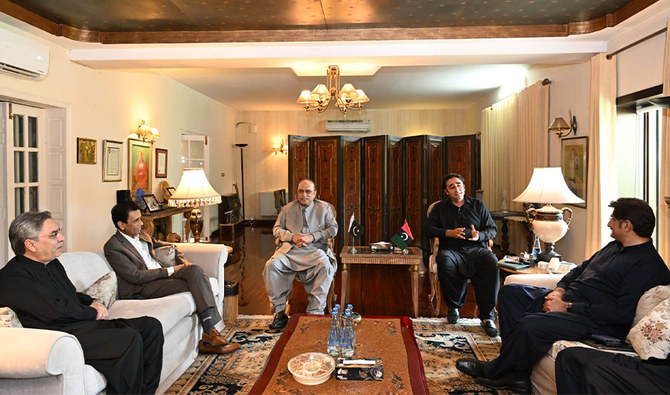


Bilawal Bhutto-Zardari, co-chairperson of PPP (2nd from L), former President Asif Ali Zardari (3rd from L) meets MQM-P Deputy Convener Dr Khalid Maqbool Siddiqui (2nd from L) in Islamabad, Mar 30, 2022. (PPPP/Twitter)

Pakistani opposition legislators have been wooing ruling party legislators away for weeks and tabled a no-confidence motion against Khan in parliament Monday, hoping to oust his government amid accusations he has mismanaged the economy and governed poorly. 
Khan came to power in a 2018 election, securing 176 seats. He needs 172 votes to remain in power but about a dozen lawmakers from his ruling party have defected, weakening his position.
The ruling PTI accuses the opposition of bribing its lawmakers to vote against the prime minister. It has also filed a presidential reference in the supreme court seeking an interpretation of Article 63-A, which sets down rules in the constitution for the disqualification of lawmakers in the case of defection and violation of party policy. Khan’s party is calling for the lifetime disqualification of defectors.
On Tuesday, Khan directed all ruling party members to abstain from the no-confidence vote.


IMF warns against policy slippage amid weak recovery as it clears $1.2 billion for Pakistan

Updated 11 December 2025
Follow

IMF warns against policy slippage amid weak recovery as it clears $1.2 billion for Pakistan

  • Pakistan rebuilt reserves, cut its deficit and slowed inflation sharply over the past one year
  • Fund says climate shocks, energy debt, stalled reforms threaten stability despite recent gains

ISLAMABAD: Pakistan’s economic recovery remains fragile despite a year of painful stabilization measures that helped pull the country back from the brink of default, the International Monetary Fund (IMF) warned on Thursday, after it approved a fresh $1.2 billion disbursement under its ongoing loan program.

The approval covers the second review of Pakistan’s Extended Fund Facility (EFF) and the first review of its climate-focused Resilience and Sustainability Facility (RSF), bringing total disbursements since last year to about $3.3 billion.

Pakistan entered the IMF program in September 2024 after years of weak revenues, soaring fiscal deficits, import controls, currency depletion and repeated climate shocks left the economy close to external default. A smaller stopgap arrangement earlier that year helped avert immediate default, but the current 37-month program was designed to restore macroeconomic stability through strict monetary tightening, currency adjustments, subsidy rationalization and aggressive revenue measures.

The IMF’s new review shows that Pakistan has delivered significant gains since then. Growth recovered to 3 percent last year after shrinking the year before. Inflation fell from over 23 percent to low single digits before rising again after this year’s floods. The current account posted its first surplus in 14 years, helped by stronger remittances and a sharp reduction in imports. And the government delivered a primary budget surplus of 1.3 percent of GDP, a key program requirement. Foreign exchange reserves, which had dropped dangerously low in 2023, rose from US$9.4 billion to US$14.5 billion by June.

“Pakistan’s reform implementation under the EFF arrangement has helped preserve macroeconomic stability in the face of several recent shocks,” IMF Deputy Managing Director Nigel Clarke said in a statement after the Board meeting.

But he warned that Islamabad must “maintain prudent policies” and accelerate reforms needed for private-sector-led and sustainable growth.

The Fund noted that the 2025 monsoon floods, affecting nearly seven million people, damaging housing, livestock and key crops, and displacing more than four million, have set back the recovery. The IMF now expects GDP growth in FY26 to be slightly lower and forecasts inflation to rise to 8–10 percent in the coming months as food prices adjust.

The review warns Pakistan against relaxing monetary or fiscal discipline prematurely. It urges the State Bank to keep policy “appropriately tight,” allow exchange-rate flexibility and improve communication. Islamabad must also continue raising revenues, broadening the tax base and protecting social spending, the Fund said.

Despite the progress, Pakistan’s structural weaknesses remain severe.

Power-sector circular debt stands at about $5.7 billion, and gas-sector arrears have climbed to $11.3 billion despite tariff adjustments. Reform of state-owned enterprises has slowed, including delays in privatizing loss-making electricity distributors and Pakistan International Airlines. Key governance and anti-corruption reforms have also been pushed back.

The IMF welcomed Pakistan’s expansion of its flagship Benazir Income Support Program, which raises cash transfers for low-income families and expands coverage, saying social protection is essential as climate shocks intensify. But it warned that high public debt, about 72 percent of GDP, thin external buffers and climate exposure leave the country vulnerable if reform momentum weakens.

The Fund said Pakistan’s challenge now is to convert short-term stabilization into sustained recovery after years of economic volatility, with its ability to maintain discipline, rather than the size of external financing alone, determining the durability of its gains.