

PM Khan 'strictly' orders ruling party lawmakers to abstain from no-confidence vote

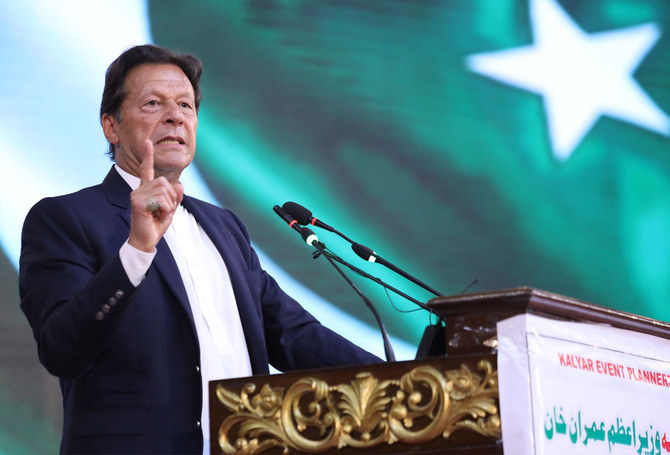
The file photo shows Pakistan Prime Minister Imran Khan speaking during PTI party convention in Islamabad, Pakistan, on March 9, 2022. (PTI/Twitter)
Short Url
Updated 30 March 2022
Follow

PM Khan 'strictly' orders ruling party lawmakers to abstain from no-confidence vote

  • The prime minister says any violation of his instructions will be treated as ‘express defection’
  • Over a dozen PTI lawmakers have said they want to attend the session, vote according to ‘conscience’

ISLAMABAD: Prime Minister Imran Khan on Tuesday stopped lawmakers belonging to the ruling Pakistan Tehreek-e-Insaf (PTI) party from attending the National Assembly session wherein a no-confidence resolution against him will be put to a vote.
Khan is facing his toughest political challenge since assuming office in 2018 as the opposition tabled the no-confidence motion against him in the national assembly on Monday. A debate on the resolution will start on March 31.
With more than a dozen PTI lawmakers demanding to attend the session and vote “according to their conscience,” the prime minister issued specific instructions to his party members to abstain from voting in a detailed letter while reminding them of Article 63-A of the constitution that deals with disqualification of lawmakers in the case of defection and violation of party policy.
“All the members of the Parliamentary Party of Pakistan Tehreek-e-Insaf in the National Assembly of Pakistan shall abstain from voting/ not attend the meeting of the National Assembly on the date when the said resolution is setout on the agenda of the National Assembly for voting,” the document said.


It maintained that only “duly designated” parliamentarians of the ruling party would speak on its behalf during the debate over the motion.
“All members are required to adhere to these directions in true letter & spirit and keep in mind the intent behind the provision of Article 63-A of Constitution of Pakistan, 1973,” it continued.
The letter stopped all PTI members from violating these instructions or extending any favor related to the no-trust vote to any other group or parliamentary party.
“Every / any violation of these directions shall be treated as express defection in terms of Article 63-A,” it warned.
The government has already submitted a presidential reference in the Supreme Court of Pakistan, seeking the interpretation of Article 63-A, after at least 13 PTI lawmakers indicated they could vote against the prime minister.
The reference requested the court to give its opinion on whether a defector should be disqualified for life from electoral activity or public office and if his or her vote, after defecting, should be counted in a parliamentary motion.


Rating firm S&P says it won’t rush Iran war downgrades, sees risks for countries like Pakistan

Updated 12 March 2026
Follow

Rating firm S&P says it won’t rush Iran war downgrades, sees risks for countries like Pakistan

  • Agency says it is monitoring indebted energy importers as higher oil prices strain finances
  • Gulf economies seen better placed to weather shock, though Bahrain flagged as vulnerable

LONDON: S&P Global ‌said it would not make any knee-jerk sovereign rating cuts following the outbreak of war in the ​Middle East, but warned on Thursday that soaring oil and gas prices were putting a number of already cash-strapped countries at risk.

The firm’s top analysts said in a webinar that the conflict, which has involved US and Israeli strikes ‌against Iran and Iranian ‌strikes against Israel, ​US ‌bases ⁠and Gulf ​states, ⁠was now moving from a low- to moderate-risk scenario.

Most Gulf countries had enough fiscal buffers, however, to weather the crisis for a while, with more lowly rated Bahrain the only clear exception.

Qatar’s banking sector could ⁠also struggle if there were significant ‌deposit outflows in ‌reaction to the conflict, although there ​was no evidence ‌of such strains at the moment, they ‌said.

“We don’t want to jump the gun and just say things are bad,” S&P’s head global sovereign analyst, Roberto Sifon-Arevalo, said.

The longer the crisis ‌was prolonged, though, “the more difficult it is going to be,” he ⁠added.

Sifon-Arevalo ⁠said Asia was the second-most exposed region, due to many of its countries being significant Gulf oil and gas importers.

India, Thailand and Indonesia have relatively lower reserves of oil, while the region also had already heavily indebted countries such as Pakistan, Bangladesh and Sri Lanka whose finances would be further hurt by rising energy prices.

“We ​are closely monitoring ​these (countries) to see how the credit stories evolve,” Sifon-Arevalo said.