ISLAMABAD: A senior member of Pakistan’s federal cabinet said on Tuesday Prime Minister Imran Khan was willing to share the content of a letter that proved a foreign-funded conspiracy to topple the ruling Pakistan Tehreek-e-Insaf (PTI) administration with the country’s top judge.
The prime minister, who is currently facing a no-confidence motion, told a mammoth political rally of his party workers and supporters on Sunday some international powers were not happy with his government and wanted to bring it down since he was pursuing an independent foreign policy.
Khan maintained he had also been threatened “in writing,” adding that he was in possession of a letter that could be used to substantiate his claim.
The revelation generated some public debate and was dismissed by opposition factions.
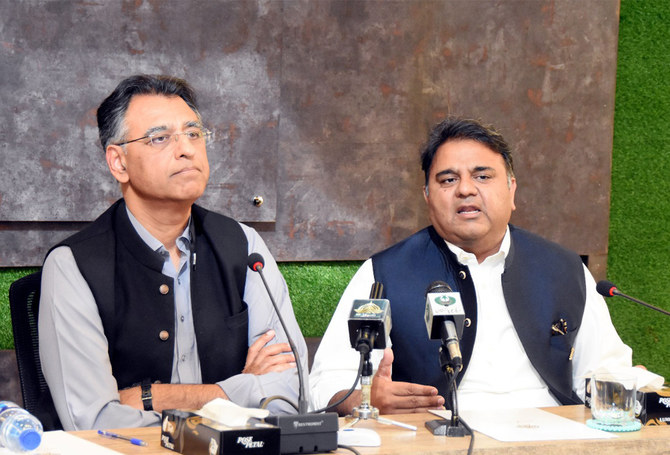
“The prime minister has asked me to announce on his behalf that he is willing to present the letter before the Supreme Court [chief justice], if it was required to ensure people’s satisfaction that the letter was genuine,” said the county’s planning minister Asad Umar while addressing a news conference in Islamabad.
He reiterated his government’s claim that the opposition’s no-trust motion was part of an elaborate international conspiracy against the country.
“The no-confidence motion was filed after this letter was written,” he continued while emphasizing that this fact required some attention. “The no-confidence motion was specifically mentioned [in the letter] and there is no ambiguity that it was written before the resolution [was moved against the prime minister].”
Umar said the letter was only shared with the country’s top civilian and military leadership.
He also named Pakistan’s former prime minister Nawaz Sharif, who is currently based in London, as one of the “characters” mentioned in the document.
The planning minister maintained that Sharif, a leading opposition politician and the prime minister’s political rival, was involved in the anti-government scheme and referred to some of his meetings abroad without sharing their detail.
Umar refused to tell the media where the letter had originated from.
Reacting to the development, Pakistan’s former prime minister Shahid Khaqan Abbasi proposed to urgently call an in-camera parliamentary session on Wednesday to discuss the letter.
He noted such an incident had not happened throughout Pakistan’s history, wondering if the country had weekend so much that international powers were beginning to send such threats to its leadership.
“The prime minister should come to the parliamentary session tomorrow and tell the lawmakers [about the letter],” he said. “We are all with him ... He should tell the parliament who issued threats to Pakistan.”
Abbasi also asked the government to immediately sever diplomatic relations with the country that was behind the letter and expel its ambassador.
“This is how sovereign countries behave when they are threatened,” he added. “If the prime minister is telling the truth, this is how Pakistan should react ... But if you [PM Khan] are not telling the truth, then come to parliament and apologize.”
Earlier in the day, Pakistan’s interior minister Sheikh Rashid Ahmed said the prime minister would fight till the “last ball” as the no-confidence vote was going to be carried out in the national assembly on April 3.
On Monday, a key coalition party, the Pakistan Muslim League-Quaid (PML-Q), said it would support Khan in the no-trust move.
The PML-Q’s support would be crucial for the prime minister as his four coalition parties have a total of 20 seats in the lower house of parliament. Without them, Khan’s party, which has 155 seats in the lower house, would fall short of the 172 needed to retain power.
“God willing till the last ball on April 3, Imran Khan will play … and we are standing by him,” the interior minister told reporters, adding that voting on the no-confidence motion would take place on April 3.
He said he hoped another key ally, the Muttahida Qaumi Movement Pakistan (MQM-P), would also decide to support Khan.
“MQM’s decision would be decisive,” the minister said.
The interior minister reiterated he was a supporter of early elections, though the PM Khan government has repeatedly rejected opposition calls to call early polls.
“I am a supporter of early elections. Elections should be held after the Hajj,” Ahmed said referring to the annual Muslim pilgrimage which will fall in July this year.
The opposition requires at least 172 votes in the 342-member National Assembly to topple PM Khan’s government. The current party position in the lower house of parliament shows the opposition collectively has 162 members, while the government enjoys the support of 179 lawmakers, including its coalition partners.
The ruling PTI accuses the opposition of bribing its lawmakers to vote against the prime minister. It has also filed a presidential reference seeking the interpretation of Article 63-A, which sets down rules for the disqualification of lawmakers in the case of defection and violation of party policy.


![]()

PM willing to share letter proving ‘foreign conspiracy’ against government with chief justice – minister
Short Url
https://arab.news/zj354
PM willing to share letter proving ‘foreign conspiracy’ against government with chief justice – minister
- The planning minister says the letter mentioned the no-trust motion even before it was filed by the opposition
- The government should urgently call an in-camera parliamentary session to discuss the documents, says opposition
Latest updates





© 2026 SAUDI RESEARCH & PUBLISHING COMPANY, All Rights Reserved And subject to Terms of Use Agreement.