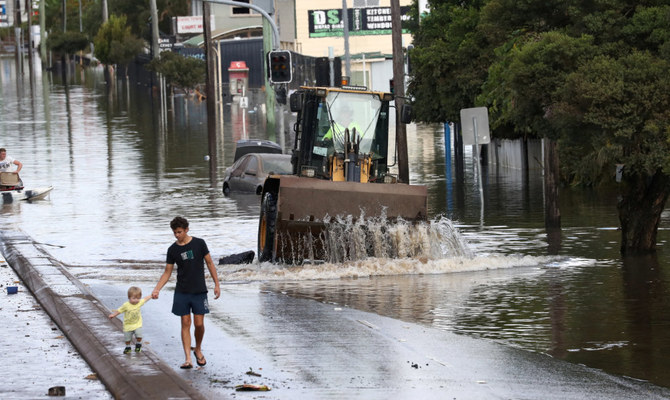
SYDNEY: Thousands of people across eastern Australia have been told to leave their homes as storms bear down on cities and towns still recovering from record deadly flooding just weeks ago.
Multiple evacuation orders were issued for the town of Lismore, which was devastated last month when record-high 14.3-meter (47 feet) floodwaters engulfed homes, swept away cars and stranded locals on the roofs of their homes.
Hundreds of people had to be dramatically rescued — many by neighbors who braved the floodwaters in private boats and even kayaks — because emergency services were overwhelmed by calls for help.
Seeking to avoid a repeat of this disaster, state emergency services said “additional people, vehicles, boats and helicopters” had been deployed ahead of forecast storms and “life-threatening” flash flooding on Tuesday.
Lismore locals spent much of Monday preparing for intense rainfall — sandbagging properties and moving to higher ground, with flood levels expected to reach close to the town’s levee height by Tuesday afternoon.
A flood relief center in the town set up by Australia’s national Indigenous newspaper The Koori Mail had to be evacuated.
February’s flooding claimed at least 21 lives across the states of Queensland and New South Wales and displaced thousands of people, many of whom are living in temporary accommodation in areas where heavy rains are expected this week.
“Since catchments are now saturated, there will be an increased risk of dangerous and life-threatening flash flooding and even landslides during this event,” the national weather bureau said in a warning Monday.
In the state of Queensland, a man was found dead in his car in floodwaters on Monday, along with several dogs, despite police rescue attempts. A woman who was in the vehicle survived and was taken to hospital to recover.


![]()

Australia’s flood-ravaged east braces for more storms
Short Url
https://arab.news/zvufu
Australia’s flood-ravaged east braces for more storms
- A flood relief center in the town set up by Australia’s national Indigenous newspaper The Koori Mail had to be evacuated

Latest updates


© 2026 SAUDI RESEARCH & PUBLISHING COMPANY, All Rights Reserved And subject to Terms of Use Agreement.