

UN chief steps up efforts to secure humanitarian truce in Ukraine 

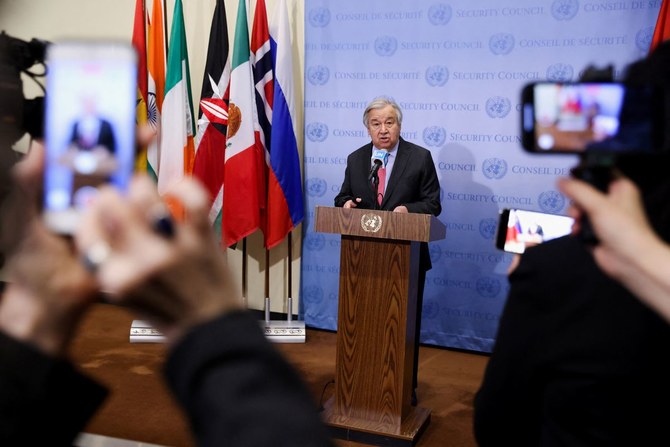
UN Secretary-General Antonio Guterres said he has asked the organization’s humanitarian chief, Martin Griffiths, to explore the possibility of a humanitarian truce in Ukraine. (Reuters)
Short Url
Updated 28 March 2022
Follow

UN chief steps up efforts to secure humanitarian truce in Ukraine 

  • Secretary-General Antonio Guterres has tasked his top humanitarian envoy to immediately explore with both sides the possibilities for a ceasefire
  • Responding to fears the war might escalate into a biological, chemical or nuclear conflict, he said he ‘can’t imagine’ the possibility and added ‘it must be avoided’

NEW YORK: UN Secretary-General Antonio Guterres said on Monday that he has asked the organization’s humanitarian chief, Martin Griffiths, “immediately to explore with the parties involved” the possibility of a humanitarian truce in Ukraine.

He said that Griffiths will begin his efforts in pursuit of a ceasefire straight away and has already initiated some contacts.

“I hope that (he) will be able to go to both Moscow and Kyiv as soon as that becomes possible,” said Guterres. “It’s very important to establish a serious dialogue with both parties in relation to the possibility of this humanitarian ceasefire.”

He added: “A cessation of hostilities will allow essential humanitarian aid to be delivered and enable civilians to move around safely. It will save lives, prevent suffering and protect civilians.”

He also called for the ceasefire “to allow for progress in serious political negotiations aimed at reaching a peace agreement based on the principles of the United Nations Charter.

Guterres said he has been in close contact with authorities in a number of countries who have been exploring potential options for mediation with the warring parties that could pave the way to a political solution, including Turkey, Qatar, Israel, India, China, France and Germany.

He added that he hopes a ceasefire will also help to tackle the wider global consequences of the war in Ukraine “which risk compounding the deep hunger crisis in many developing countries that already lack fiscal space to invest in their recovery from the pandemic, and now face soaring food and energy costs.”

The UN chief lamented the “senseless loss of thousands of lives” since the war began on Feb. 24, along with “the displacement of 10 million people, mainly women and children, the systematic destruction of essential infrastructure, and skyrocketing food and energy prices worldwide.”

He said: “This must stop. The solution to this humanitarian tragedy is not humanitarian. It is political.”

In response to fears that the conflict could escalate into a biological or nuclear war, Guterres said the International Atomic Energy Agency will announce a number of “very important initiatives” soon “to guarantee the security of the nuclear facilities inside Ukraine.”

He added: “On the other hand, I can’t imagine the possibility of having a nuclear, a biological or a chemical war in this scenario. That will be something that I think will be avoided. It must be avoided.”


France’s homeless wrap up to survive at freezing year’s end

Updated 58 min 41 sec ago
Follow

France’s homeless wrap up to survive at freezing year’s end

  • Several French regions including Paris have increased shelter beds to help the homeless, but reports have already emerged of some appearing to have frozen to death

PARIS: In the biting cold, homeless friends Danish and Sylvain walked briskly in the dark toward a hot meal distribution point, rubbing their hands together, their huge backpacks weighing down on their shoulders.
“If you stop, the cold seeps into your bones. As long as we’re walking, we’re producing heat,” said 50-year-old Danish, a Pakistani who asked to withhold his surname to avoid embarrassing his France-based family.
Temperatures in France have dropped in recent weeks and are expected to hover around zero in many areas on New Year’s Eve.
Several French regions including Paris have increased shelter beds to help the homeless, but reports have already emerged of some appearing to have frozen to death.
Sylvain, 52, said he and his companion checked the weather forecast on their phones every night to best prepare.
The Frenchman, who also did not want to give his surname to protect his three children, said he wore six layers on his chest — a t-shirt, a jumper, a fleece, a waistcoat and two jackets.
“The trick is to let air between the layers. If it’s too tight, there’s not much isolation,” he said.
He also wears tights and two pairs of socks, and he tops it all off with a beanie, a cap and a furry hat with flaps.
“You lose heat through the top of your head,” he said.
Neither he, nor his companion Danish, drink alcohol, he said.
“It makes you numb so you don’t know when you’re cold, and you can slip away during the night,” Sylvain said.

- ‘Sleep without fear’ -

This winter has already proven deadly.
A homeless man was found lifeless in a Paris street on Sunday, likely having frozen to death, a police source said. He had been staying in a nearby shelter.
On Christmas day, a 35-year-old homeless person was found dead in the northern city of Reims, a prosecutor said.
There are no recent official figures on homelessness in France. But the Housing Foundation, a charity, estimates 350,000 people do not have a permanent home — including 20,000 who sleep rough nationwide. Many in Paris are undocumented migrants.
More than 900 people without a home died throughout the year in 2024, on average aged 47, according to a charity called Dead in the Street.
Paris authorities say they have set up emergency shelters in sports halls and schools to help during the cold wave, while charities too have added beds to their facilities.
At a charity-run shelter in Paris, which provides bedding for more than 370 people on seven floors, volunteers have been handing out hot meals.
Nakunzi Fumiasuca, a 36-year-old from the Democratic Republic of Congo, said he had been living in a tent until he was offered a bed.
“Here I can sleep without fear,” he said.
Taha Nouri, a 32-year-old who arrived in France from Libya in 2021, came after the charity brought him in, telling him he could stay for a week.
“I was able to have a shower, eat well, see a doctor and get medicine,” he said.
But Danish and Sylvain say their calls to a hotline to request shelter never go through.
Instead they have been sleeping rough in one of the main train stations in Paris — always trying to watch out that no one steals their blanket.
“When you have one stolen and it’s cold, it’s a disaster,” said Sylvain. “Your only option is to ride the night bus around Paris until dawn.”

- ‘Time stopped’ -

Danish said he came to France with his father three decades ago and was working as a waiter, but ended up in the street after a dispute with his boss three months ago.
“I’m deeply ashamed sometimes,” he said. “I don’t want my family to see me like this.”
Sylvain said he worked as a cleaner for 15 years before a painful separation from his wife in 2022 pushed him into the street.
When he left, his three children were eight, 12 and 16, he said.
“Time stopped,” he said.
He speaks to them on the phone every week, but tells them he is “staying with a friend.”
Until they can find a solution, the two men plan their lives around the capital’s free food distributions.
Keeping clean is difficult as public bathrooms are often closed or out of hot water, Sylvain said.
But Danish insisted they do their best with cold water.
Sometimes there are good surprises. Last week, a charity handed Sylvain what he said was “a real present.”
“It had everything: a hat, toothpaste, cotton buds and even perfume — not the cheap kind,” he said.
But at the weekend, Sylvain said, he had to rip out two teeth himself to stop a throbbing toothache.
“I gave them a good yank and now it’s sorted,” he said.