

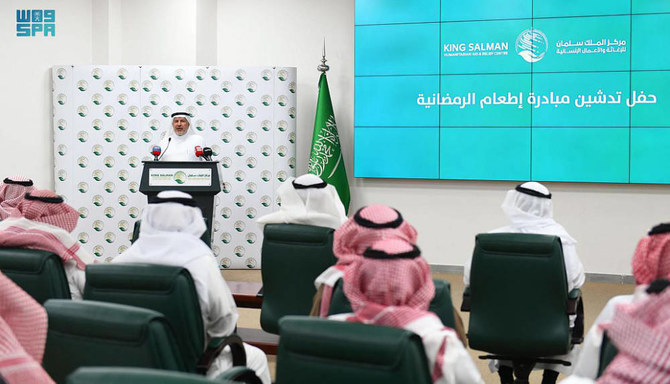
Saudi aid agency launches Ramadan project in 19 countries

Dr. Abdullah Al-Rabeeah, supervisor general of KSrelief, inaugurated the SR37 million ($10 million) “Eta’am” initiative on Sunday. (SPA)
Short Url
Updated 28 March 2022
Follow

Saudi aid agency launches Ramadan project in 19 countries

  • Al-Rabeeah stressed the keenness of the Kingdom to contribute to relief efforts, noting that it ranked third worldwide in 2021 in providing humanitarian aid

RIYADH: The King Salman Humanitarian Aid and Relief Center will distribute 156,993 food baskets across 19 countries during the holy month of Ramadan.

Dr. Abdullah Al-Rabeeah, supervisor general of KSrelief, inaugurated the SR37 million ($10 million) “Eta’am” initiative on Sunday.

The project aims to reach 901,463 people.

Al-Rabeeah said that the project comes as part of the continuous humanitarian aid provided by the Saudi government to impoverished people around the world.

He added that it will support food needs and improve living conditions for the neediest groups in several countries during Ramadan.

Al-Rabeeah stressed the keenness of the Kingdom to contribute to relief efforts, noting that it ranked third worldwide in 2021 in providing humanitarian aid.

He said that since KSrelief’s founding in May 2015, it has launched more than 1,920 projects in vital sectors across 79 countries, spending more than $5.6 billion in the process.

According to a recent report, the countries and territories that have benefited the most from KSrelief aid are Yemen ($4 billion), Palestine ($368 million), Syria ($325 million) and Somalia ($210 million).

The center’s programs cover food security, water sanitation and hygiene, health, education, humanitarian and emergency relief coordination, logistics, nutrition and emergency telecommunication.


Fragrance artisans weave heritage into Jazan Festival experience

Updated 02 January 2026
Follow

Fragrance artisans weave heritage into Jazan Festival experience

Riyadh: Perfumes are emerging as living connections to ancestral memory at the Jazan Festival 2026, which opened on Friday, the Saudi Press Agency reported.

A narrative rooted in botanical origins is unfolding as veteran craftswomen showcase decades of accumulated wisdom, transforming the contents of native plants into small vessels that distill the human bond with terrain.

Aromas wafting through the space suggest imagery of regional ecosystems — fragrant vegetation cultivated across highland and lowland zones, harvested during optimal periods, then subjected to extended drying and distillation processes before materializing as perfumes and essences embodying geographical character, the Saudi Press Agency reported.

Arranged fragrance containers resemble nature’s output, composed by skilled practitioners versed in harvest timing, plant dormancy requirements and scent extraction methods, yielding products preserving organic integrity and territorial identity.

Craftswoman Fatima bint Mohammed Al-Faifi has dedicated two decades to perfume production, characterizing regional practice as social custom interwoven throughout daily existence — deployed in guest reception, featured at celebrations, accompanying community gathering — elevating scent to cultural signature, the Saudi Press Agency reported.

Festival attendees are discovering aromatic botanicals, absorbing production methodology explanations and discerning nuanced olfactory distinctions, demonstrating how craftsmanship blends persistence with expertise, tradition with innovation.

Perfume artisan involvement aligns with Jazan Festival’s initiative repositioning traditional crafts as dynamic, evolving culture while spotlighting women’s contributions safeguarding regional inheritance and expressing this through modern methods, the Saudi Press Agency reported.