



KARACHI: Over 150,000 pilgrims are set to participate in the largest Hindu pilgrimage in Pakistan, an annual festival at the cave temple of Hinglaj Mata in the southwestern Balochistan province, which is being held after a gap of two years due to the coronavirus pandemic, a Pakistani Hindu lawmaker said on Saturday.
The festival began on Friday and will conclude on Sunday after three days of high priests chanting mantras and beseeching Hindu gods to accept the offerings of the devotees and bestow them with peace and prosperity.
According to Hindu mythology, Lord Vishnu cut up the dead body of Sati into 50 pieces, which fell to the earth. Her head, it is said, fell at Hinglaj and it has since been the site for a revered pilgrimage.
Pilgrims arrive from all over Pakistan, adorned in decorative red-and-gold headscarves and saffron headbands, displaying the holy colors of Hinglaj Mata.
“The Hinglaj-Yatra is being held this year after a gap of two years due to coronavirus but with improved arrangements and security,” said Senator Danesh Kumar Palyani, a former advisor to the Balochistan chief minister on religious minorities and interfaith harmony.
In the last two years, Palyani said, around twelve people would visit the temple to perform the annual rituals.
Shri Ram Nath Maharaj, the caretaker of Panchmukhi Hanuman Mandir and member of the Hinglaj Mata committee, said though yatra (pilgrimage) of the historic Hinglaj Mata continues around the year and attracts thousands, including from abroad, the annual event is very important.
“This annual festival, which is usually held in April, is called Tirtha Yatra and is significant to us as is Hajj important to Muslims,” Maharaj told Arab News.
This year, the festival was not organized in April in view of the Islamic month of Ramazan and for the sake of interfaith harmony, according to Palyani.
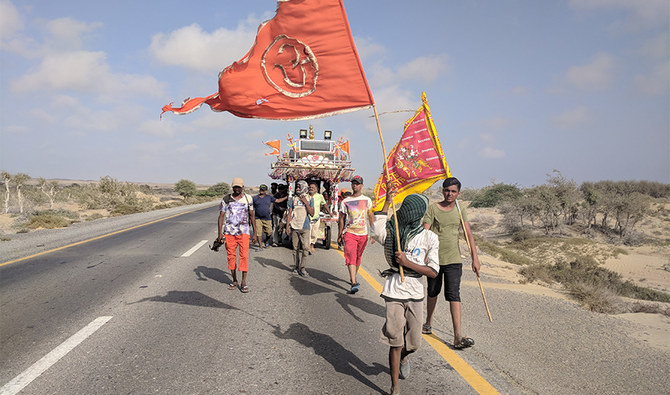
Thousands of Hindus from different parts of the country walk by foot for weeks to arrive at Hinglaj as pledge to Sri Hinglaj Mata. (AN photo/File)
Most pilgrims come in buses, some on private cars and even on bicycles all the way from Karachi and other parts of Sindh. Others prefer to walk.
“A large number of people start their journey weeks before and travel a distance of several hundred kilometers by foot to perform the rituals,” Maharaj said.
The festival, which began in 1988, has attracted several important figures, including former Indian external affairs minister Jaswant Singh, in the past.
The number of pilgrims has also increased because of better arrangements and the construction of the Makran Coastal Highway, a 653-kilometer-long road that extends along Pakistan’s Arabian Sea coast from Karachi in Sindh province to Gwadar in Balochistan. The temple is 247km west of Karachi and 413 kilometers from Gwadar.
Balochistan has been plagued by violence and a site of a long-running insurgency and, with several separatist and militant groups operating in the region that boasts vast mineral resources.
However, the security situation has relatively improved across much of Pakistan in recent years.
“Such a huge event with best security arrangements for Hindu pilgrims is proof of the fact that Pakistan is secure for us and our country takes best care of its minorities,” Senator Palyani told Arab News.
On a visit to the temple, he urged Indian premier Narendra Modi to come and witness the beautiful sight of Hindus performing their rituals so freely and with best arrangements extended by the authorities.
Palyani said the past few years had seen massive development at the Hinglaj Mata temple, which was once a difficult-to-access place.
“A 14-kilometer-long road has been constructed to connect the temple with the coastal highway, solar panels and lights have been installed, boundary wall has been erected, a water plant with 100,000-gallon capacity has been installed and 50 bathrooms have been constructed to facilitate the pilgrims,” Palyani detailed.
A medical dispensary and an ambulance worth Rs8 million ($44,000) have also been provided by the Balochistan government for the pilgrims, he added.


