It is “foolish” to believe that Western sanctions against Russian businesses could have any effect on the Moscow government, Russian ex-president and deputy head of security council Dmitry Medvedev was quoted as saying on Friday.
The sanctions will only consolidate the Russian society and not cause popular discontent with the authorities, Medvedev told Russia’s RIA news agency in an interview.
The West has imposed an array of sanctions on Russia following its invasion of Ukraine, but one month into the war, the Kremlin says it will continue the assault until it accomplishes its goals of Ukraine’s “demilitarization and denazification.”
Some of the sanctions have specifically targeted billionaire businessmen believed to be close to President Vladimir Putin.
“Let us ask ourselves: can any of these major businessmen have even the tiniest quantum of influence of the position of the country’s leadership?” Medvedev said.
“I openly tell you: no, no way.”
Medvedev said there are several grounds under which Russia has the right to use nuclear weapons, including an attack on the country or encroachment on infrastructure as a result of which Russia’s nuclear deterrent forces would be paralyzed.
That demonstrated Russia’s “determination to defend the independence, sovereignty of our country, not to give anyone a reason to doubt even the slightest that we are ready to give a worthy response to any infringement on our country, on its independence,” he said.
However, negotiations — even in the most difficult situations such as those around Ukraine — are Moscow’s preferred path to proceed, he added.
Medvedev said opinion polls showed three-quarters of Russians supported the Kremlin’s decision to carry out a military operation in Ukraine and even more supported President Vladimir Putin.
While downplaying the economic impact of sanctions, Medvedev said the Russian government will have to find “adequate solutions” on its own to spur the development of the aircraft, automotive and IT industries, among others.
“Now, it will be more difficult to tackle those issues, but on the other hand, we cannot rely on anyone,” Medvedev said. “In this case, we will have to solve those problems ourselves.”
He lashed out at those Russians who spoke against the invasion while staying outside Russia.
“You can be dissatisfied with some of the authorities’ decisions, criticize the authorities — this is normal,” he said.
“But you cannot take a stand against the state in such a difficult situation, because this is treason.”
Thousands of people were earlier this month detained at Russia-wide protests against Putin’s invasion of Ukraine, according to an independent protest monitoring group.

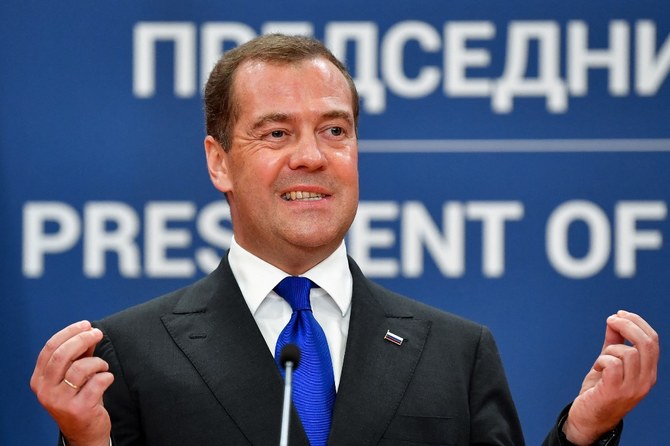
Western sanctions will not sway Kremlin, Russia’s former president Dmitry Medvedev says
Short Url
https://arab.news/r4hgx
Western sanctions will not sway Kremlin, Russia’s former president Dmitry Medvedev says
- Sanctions will only consolidate the Russian society and not cause popular discontent with the authorities
Police target Ukrainians and Russian in ransomware probe
BERLIN: Police have carried out raids against two members of a ransomware group known as “Black Basta” in Ukraine, and issued an arrest warrant for its Russian head, German prosecutors said Thursday.
The group is accused of using malware to encrypt systems and then demanding money to restore them.
Between March 2022 and February 2025, its members extorted hundreds of millions of euros from around 600 companies and public institutions around the world, the prosecutors said in a statement.
The victims were mainly “companies in Western industrialized nations” but also included hospitals and other public institutions.
As part of a coordinated operation between Germany, the Netherlands, Switzerland, Ukraine and Britain, police searched the homes of two Ukrainian suspects and seized evidence, the prosecutors said.
Investigators have also identified and issued an arrest warrant for a Russian citizen accused of being the founder and head of the group, they said.
German police named the suspect as Oleg Evgenievich Nefedov, 35.
Nefedov “decided on targets, recruited employees, assigned them tasks, participated in ransom negotiations, managed the proceeds and used them to pay the members of the group,” the police said.
The searches in Ivano-Frankivsk and Lviv were directed against suspected members of the group accused of so-called hash cracking, a method of guessing passwords.
Ukrainian officials also searched the home of another member of the group near Kharkiv in August, whose job was allegedly to help ensure the malware was not detected by antivirus programs.
Black Basta extorted some 20 million euros ($23 million) from around 100 companies and institutions in Germany alone, the prosecutors said.
The group is accused of using malware to encrypt systems and then demanding money to restore them.
Between March 2022 and February 2025, its members extorted hundreds of millions of euros from around 600 companies and public institutions around the world, the prosecutors said in a statement.
The victims were mainly “companies in Western industrialized nations” but also included hospitals and other public institutions.
As part of a coordinated operation between Germany, the Netherlands, Switzerland, Ukraine and Britain, police searched the homes of two Ukrainian suspects and seized evidence, the prosecutors said.
Investigators have also identified and issued an arrest warrant for a Russian citizen accused of being the founder and head of the group, they said.
German police named the suspect as Oleg Evgenievich Nefedov, 35.
Nefedov “decided on targets, recruited employees, assigned them tasks, participated in ransom negotiations, managed the proceeds and used them to pay the members of the group,” the police said.
The searches in Ivano-Frankivsk and Lviv were directed against suspected members of the group accused of so-called hash cracking, a method of guessing passwords.
Ukrainian officials also searched the home of another member of the group near Kharkiv in August, whose job was allegedly to help ensure the malware was not detected by antivirus programs.
Black Basta extorted some 20 million euros ($23 million) from around 100 companies and institutions in Germany alone, the prosecutors said.
© 2026 SAUDI RESEARCH & PUBLISHING COMPANY, All Rights Reserved And subject to Terms of Use Agreement.


