

Ukraine, Iran deal, post-pandemic woes focus of Middle East summits

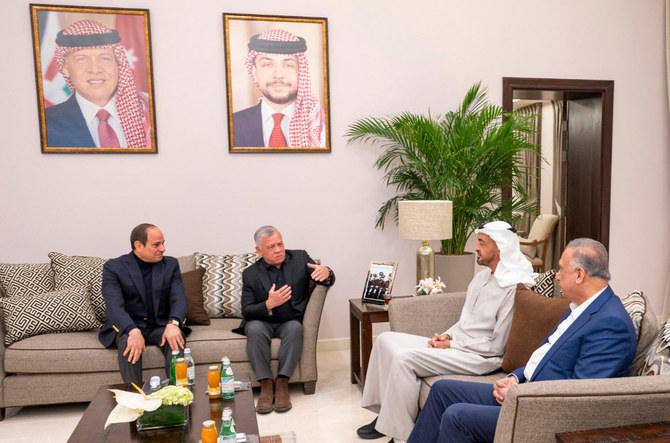
Egypt's President Abdel Fattah El-Sisi, King Abdullah II of Jordan, Crown Prince of Abu Dhabi Mohamed bin Zayed Al-Nahyan, and Iraqi Prime Minister Mustafa Al-Kadhemi (L to R), meeting in Jordan's Red Sea resort of Aqabah on March 25, 2022. (AFP)
Short Url
Updated 25 March 2022
Follow

Ukraine, Iran deal, post-pandemic woes focus of Middle East summits

  • Blinken travels to the Middle East and North Africa next week as the administration of US President Joe Biden tries to keep allies and partners united in opposition to Russia’s war in Ukraine

AMMAN: The Ukraine-Russia conflict, the possibility of an Iran deal in Vienna, and post-pandemic economic worries appear to be the discussion topics for several regional summits.

One is a four-way Iraqi, UAE, Egyptian, and Jordanian summit in Aqaba. Another is a foreign ministerial meeting in Israel with US Secretary of State Antony Blinken, and there is a three-way summit in the Egyptian resort of Sharm El-Sheikh to be attended by President Abdel Fattah El-Sisi, Israeli Prime Minister Naftali Bennett, and Abu Dhabi Crown Prince Mohammed bin Zayed.

Blinken travels to the Middle East and North Africa next week as the administration of US President Joe Biden tries to keep allies and partners united in opposition to Russia’s war in Ukraine.

Oraib Rantawi, director of the Amman-based Al-Quds Center for Political Studies, said the meetings were more about coordination and consultation than producing an agreement or signing a new covenant.

“I think all these parties realize that we are approaching a critical stage due to the Ukrainian-Russia conflict as well as the possibility of a nuclear deal in Vienna,” he told Arab News.

Rantawi said that while all the parties who were meeting were strong US allies, they were unwilling to go as far as the US wanted them to go on the Ukraine war.

The political strategist believed the parties “want to consult and coordinate positions rather than reach a specific agreement.”

Jamil Nimri, a member of the Jordanian Senate and a leading figure in the efforts to create ruling political parties in the country, agreed that Iran and Ukraine were the two key elements during the current high-level consultations.

“What we are seeing is a political movement that is not in the traditional way,” he told Arab News.

The high-level meetings might also be connected to post-pandemic economic difficulties and the fear of disruption in food and energy costs.

Nimri said Egypt was facing economic problems, and that the conflict in Ukraine threatened to affect the supply of wheat from both Russia and Ukraine as well as a sharp rise in energy costs for oil-consuming countries.

Rantawi said food and energy were becoming “part of national security” for many Arab countries, and that the region was on edge and could blow up from a spark from one place or another.

“It is unusual that with all the problems of Ukraine both the US secretary of state and King Abdullah have decided to visit Ramallah,” he said, adding the concern was about reverberations spreading to many countries if things blew up at Al-Aqsa Mosque.

“We rarely see the king go to Ramallah or a senior US official visit the occupied Palestinian areas. They all know that the spark from Al-Aqsa could have a domino effect on the region that brings back memories of the Arab Spring.”

The various high-level meetings appear to have a strong Gulf influence, with the UAE leadership present in almost every meeting, reflecting concern about the Iran agreement and the effects of the polarization coming out of Ukraine.


Turkiye to forge on with tight economic policy, some fine-tuning, VP Yilmaz says

Updated 2 sec ago
Follow

Turkiye to forge on with tight economic policy, some fine-tuning, VP Yilmaz says

ISTANBUL: Turkiye is committed to carrying on its tight economic policies ​in order to cool inflation, and though it may fine-tune the program it will not change course, Vice President Cevdet Yilmaz said in comments embargoed to Friday.
“There is no plan to pause our program,” Yilmaz said at a briefing with reporters in Istanbul on Thursday. “All programs are dynamic, and adjustments can always be made.”
Yilmaz, who plays a key role overseeing economic policy at the presidency, said any such adjustments would aim to support production, investment and ‌exports while moderating consumption.
Turkiye ‌has pursued tight monetary and fiscal policies ‌for more ⁠than ​two years ‌in order to reduce price pressure, leading to high financing and borrowing costs that have weighed on businesses and households. Inflation has eased slowly but steadily over the last year but remains elevated at 31 percent annually.
Last month, Is Bank CEO Hakan Aran warned that focusing solely on one target — inflation — could create side effects, suggesting a “pause and restart” might be healthy once the program achieves certain targets.
Yılmaz said the ⁠government expects improvements in inflation in the first quarter, which should reflect to market expectations for year-end ‌inflation around 23 percent. The government projects inflation to dip ‍as far as 16 percent by year end, ‍within a 13-19 percent range, and falling to 9 percent in 2027. The central ‍bank forecasts inflation between 13-19 percent by end-2026.
Yilmaz noted inflation fell by nearly 45 points despite pressure from elevated food prices, hit by agricultural frost and drought.
The agricultural sector is expected to support growth and help ease price rises this year, which could ​help achieve official inflation targets, he said.
Yilmaz said the government wants to avoid a rapid drop in inflation that could hurt economic ⁠growth, jobs and social stability.
Turkiye’s economic program was established in 2023 after years of unorthodox easy money that aimed to stoke growth but that sent inflation soaring and the lira plunging. The program aims to dislodge high inflation expectations while boosting production and exports, in order to address long-standing current account deficits.
The central bank, having raised interest rates as high as 50 percent in 2024, eased policy through most of last year, bringing the key rate down to 38 percent.
Asked whether lower rates could trigger an exit from the lira currency, Yilmaz said: “What matters is real interest rates. Lowering rates as inflation falls does not affect real rates, so we do ‌not expect such an impact.”
He added that the government will strengthen mechanisms that selectively support companies while improving overall financial conditions.