
DUBAI: Russia banned Facebook and Instagram earlier this month in a crackdown on the Western social media giants, describing the platforms’ parent company Meta as an “extremist” firm.
“The activities of the Meta organization are directed against Russia and its armed forces,” Igor Kovalevsky, a representative of the Russian security service FSB, said, according to Russian state news agency TASS.
Adam Mosseri, head of Instagram, said the platform’s 80 million users in Russia will be cut off because of the ban.
On Monday, Instagram will be blocked in Russia. This decision will cut 80 million in Russia off from one another, and from the rest of the world as ~80% of people in Russia follow an Instagram account outside their country. This is wrong.
— Adam Mosseri (@mosseri) March 11, 2022
Moscow’s crackdown will stop individual users from posting and connecting with others, as well as hinder their ability to receive information.
But it is the country’s army of social media influencers who are paying a particularly heavy price.
Russia is home to thousands of fashion influencers with millions of followers. Influencer marketing platform Starngage alone tracks 176,070 influencers in Russia, with follower counts ranging from 1,000 to 10 million.
“Roughly half of all my income came through Instagram advertising,” said Karina Istomina, a DJ and Instagram influencer with more than 400,000 followers, reported The Guardian.
“Most likely I will have to find new sources of income and will have to rediscover myself,” she added.
Another influencer, Karina Nigay, said tearfully: “This (Instagram) is my life, this is my soul. This is what I have been waking up to and falling asleep with for the past five years.”
Девушка-блогер плачет из-за блокировки инстаграм. Может уже пора переставать быть вне политики и включить мозги? Все крупные звёзды, кто не высказался в первую неделю против войны, вероятно, просто решили отмолчаться и переждать. Просто позор. pic.twitter.com/DgJZBky6J7
— Соболь Любовь (@SobolLubov) March 12, 2022
“I’m in a state of resentment and nowhere near a state of acceptance,” she added.
A few days later, Nigay was in Dubai, celebrating her birthday and dancing on a boat.
The influencer, who has 2.9 million Instagram followers, posted on the platform last week, complaining about the ban and claiming that any platforms which replace it will require four times as much work.
“I want to live and work in Russia, but at the same time I don’t want to lose my career in Europe, which I have built over the years.”
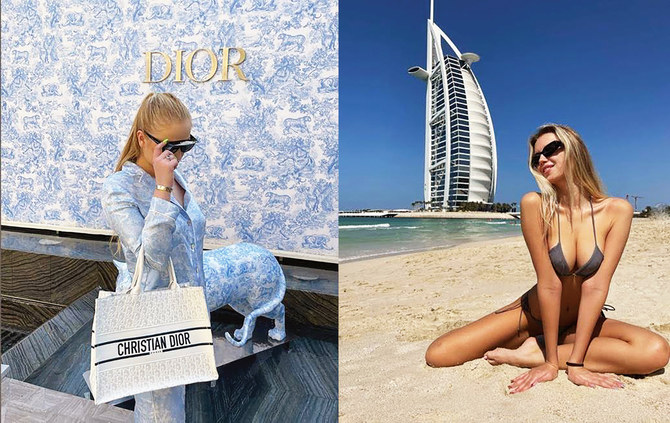
The UAE’s sunny beaches and luxurious hotels have become a refuge for Russian influencers, who now find themselves struggling to make a living off Instagram.
Pavel Durov, the founder of Telegram and, previously, VKontakte, a Russian social media app, was among those who left Russia for Dubai in the wake of the government crackdown.
He has publicly posted his story on Telegram, describing how his career at VKontakte ended due to pressure from the FSB, and his determination to protect users’ privacy and data — especially that of Ukrainians.
Another influencer, Khabib Nurmagomedov, who has over 30 million Instagram followers, was also seen in Dubai recently.
Russian TV personality Olga Buzova, who had more than 20 million followers on Instagram, also broke down in a tearful video when the ban was announced and has since traveled to the UAE, according to media reports.
Her sponsors are paying for the vacation, including flights and a room at a five-star hotel, according to the Russian tabloid Komsomolskaya Pravda.
Sonia Plotnikov, the daughter of Vladimir Plotnikov, an MP and supporter of Russian President Vladimir Putin, has over 100,000 followers on Instagram and is also currently in Dubai.
However, if the influencer was expecting sympathy, she may be disappointed. Comments on Plotnikov’s posts reveal how many people feel about influencers being able to travel to other countries, and even continue enjoying a luxurious lifestyle, while their country wages war on Ukraine.
One of the #Russian bloggers cries that in two days her Instagram will stop working
She does not care at all about the thousands of dead people, including her compatriots. Obviously, her biggest worry right now is that she won't be able to post pictures of food from restaurants. pic.twitter.com/LSdBiSlwHr
— NEXTA (@nexta_tv) March 11, 2022
In a separate interview, Dubai-based influencer Becky Jefferies told Arab News: “We live in a world in which many people across the globe are without basic necessities, or are otherwise in need, and that’s an unfortunate reality in both good times and bad.
“But I don’t see social media as a cause, or solution, to economic challenges on a micro or macro level.”
Increasingly, the UAE has become a safe haven for Russian influencers but it isn’t the only one. Within the region, for instance, Russian model and Instagram star Polina Malinovskaya with 2.2 million followers was seen in Egypt this month.
Some have taken off to the relaxing comfort of hotels in Bali and the Maldives, while others are looking for normalcy in the bustling cities of New York and London.
Vlad Berenich, for instance, who has over 800,000 followers on Instagram is relaxing in Bali, while Polina Kovaleva lives the high brow life in London.
Maria Pevchikh, who heads investigations at Russian lawyer Alexei Navalny’s Anti-Corruption Foundation, recently posted Kovaleva’s story in a Twitter thread.
I would like you to meet Polina Kovaleva. Polina is a 26-year-old glamorous Russian girl from London. She lives in a huge apartment in Kensington and loves to party, her instagram feed looks like a non-stop holiday. That’s not unheard of, but there is one small detail…(THREAD) pic.twitter.com/6OsVGjPxQQ
— Maria Pevchikh (@pevchikh) March 10, 2022
Kovaleva is the stepdaughter of Russia’s Minister of Foreign Affairs Sergei Lavrov, who, at the age of 21, bought an apartment in London on Kensington High Street for £4.4 million — in cash.
Moreover, her fancy lifestyle is evident via her Instagram profile that has since been deleted and a new temporary one, which is private, has been created. After the news broke on Twitter, Kovaleva was sanctioned by British authorities.