
LONDON: In Lebanon, people have often resorted to humor and social jokes to get through the various hardships they have endured in recent years. However, in many instances, this humor crossed moral and ethical lines.
A Lebanese media outlet, Al-Sharq newspaper, was slammed last week for its misogynistic coverage of the Ukrainian-Russian war, which objectified Ukrainian women in false attempts to evoke sympathy.
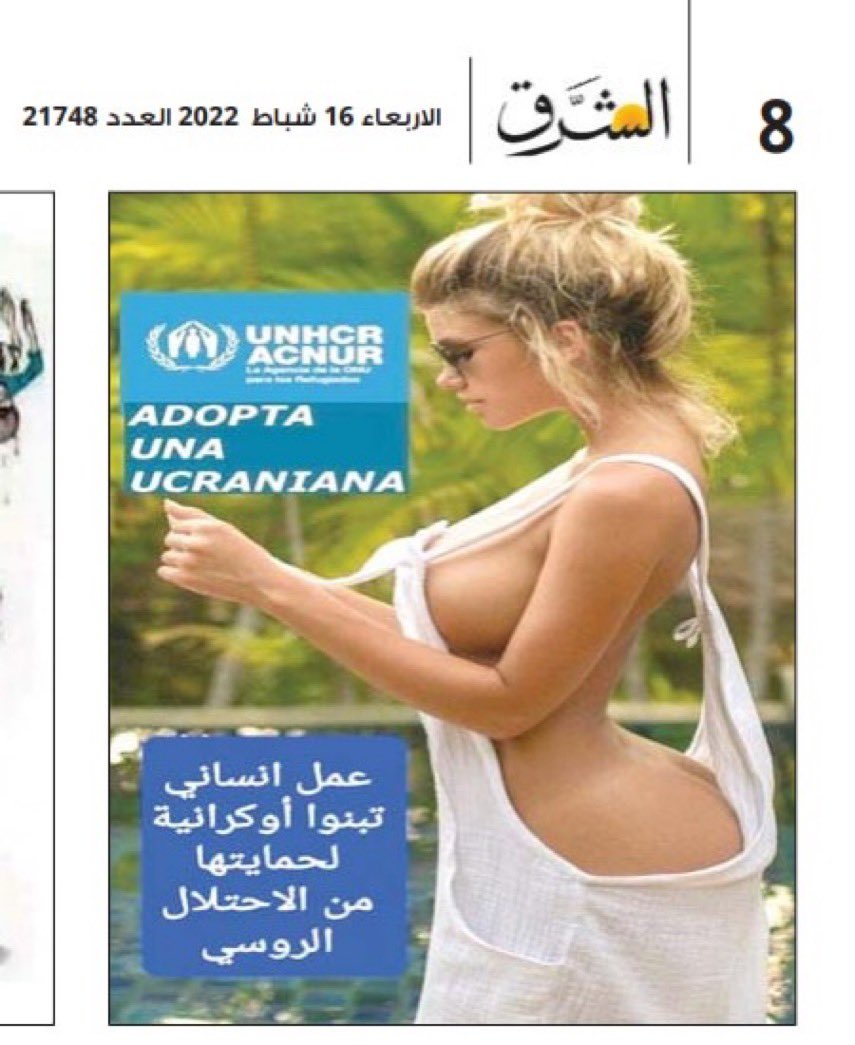
Lebanon's Al-Sharq newspaper featured a half-clothes Russian model who the newspaper claimed is a Ukrainian woman. (Twitter)
Misogynistic images were also circulated on Lebanese WhatsApp groups objectifying Russian and Ukrainian women under the guise of humor.
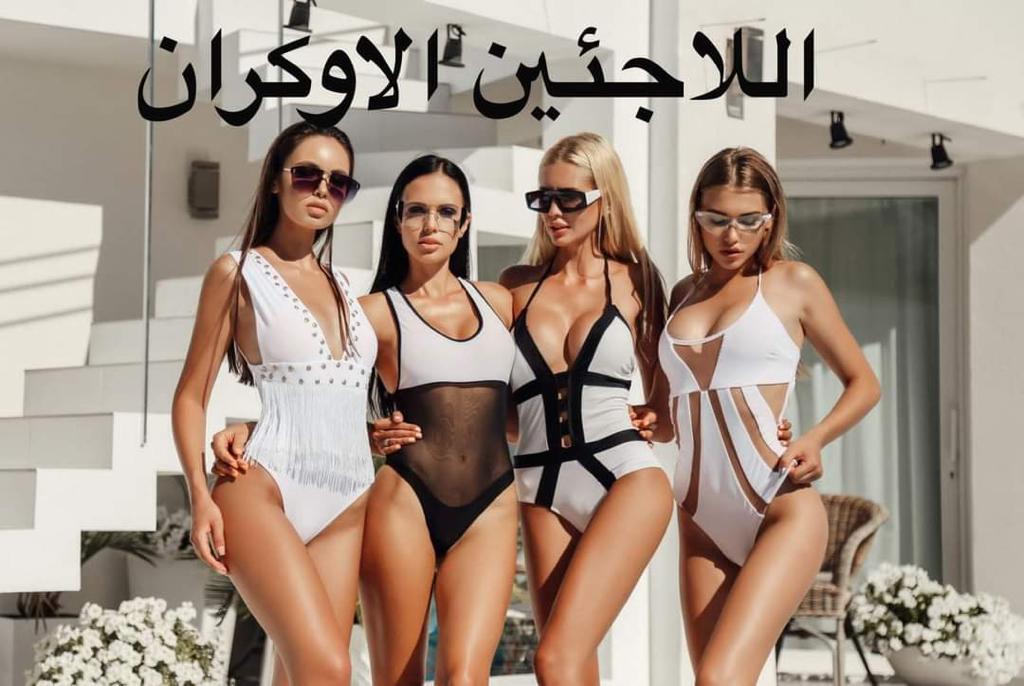
Images objectifying Ukrainain women were circulated on Lebanese WhatsApp groups with the caption: "Ukrainian refugees." (Twitter)
“These are not innocent jokes; they are misogyny and sexism concealed in humor. They are instruments of propaganda and control that propagate and maintain the misogynist discourse in society,” Lina Zhaim, a media, communications and development expert, told Arab News.
On its eighth page in the variety segment, Al-Sharq published a photo of a half-clothed blonde curvy woman, who the newspaper claimed is a Ukrainian woman.
The image was accompanied with a photoshopped superimposed logo of the UN High Commissioner for Refugees and a caption in Spanish that read “Adopta una Ucraniana,” (adopt a Ukrainian).
Underneath the logo, the newspaper included a deeply insulting Arabic caption, likely intended to be humorous, which read: “Humanitarian deed, adopt a Ukrainian woman to protect her from the Russian occupation.”
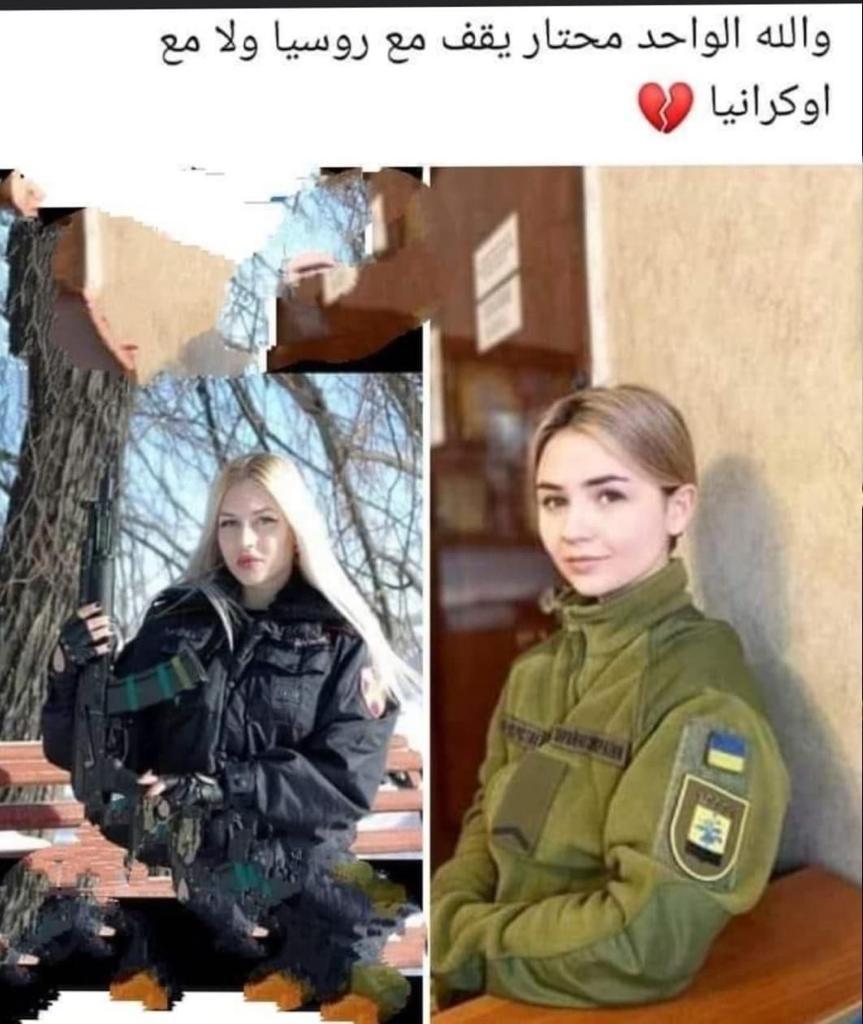
Images objectifying Russian and Ukrainain women were circulated on Lebanese WhatsApp groups with the caption: "God knows who we should side with, Russia or Ukraine." (Twitter)
“These types of jokes stereotype women and normalize the sexual objectification of women under the disguise of humor. The image as well as the language of the joke are offensive to women everywhere; they devalue women and reduce them to sexual objects for the gaze of men and reinforce the sexual stereotyping of women,” Zhaim added.
The fact that the editor-in-chief of Al-Sharq, Awni Kaaki, is also the head of the Lebanese Press Syndicate makes matters even worse.
“The media is not becoming sexist; it was always like this. It is reflective of the institutionalized misogyny, toxic masculinity and condescending attitudes towards women,” Zhaim explained.
“The Lebanese media are still dominated by misogynist and sexist cultures and ideologies, and are still managed by misogynist men like Kaaki who control the narrative of the women’s agency in our culture: they have created and continue to cement the image of women as nothing more than sexual objects to be shown off, exploited and oppressed.”
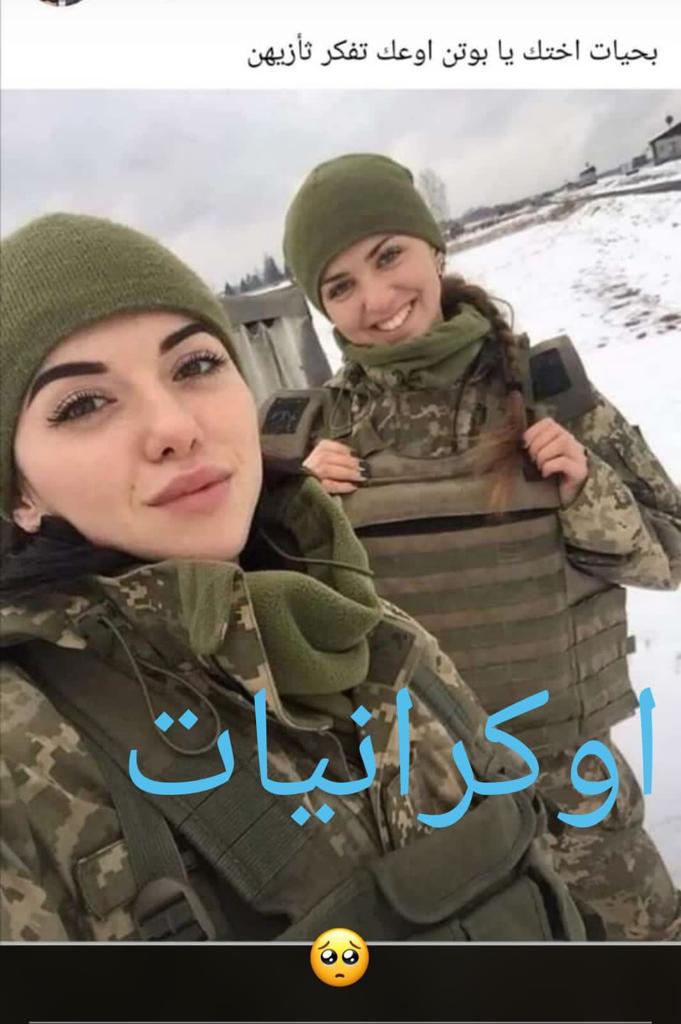
Images objectifying Russian and Ukrainain women were circulated on Lebanese WhatsApp groups with the caption: "For the love of God Putin, don't you dare harm them." (Twitter)
Journalists and media experts in Lebanon slammed Al-Sharq and Kaaki for the level of misogyny seemingly disguised as humor.
Veteran journalist Magda Abu Fadil detailed in a blog post Kaaki’s response to the accusations. After receiving heavy backlash, Kaaki claimed that newspaper editors don’t always micromanage a publication.
“First of all, she’s a beautiful girl; this is on social media and the guys at my paper published it,” Kaaki said in response to the publication.
“This is Al-Sharq newspaper, the paper of the Press Syndicate’s president Awni Kaaki, president of the misogynistic press, accused in Kuwait of human trafficking prostitutes,” tweeted Zhaim.
“This is Awni Kaaki who accuses independent women journalists of faking being journalists because they refused to recognize him and the male chauvinist union over which he presides like a rooster.”
هيدي جريدة الشرق، جريدة نقيب الصحافة عوني الكعكي، نقيب الصحافة الذكورية، المتهم بالكويت بالمتاجرة ببنات الهوى. هيدا عوني الكعكي يللي عم يتهم الصحافيات المستقلات بإنتحال شخصية لأن رفضوا الإعتراف فيه وبنقابة الذكورية يللي حضرته عامل عليها ديك. pic.twitter.com/o9q3aM2N4h
— Lina Zhaim ~ لينا (@LinaZhaim) February 16, 2022
“Al-Sharq newspaper is hardly representative of the Lebanese press and population,” Mohanad Hage Ali, director of communications and fellow at Malcolm H. Kerr Carnegie Middle East Center, told Arab News.
Ali added that “the newspaper is notorious for their light reporting, often publishing WhatsApp jokes without the slightest fact check.”
However, regardless of whether the feature was designed to be taken seriously, this kind of content is familiar territory in Lebanon. Indeed, racism is one form of discrimination that is rampant and mainstream in the country’s politics and media and targets numerous nationalities, including those from Syria, the Phillippines, Bangladesh, Sri Lanka and many others.
Migrant workers, particularly those from southeast Asian and African countries, have been suffering for decades in Lebanon under the Kafala system where they are treated with abuse, exploitation and a denial of basic human rights.
Following Lebanon’s devastating economic crisis, many were kicked out of homes where they had worked for years and left on the streets to fend for themselves.
In 2015, thousands of people in Lebanon were subjected to an advert which read: “For Mother’s Day indulge Ur Mom and offer her a housekeeper. Special offers on Kenyan and Ethiopian nationalities for a period of 10 days.”
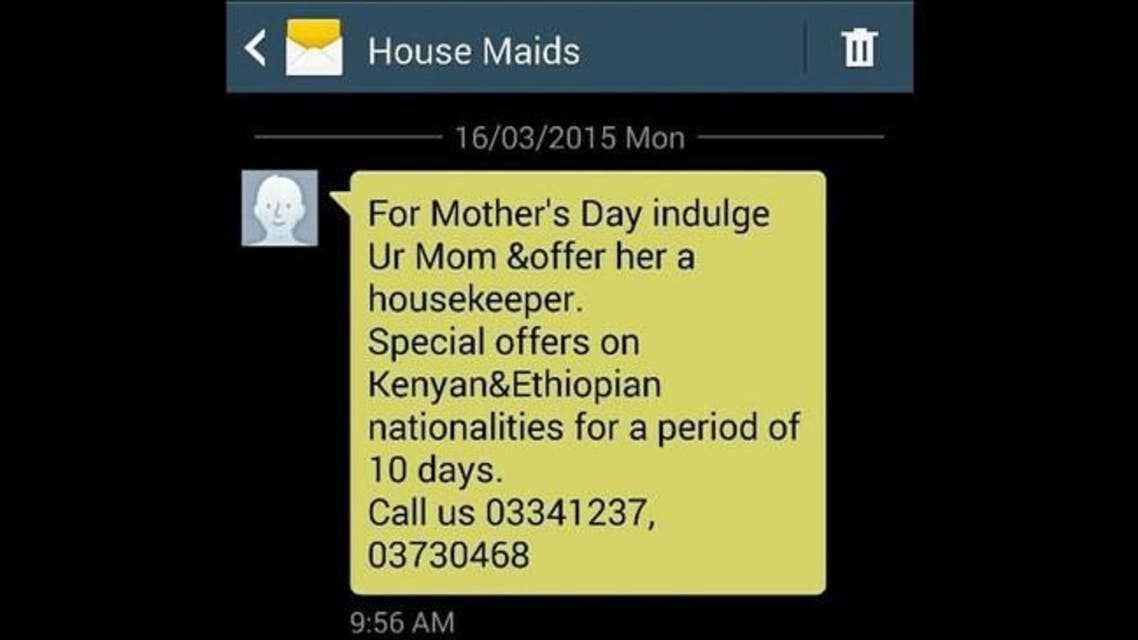
Text message was sent to thousands of Lebanese numbers. (Twitter)
More recently, Sporting Beach club in Beirut sparked controversy online after its racist policy form made headlines.
It all started when a regular at the beach club uploaded a Facebook post showcasing a new policy form — targeting migrant domestic workers — that management handed out to their customers.
The form, which clients were asked to sign, is titled “Helper Dress Policy,” and features an image depicting what a domestic worker should be wearing to be allowed into the beach club.
The form added that those who breach the dress code will be asked to leave the premises without a refund.
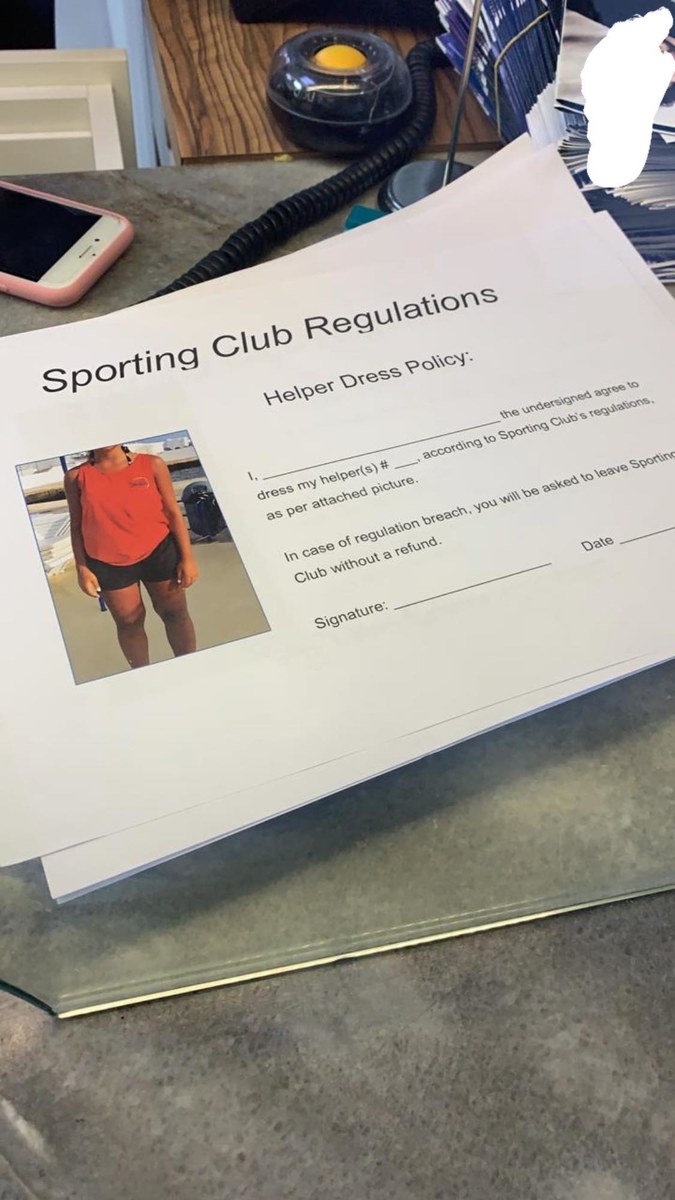
Visitors were provided this form to fill upon entering the beach club. (Step Feed)
The incident coincided with heavy criticism against the club when the management refused entry to an Indian woman and her daughter. The woman in question was a lecturer attending the club with fellow academics.
This is not the first time the club has been slammed for racist policies. Indeed, an undercover video taken at its lavish premises exposed a cashier repeatedly refusing to grant entry to an African woman from Madagascar went viral online in 2010.
More recently, a Sudanese TV anchor received heaps of misogynist and racist tweets following a report on her show that criticized the Lebanese government.
The hate-filled comments targeting Dalia Ahmad, an anchor on Lebanon’s Al-Jadeed news channel, ranged from calling her a “female dog” to tweets suggesting she should be “offered for sale in the slave market, along with her ilk, by ISIS,” another term for terror group Daesh.
Another tweet said: “By God, by God, whoever wants to attack the Al-Sayyed (Nasrallah), I want to wipe the ground with them and curse those who gave birth to them,” alongside an image of Ahmad with the face of a dog photoshopped over hers.
Often referred to as a progressive country, Lebanon in reality suffers from a deep case of racism and misogyny. Targeting domestic migrant workers and those with darker skin colors does not seem to be the only form of discrimination.
Following the Syrian conflict, a similar scourge of racist treatment was felt by Syrian refugees who had fled the atrocities of the civil war into neighboring Lebanon.
Lebanese politicians have been actively scapegoating Syrian refugees and blaming them for economic, social and security failures in the country. In some villages in Lebanon, local authorities have even imposed curfews on Syrian refugees.
Syrian refugees were often accused of “stealing jobs,” and many were referred to as construction workers or janitors.
Mainstream Lebanese media has not been an innocent bystander in this xenophobic targeting. A video went viral on social media in 2016 after Lebanese university students were asked whether they would date a Syrian. Almost all responders said no.
Explaining their position, the Lebanese interviewed said: “No, because he’s from a different culture,” or “no because he doesn’t speak the language.”