BRUSSELS: US President Joe Biden and Western allies opened the first of three summits Thursday focused on increasing pressure on Russian President Vladimir Putin over his war in Ukraine while tending to the economic and security fallout spreading across Europe and the world.
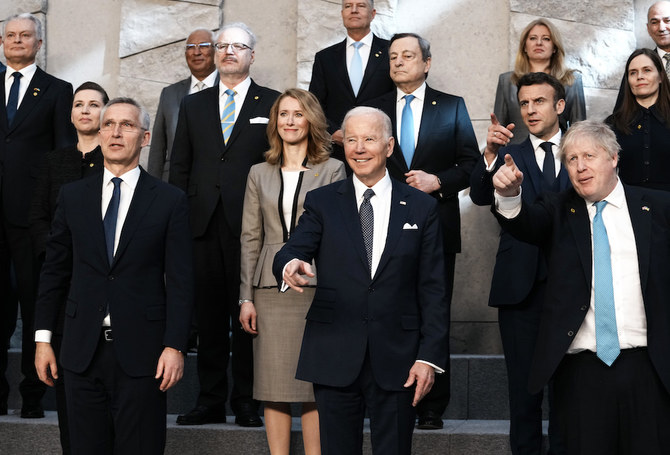
Biden and the leaders of other NATO countries met at the alliance’s headquarters where they posed for a group photo memorializing the urgent gathering before retreating behind closed doors for their summit, which was expected to last several hours.
Over the course of Thursday, the European diplomatic capital is hosting an emergency NATO summit as well as a gathering of the Group of Seven industrialized nations and a summit of the 27 members of the European Union. Biden will attend all three meetings and plans to hold a news conference at the end of the day.
Biden arrived here late Wednesday with the hopes of nudging allies to enact new sanctions on Russia, which has already seen its economy crippled by a steady stream of bans, boycotts and penalties over the past four weeks.
While the West has been largely unified in confronting Russia after it invaded Ukraine, there’s wide acknowledgement that unity will be tested as the costs of war chip at the global economy.
The bolstering of forces along NATO’s eastern flank, almost certainly for at least the next 5-10 years if Russia is to be effectively dissuaded, will also put pressure on national budgets.
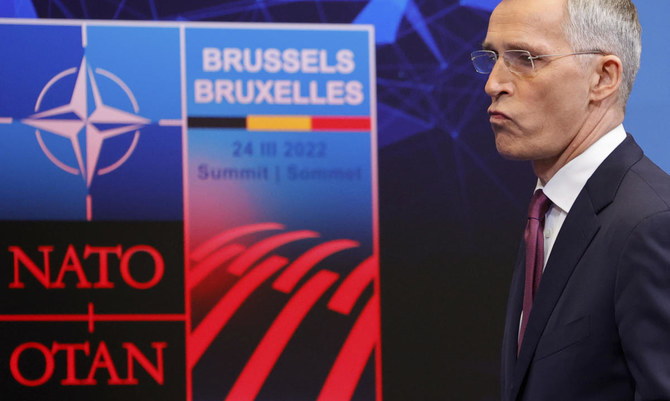
“We need to do more, and therefore we need to invest more. There is a new sense of urgency and I expect that the leaders will agree to accelerate the investments in defense,” said NATO Secretary-General Jens Stoltenberg before chairing the security alliance’s summit.
En route to Brussels aboard Air Force One, Biden’s national security adviser, Jake Sullivan, told reporters that “what we would like to hear is that the resolve and unity that we’ve seen for the past month will endure for as long as it takes.”
The energy crisis exacerbated by the war will be a particularly hot topic at the European Council summit, where leaders from Spain, Portugal, Italy and Greece are hoping for an urgent, coordinated bloc-wide response. EU officials have said they will seek US help on a plan to top up natural gas storage facilities for next winter, and they also want the bloc to jointly purchase gas.
German Chancellor Olaf Scholz has dismissed calls to boycott Russian energy supplies, saying it would cause significant damage to his country’s economy. Scholz is facing pressure from environmental activists to quickly wean Germany off Russian energy, but he said the process will have to be gradual.
“To do so from one day to the next would mean plunging our country and all of Europe into recession,” Scholz said Wednesday.
Poland and other eastern flank NATO countries will also be looking for clarity on how the United States and fellow European nations can assist in dealing with their growing concerns about Russian aggression as well as a spiraling refugee crisis. More than 3.5 million refugees have fled Ukraine in recent weeks, including more than 2 million to Poland.
Biden is scheduled to travel to Poland on Friday, where both issues are expected to be at the center of talks with President Andrzej Duda. Another significant moment could come shortly before Biden returns to Washington on Saturday. The White House said he plans to “deliver remarks on the united efforts of the free world to support the people of Ukraine, hold Russia accountable for its brutal war, and defend a future that is rooted in democratic principles.”
Sullivan said that Biden and fellow leaders would aim to “set out a longer-term game plan” for what forces and capabilities are going to be required for the alliance’s eastern flank countries.
Four new NATO battlegroups, which usually number between 1,000-1,500 troops, are being set up in Hungary, Slovakia, Romania and Bulgaria.
Ukrainian President Volodymyr Zelensky, who is expected to address the NATO summit by video, said late Wednesday that he wants the alliance to “declare that it will fully assist Ukraine to win this war” by supplying any weapons necessary.
All the while, national security officials from Washington to Warsaw are increasingly worried that Putin might deploy chemical, biological or even nuclear weaponry. Sullivan said the allies would consult on how to respond to “potential contingencies” of that sort, including “this whole question of the potential use of nuclear weapons.”
Biden, before departing for Brussels on Wednesday, told reporters that he believed the possibility of Russia deploying chemical weapons was a “real threat.”
Stoltenberg would not be drawn Thursday on whether such a strike is a red line that would draw the alliance into war with Russia. “I will not speculate beyond the fact that NATO is always ready to defend, to protect and to react to any type of attack on a NATO allied country,” he said.
Kremlin spokesman Dmitry Peskov in a CNN interview this week said that Russia could consider using its nuclear weapons if it felt there was “an existential threat for our country.”
The head of the European Union’s executive arm said she wanted to discuss with Biden the possibility of securing extra deliveries of liquefied natural gas from the United States for the 27-nation bloc.
Speaking at the European Parliament ahead of Biden’s visit, Ursula von der Leyen said the EU was seeking a a commitment for additional LNG supplies from the US “for the next two winters.”
The EU imports 90 percent of the natural gas used to generate electricity, heat homes and supply industry, with Russia supplying almost 40 percent of EU gas and a quarter of its oil. The bloc is looking at ways to reduce its dependence on Russian gas by diversifying suppliers.
Sullivan said the United States was looking for ways to “surge” LNG supplies to Europe to help make up for supply disruptions.
Biden, for his part, was expected to detail plans for new sanctions against Russia and humanitarian assistance for the region.
One new sanctions option that Biden is weighing is to target members of the Russian State Duma, the lower house of parliament, according to a US official who spoke on the condition of anonymity to discuss private deliberations. The official added that a final decision hadn’t been made and that the new sanctions would be rolled out in coordination with Western allies.


![]()
![]()


Joe Biden, NATO leaders open summits on Russian war
Short Url
https://arab.news/mph6u
Joe Biden, NATO leaders open summits on Russian war
- US leader hopes to nudge allies to enact new sanctions on Russia
- Wide acknowledgement that unity will be tested as the costs of war chip at the global economy


Pentagon foresees ‘more limited’ role in deterring North Korea
- South Korea hosts about 28,500 US troops in combined defense against North Korea’s military threat
- In recent years, US officials have signaled a desire to make US forces in South Korea more flexible
The Pentagon foresees a “more limited” role in deterring North Korea, with South Korea taking primary responsibility for the task, according to a policy document released on Friday, a move that could lead to a reduction of US forces on the Korean Peninsula.
South Korea hosts about 28,500 US troops in combined defense against North Korea’s military threat and Seoul has raised its defense budget by 7.5 percent for this year.
“South Korea is capable of taking primary responsibility for deterring North Korea with critical but more limited US support,” the Pentagon said in the 25-page National Defense Strategy document that guides its policies.
“This shift in the balance of responsibility is consistent with America’s interest in updating US force posture on the Korean Peninsula.”
In recent years, US officials have signaled a desire to make US forces in South Korea more flexible, to potentially operate outside the Korean Peninsula in response to a broader range of threats, such as in defending Taiwan and checking China’s growing military reach.
South Korea has resisted the idea of shifting the role of US troops, but has worked to grow its defense capabilities in the past 20 years, with the goal of being able to take on the wartime command of combined US and South Korean forces. South Korea has 450,000 troops.
The Pentagon’s top policy official, Elbridge Colby, is due to travel to Asia next week and is expected to visit South Korea, a US official said.
The wide-ranging document, which each new administration publishes, said the Pentagon’s priority was defending the homeland. In the Indo-Pacific region, the document said, the Pentagon was focused on ensuring that China could not dominate the United States or US allies.
“This does not require regime change or some other existential struggle. Rather, a decent peace, on terms favorable to Americans but that China can also accept and live under, is possible,” the document said, without mentioning Taiwan by name.
China claims democratically governed Taiwan as its own territory and has not ruled out the use of force to take control of the island. Taiwan rejects Beijing’s sovereignty claims and says only the people of Taiwan can decide their future.
The Pentagon document is based on US President Donald Trump’s National Security Strategy, published last year, which said the United States will reassert its dominance in the Western Hemisphere, build military strength in the Indo-Pacific, and possibly reassess its relationship with Europe.
Iran seeks to rebuild military
President Trump said on Thursday the United States has an “armada” heading toward Iran but that he hoped he would not have to use it, as he renewed warnings to Tehran against killing protesters or restarting its nuclear program.
The deployments to the Middle East expand the options available to Trump, both to better defend US forces in the region at a moment of high tension and to take any additional military action after striking Iranian nuclear sites in June.
The Pentagon document said that while Iran had suffered setbacks in recent months, it was aiming to rebuild its military, with Tehran leaving open the possibility that it could “try again to obtain a nuclear weapon.”
Even with US troops heading to the region, the document said Israel was a “model ally” and could be further empowered to defend itself. The United States has had a sometimes strained relationship with Israel over its war in Gaza.
US to remain engaged in Europe
Trump’s National Security Strategy from last year drew an outcry from Europeans after it said that Europe faced “civilizational erasure” and may one day lose its status as a reliable US ally.
The Trump administration is putting pressure on Kyiv to reach a peace deal in the war triggered by Russia’s full-scale invasion in February 2022, with Moscow demanding Kyiv cede its entire eastern industrial area of Donbas before it stops fighting.
The Pentagon’s strategy document was more measured on European allies, saying that while the United States would remain engaged in Europe it would prioritize defending the United States and deterring China.
It said that Russia would remain a “persistent but manageable” threat for NATO’s eastern members, and that the Pentagon would provide Trump with options to “guarantee US military and commercial access to key terrain” in different parts of the world, including in Greenland.
Trump said earlier this week he had secured total and permanent US access to Greenland in a deal with NATO, whose head said allies would have to step up their commitment to Arctic security to ward off threats from Russia and China.
South Korea hosts about 28,500 US troops in combined defense against North Korea’s military threat and Seoul has raised its defense budget by 7.5 percent for this year.
“South Korea is capable of taking primary responsibility for deterring North Korea with critical but more limited US support,” the Pentagon said in the 25-page National Defense Strategy document that guides its policies.
“This shift in the balance of responsibility is consistent with America’s interest in updating US force posture on the Korean Peninsula.”
In recent years, US officials have signaled a desire to make US forces in South Korea more flexible, to potentially operate outside the Korean Peninsula in response to a broader range of threats, such as in defending Taiwan and checking China’s growing military reach.
South Korea has resisted the idea of shifting the role of US troops, but has worked to grow its defense capabilities in the past 20 years, with the goal of being able to take on the wartime command of combined US and South Korean forces. South Korea has 450,000 troops.
The Pentagon’s top policy official, Elbridge Colby, is due to travel to Asia next week and is expected to visit South Korea, a US official said.
The wide-ranging document, which each new administration publishes, said the Pentagon’s priority was defending the homeland. In the Indo-Pacific region, the document said, the Pentagon was focused on ensuring that China could not dominate the United States or US allies.
“This does not require regime change or some other existential struggle. Rather, a decent peace, on terms favorable to Americans but that China can also accept and live under, is possible,” the document said, without mentioning Taiwan by name.
China claims democratically governed Taiwan as its own territory and has not ruled out the use of force to take control of the island. Taiwan rejects Beijing’s sovereignty claims and says only the people of Taiwan can decide their future.
The Pentagon document is based on US President Donald Trump’s National Security Strategy, published last year, which said the United States will reassert its dominance in the Western Hemisphere, build military strength in the Indo-Pacific, and possibly reassess its relationship with Europe.
Iran seeks to rebuild military
President Trump said on Thursday the United States has an “armada” heading toward Iran but that he hoped he would not have to use it, as he renewed warnings to Tehran against killing protesters or restarting its nuclear program.
The deployments to the Middle East expand the options available to Trump, both to better defend US forces in the region at a moment of high tension and to take any additional military action after striking Iranian nuclear sites in June.
The Pentagon document said that while Iran had suffered setbacks in recent months, it was aiming to rebuild its military, with Tehran leaving open the possibility that it could “try again to obtain a nuclear weapon.”
Even with US troops heading to the region, the document said Israel was a “model ally” and could be further empowered to defend itself. The United States has had a sometimes strained relationship with Israel over its war in Gaza.
US to remain engaged in Europe
Trump’s National Security Strategy from last year drew an outcry from Europeans after it said that Europe faced “civilizational erasure” and may one day lose its status as a reliable US ally.
The Trump administration is putting pressure on Kyiv to reach a peace deal in the war triggered by Russia’s full-scale invasion in February 2022, with Moscow demanding Kyiv cede its entire eastern industrial area of Donbas before it stops fighting.
The Pentagon’s strategy document was more measured on European allies, saying that while the United States would remain engaged in Europe it would prioritize defending the United States and deterring China.
It said that Russia would remain a “persistent but manageable” threat for NATO’s eastern members, and that the Pentagon would provide Trump with options to “guarantee US military and commercial access to key terrain” in different parts of the world, including in Greenland.
Trump said earlier this week he had secured total and permanent US access to Greenland in a deal with NATO, whose head said allies would have to step up their commitment to Arctic security to ward off threats from Russia and China.
Latest updates


© 2026 SAUDI RESEARCH & PUBLISHING COMPANY, All Rights Reserved And subject to Terms of Use Agreement.