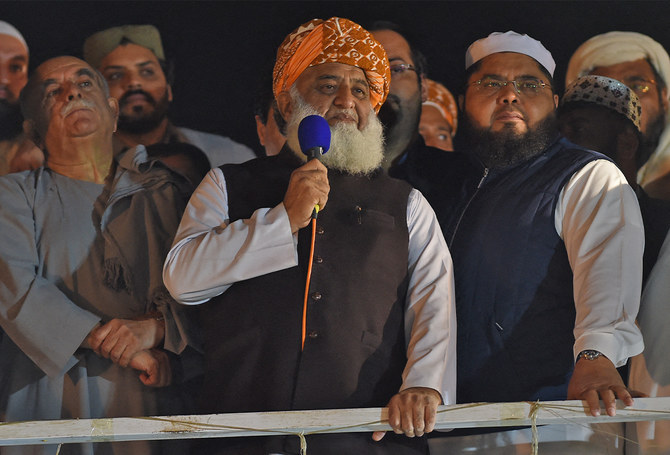
KARACHI: President of Pakistan Democratic Movement (PDM) Maulana Fazlur Rehman said on Tuesday the government had lost support of its coalition partners, though they could take a couple of days to announce they were not voting for Prime Minister Imran Khan during the no-confidence session.
The PDM politician issued the statement during a joint news conference with Muttahida Qaumi Movement-Pakistan (MQM-P) leaders after holding a meeting with them in Karachi.
The opposition alliance submitted a no-trust motion against the prime minister in the National Assembly Secretariate on March 8, accusing his administration of mismanaging the country’s economy and foreign policy.
The Pakistani prime minister has also faced defections in his party and criticism from his allies, making the opposition claim that he has lost his majority in the lower house of parliament.
“The allies of the government are no longer with it, though they may take some time to announce their support for us,” the PDM president said during the joint news conference, adding: “I am leaving with full confidence.”
Asked about the chances of success of the no-confidence motion, Rehman said he was certain of it.
Speaking to media, a top MQM-P leader, Dr. Khalid Maqbool Siddiqui, said he had an understanding with the PDM chief to continue such conversations with the opposition, though he added that his political faction was different from others in several respects.
“We have no political space,” he maintained. “We are only the political party with more than 100 workers missing.”
Siddiqui said the MQM-P also wanted a strong local government system.
The PDM president maintained the opposition Pakistan Peoples Party (PPP), which rules the Sindh province, was willing to accommodate MQM-P suggestions regarding the local government law.
Asked by Arab News if Rehman was right that MQM-P and other coalition partners of Prime Minister Imran Khan had decided to leave the government, Siddiqui said his party was not in a haste.
“We have yet to finalize our decision,” he said. “We are unhappy with the government and have a very bad experience with the opposition. We are not in a hurry and have more options than others.”
Siddiqui also informed that his party would not participate in PDM’s Islamabad march, adding the MQM-P was not part of the opposition and was still a component of the government.


![]()

Pakistani opposition alliance says government’s coalition partners no longer supporting PM Khan
Short Url
https://arab.news/mdfxz
Pakistani opposition alliance says government’s coalition partners no longer supporting PM Khan
- The top PDM leader visits the MQM-P headquarters in Karachi ahead of the no-confidence vote against the prime minister
- An MQM-P leader tells Arab News his party may be unhappy with the government but it also has bad experience with the opposition
Latest updates


© 2026 SAUDI RESEARCH & PUBLISHING COMPANY, All Rights Reserved And subject to Terms of Use Agreement.