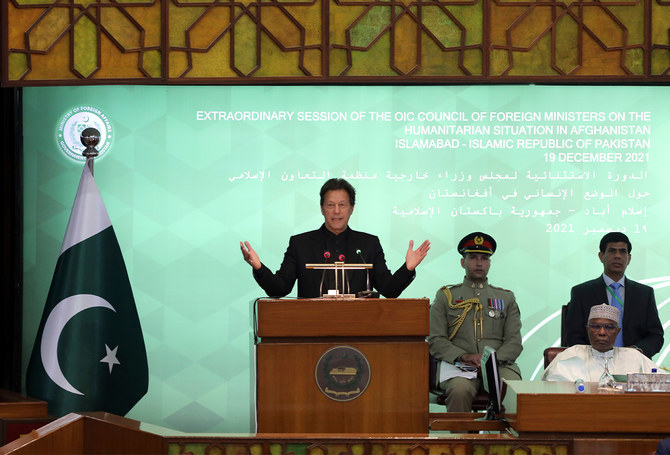
ISLAMABAD: Prime Minister Imran Khan has said that the two-day meeting of the Council of Foreign Ministers (CFM) of the Organization of Islamic Cooperation (OIC) in Pakistan is taking place at a critical moment in world history, asking Muslim countries to prepare themselves for emerging global realities.
Pakistan will host the 48th session of the OIC CFM conference in Islamabad starting March 22.
The meeting is annually held to take important decisions and adopt new policies by OIC member states.
“Structures of the global security and economic order established in 1945 have been eroded by the repeated unilateral use of force, a new ‘cold war’ and growing inequalities among and within nations, exacerbated by the COVID-19 pandemic, the impact of climate change and the technology revolution,” the prime minister wrote in an article exclusively published by Arab News. “Islamic countries must carefully navigate these ‘new realities’ and actively shape the emerging world order to realize their individual and collective interests.”
However, Khan maintained the Muslim world should focus on internal disputes instead of getting involved in great power rivalries. He also emphasized that Islamic countries should do their best to prevent foreign interference and intervention.
Given the volatile situation of the world, the prime minister asked the OIC member countries to think in terms of developing their own security architecture.
“The OIC should seriously consider establishing its own peace and security architecture to promote conflict resolution through dialogue and negotiations whenever disputes arise among Muslim countries or between them and non-Muslim countries or entities,” he maintained.
Khan added the OIC must continue to support the just causes of Palestine and Kashmir for self-determination and liberation from foreign occupation.
“Although these goals are daunting,” he continued, “I am convinced that the arc of history bends toward justice.”
He also emphasized the significance of resolving conflicts in Syria, Libya and Yemen while pointing out it was the first time in 40 years that Afghanistan had got a “real opportunity” to restore peace and security.
He noted that the Muslim world should join other developing countries in mobilizing resources for recovery from the coronavirus pandemic and demanded fair and equal treatment in the international finance, trade and taxation architecture.
Referring to one of the major causes championed by his administration, Khan said: “We must boldly arrest and reverse the outflow of billions of dollars each year from our countries to ‘safe havens’ through corruption, fraud, tax evasion and tax avoidance.”
He also urged OIC nations to prepare themselves for a knowledge-driven, integrated and digital global economy of the future.
“Finally, we must promote global respect for our faith, Islam, and offer protection to every Muslim everywhere. We must object vigorously to the defamation or denigration of Islam, our Holy Book or our Holy Prophet, peace be upon him,” he maintained.

PM Khan urges OIC nations to brace for ‘new realities’ amid shifting world order
https://arab.news/rzte8
PM Khan urges OIC nations to brace for ‘new realities’ amid shifting world order
- In an exclusive article for Arab News, Khan says the OIC must consider developing its own peace and security architecture
- The prime minister says Islamic countries should resolve internal disputes instead of getting involved in great power rivalries
Pakistan accuses India of manipulating Indus waters, warns of risks to regional peace
- India announced in April it was putting the Indus Waters Treaty in abeyance over a gun attack in disputed Kashmir it blamed on Pakistan
- Islamabad says it has witnessed ‘unusual, abrupt variations’ in the flow of Chenab river, accusing New Delhi of ‘material breaches’ of treaty
ISLAMABAD: Pakistan on Friday accused India of manipulating flows of Indus waters in violation of a 1960 water-sharing treaty, warning that unilateral actions over the transboundary waters could heighten tensions and pose risks to regional peace.
The Indus Waters Treaty (IWT), mediated by the World Bank, divides control of the Indus basin rivers between the two nuclear-armed neighbors. India said in April it was holding the treaty “in abeyance” after a gun attack in Indian-administered Kashmir killed more than 26 tourists. New Delhi blamed the assault on Pakistan, Islamabad denied it.
The treaty grants Pakistan rights to the Indus basin’s western rivers — Indus, Jhelum, and Chenab — for irrigation, drinking, and non-consumptive uses like hydropower, while India controls the eastern rivers — Ravi, Beas, and Sutlej — for unrestricted use but must not significantly alter their flow. India can use the western rivers for limited purposes such as power generation and irrigation, without storing or diverting large volumes, according to the agreement.
Speaking to foreign envoys in Islamabad, Pakistani Deputy Prime Minister Ishaq Dar accused New Delhi of “material breaches” of the IWT that may have consequences for regional stability, citing “unusual, abrupt variations” in the flow of Chenab river from April 30 to May 21 and from Dec. 7 to Dec. 15.
“These variations in water flows are of extreme concern for Pakistan as they point to unilateral release of water by India into River Chenab. India has released this water without any prior notification or any data- or information-sharing with Pakistan as required under the treaty,” he said.
“India’s most recent action clearly exemplifies the weaponization of water to which Pakistan has been consistently drawing attention of the international community.”
There was no immediate response from New Delhi to the statement.
Dar said this water “manipulation” occurs at a critical time in Pakistan’s agricultural cycle and directly threatens the lives and livelihoods as well as food and economic security of its citizens.
He shared that Indian actions prompted Indus Water Commissioner Mehar Ali Shah to write a letter to his Indian counterpart, seeking clarification on the matter as provided under the Indus Waters Treaty.
“We expect India to respond to the queries raised by Pakistan’s Indus water commissioner, refrain from any unilateral manipulation of river flows, and fulfill all its obligations in letter and spirit under the Indus Waters Treaty provisions,” the Pakistani deputy premier said.
Dar also accused India of consistently trying to undermine the IWT by building various dams, including Kishenganga and Ratle hydropower projects, which he said sets “a very dangerous precedent.”
“Alarmingly, India is now subverting the treaty’s own dispute resolution mechanism by refusing to participate in the Court of Arbitration and neutral expert proceedings. India is pursuing a deliberate strategy to sabotage the well-established arbitration process under the treaty provisions,” he said.
The South Asian neighbors have been arguing over hydroelectric projects on the shared Indus river system for decades, with Pakistan complaining that India’s planned hydropower dams will cut its flows.
In August, the International Court of Arbitration rendered an award on issues of general interpretation of the IWT, explaining the designed criteria for the new run-of-river hydropower projects to be constructed by India on the western rivers of Chenab, Jhelum and Indus, which Islamabad said vindicated its stance.
In its findings, the Court of Arbitration declared that India shall “let flow” the waters of the western rivers for Pakistan’s unrestricted use. In that connection, the specified exceptions for generation of hydro-electric plants must conform strictly to the requirements laid down in the Treaty, rather than to what India might consider an “ideal” or “best practices approach,” according to the Pakistani foreign office.
“Pakistan would like to reiterate that Indus Waters Treaty is a binding legal instrument that has made an invaluable contribution to peace and stability of South Asia,” Dar said.
“Its violation, on the one hand, threatens the inviolability of international treaties and on the other, it poses serious risks to regional peace and security, principles of good neighborhood, and norms that govern inter-state relations.”