

Tunisian eco-pioneers battle to save Sahara oasis life

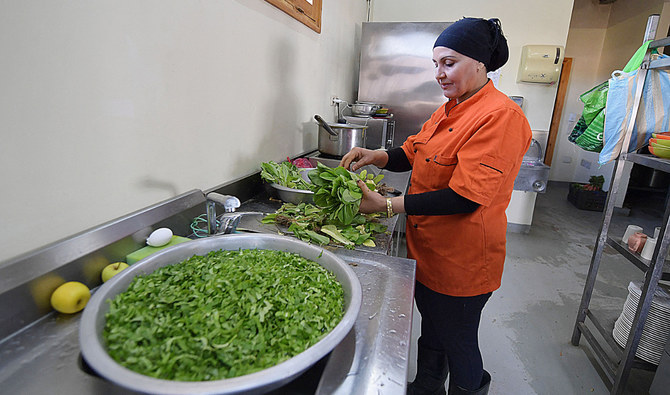
Chef Najah Ameur prepares a salad from vegetables grown in their premises at Dar Hi hotel in the remote Nefta oasis, a seven-hour drive from Tunis. (AFP)
Short Url
Updated 20 March 2022
Follow

Tunisian eco-pioneers battle to save Sahara oasis life

  • A key theme is tackling severe water shortages by experimenting with technology such as drip irrigation

NEFTA, Tunisia: A remote oasis in Tunisia’s desert was exhausted by decades of wasteful water use for agriculture — but now pioneers around an eco-lodge are reviving the spot with innovative projects.

They hope their back-to-basics approach can keep alive the ancient Saharan caravan stop and its traditions as a sustainable alternative to the region’s high-irrigation date plantations.

“Among the palm trees, everything can grow,” said Mohammed Bougaa, 63, a farmer in the remote Nefta oasis, a seven-hour drive from the coastal capital Tunis.

“There’s everything you need here: Vegetables, fruit. We can plant peppers, tomatoes, carrots — everything grows when there’s sun and water.”

The problem has been that the Nefta spring — which once delivered some 700 liters of water per second — has been exhausted to irrigate the region’s famous dates, called “deglet nour.”

“The Nefta springs dried up 20 years ago,” said Bougaa.

As underground water sources have failed and summer temperatures peaked at a scorching 55 degrees Celsius (131 degrees Fahrenheit) last August, the season’s crop has been disappointing.

Patrick Ali El-Ouarghi, who runs an eco-tourism lodge in the oasis, said date palm plantations, at the right scale, can be run sustainably.

He called them an ideal demonstration of permaculture, a system for producing food organically by mimicking natural ecosystems.

“The palm trees protect the fruit trees, and the fruit trees protect the vegetable patches, it’s natural in an oasis,” El Ouarghi said.

The French-Tunisian set up his Dar Hi lodge 11 years ago — including the so-called “Palm Lab” where engineers, architects and artists discuss how to conserve the oasis.

The ecology project aims “to make investors and farmers want to reinvest in the oasis, because it’s decaying a bit,” he said.

A key theme is tackling the severe water shortages by experimenting with technology such as drip irrigation.

The current system of flooding orchards with water, pumped from 100 meters below ground, is wasteful, he said.

Not far from Dar Hi, others are trying different ways of creating value in the oasis.

American Kevin Klay, 35, a former resident of Sousse in northern Tunisia, says he fell in love with dates during a visit to the south.

“We realized that many dates, up to 20 to 30 percent, were thrown out and not used because of a small visual blemish,” he said.

So he bought a few kilos, removed their seeds, dried them and then put them through a coffee grinder.

The result, he said, was a sweetener “with a fifth of the calories of white sugar” that is full of fiber and contains “more potassium than bananas.”

Armed with this knowledge, Klay in 2018 launched “Dateible,” selling his “date sugar” produced from the organic-certified desert fruits for export.

He now employs nine people, seven of them women.

“We’ve seen huge demand, particularly in the US where our main market is,” he said.

The firm is exporting dates in bulk and also starting to sell on online retail site Amazon.

Several firms are producing other date derivatives such as a coffee substitute made of date pips and a form of molasses for use in pastries.

Back at the lodge, the restaurant is reviving traditional desert cuisine.

“It’s very simple and dates from the arrival of nomads,” when Nefta, today regarded as a spiritual home of Sufism, was a key stop on Saharan desert routes, El Ouarghi said.

They brought “unknown flavors and spices that have remained here as a tradition,” he said.

Chef Najah Ameur says residents create their own unique spice mixes.

“It’s not the same as buying them at the market: Cleaning the leaves, the smell, the flavor, you have to know exactly how to do it,” the 40-year-old said.

She cooks a menu of dishes she learned from her mother and from French celebrity chef Frederick Grasser Herme, the recipes collated in a recently published book on oasis cuisine.

“Many ingredients come from the palm groves: parsley, celery, chard, green beans, peas,” she said.

Some recipes are also adapted to use Moringa, an Indian tree famed for its nutritional and medicinal qualities and its ability to thrive in arid conditions.

The tree species may be new to the oasis, but residents are hoping that a mix of old and new can keep both their community and their ecosystem in good health.


Israeli military drops charges against soldiers accused of sexually assaulting Palestinian detainee

Updated 7 sec ago
Follow

Israeli military drops charges against soldiers accused of sexually assaulting Palestinian detainee

  • “Israel’s military advocate general just gave his soldiers license to rape — so long as the victim is Palestinian,” said Bashi
  • Netanyahu welcomed the decision, saying that “the state of Israel must pursue its enemies, not its heroic fighters”

JERUSALEM: Israel’s military on Thursday said it was dropping charges against five soldiers accused of beating and sexually abusing a Palestinian detainee in an alleged assault partially caught on camera.
The decision, which came as much of the country’s attention was focused on the war with Iran, closed a flashpoint case that has bitterly divided Israel since the soldiers were arrested in 2024 at the notorious Sde Teiman military prison, prompting anger from members of the far-right government and hard-line ultranationalists who violently overran the prison in protest.
Prime Minister Benjamin Netanyahu hailed the announcement, while human rights groups accused the military of ignoring one of the gravest instances of abuse in the country’s network of wartime prisons.
“Israel’s military advocate general just gave his soldiers license to rape — so long as the victim is Palestinian,” said Sari Bashi, executive director of the Public Committee Against Torture in Israel, after the case was dismissed. She said the decision was “the latest in a long line of actions that whitewash abuses against detainees whose frequency and severity have worsened since Oct. 7, 2023.”
Netanyahu welcomed the decision, saying that “the state of Israel must pursue its enemies, not its heroic fighters.”
The now-dismissed indictment against the soldiers accused them of an assault that included dragging a Palestinian prisoner along the floor, stepping on him, tasering him, and sexually assaulting him by stabbing him in the rectum. The Palestinian was taken to an Israeli hospital with fractured ribs and a perforated rectum that required surgery before he was returned to the prison.
The allegations of abuse at the facility gained steam when, in August 2024, Israeli news broadcast a leaked video of the alleged assault.
The video showed a group of masked soldiers wresting a detainee from the ground, where he and other Palestinians were lying face down and handcuffed in a fenced-in pen, and taking the detainee to an area of the pen they cordoned off using shields.
In its Thursday decision dismissing the case, the military’s top legal officers said the charges against the soldiers were being dropped because the video did not show abuse violent enough to merit a criminal conviction and had been improperly leaked to the media. The decision added that the Palestinian victim had since been released back to Gaza, creating an “absence of certainty” he would be able to testify in a trial.
In November 2025, after much speculation about how the leaked video got out, Military Advocate General Yifat Tomer-Yerushalmi — the top legal official in the military — admitted that she had approved its release, saying she had wanted to show how serious the abuse was and convince people the military had a duty to investigate.
Facing an uproar from Netanyahu’s government, she abruptly resigned and then disappeared, only to be found phoneless on a Tel Aviv beach after a frantic search by authorities. The phone, believed to hold possible evidence against her, was later recovered in the sea.
The Associated Press investigated allegations of inhumane treatment and abuse at Sde Teiman before the surveillance video.
The prison was set up after Oct. 7, 2023, to hold Palestinians rounded up in Gaza during Israel’s war against the Hamas militant group. The secretive facility quickly gained notoriety as employees and Palestinians freed from detention described scenes of abuse and torture and Israeli rights groups petitioned the country’s top court for it to be shuttered.
Israel has long been accused of failing to hold its soldiers accountable for crimes committed against Palestinians. The allegations have intensified during the war in Gaza. Israel says its forces act within military and international law and says it thoroughly investigates any alleged abuses.