
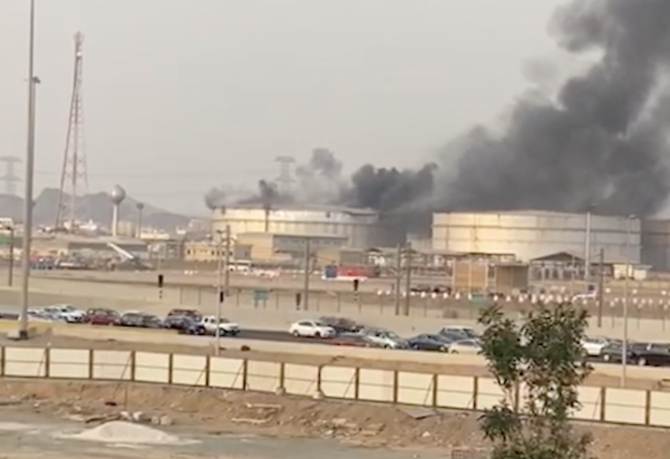
Fire breaks out at Aramco plant in Houthi attack

1 / 5
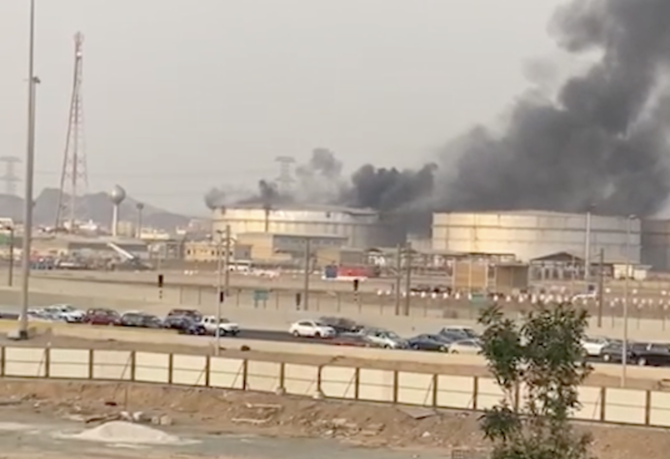
The fire had broken out in a tank at the Aramco distribution station and no casualties or injuries were reported, the coalition said. (Screenshot)
2 / 5
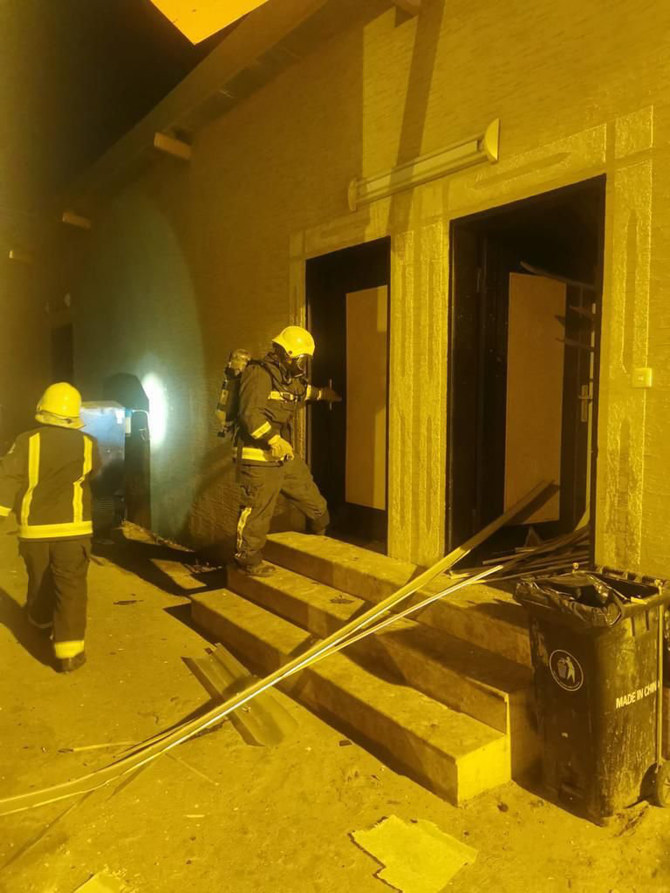
Saudi firefighters inspect the damage caused by the debris of a missile intercepted in Jazan on Saturday night. (SPA)
3 / 5
Falling debris from an intercepted missile damaged some vehicles at a parking lot in Jazan on Saturday. (SPA)
4 / 5
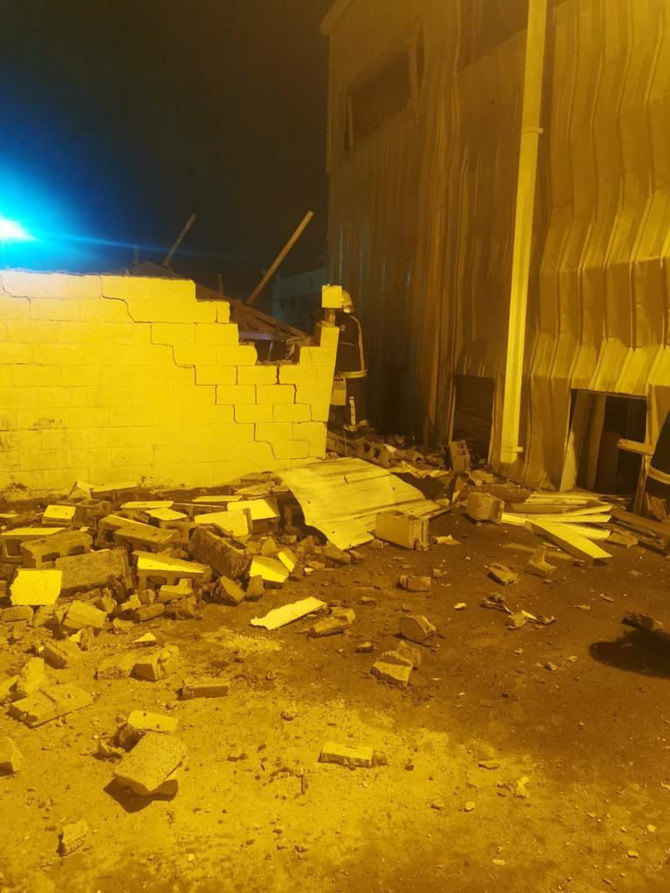
Falling debris from an intercepted missile damaged a residential area in Jazan on Saturday. (SPA)
5 / 5
Saudi firefighters inspect the damage caused by the debris of a missile intercepted in Jazan on Saturday night. (SPA)
Short Url
Updated 21 March 2022
Follow

Fire breaks out at Aramco plant in Houthi attack

  • Fire had broken out in a tank at the distribution station and no casualties or injuries were reported
  • The UAE, Kuwait, Qatar, US, the OIC, the Arab League, the GCC, Jordan and Pakistan condemned the attacks

RIYADH: A fire broke out at an Aramco distribution center in Jeddah after it was targeted by a Houthi attack, the Coalition to Restore Legitimacy in Yemen said on Sunday.

The small fire, which was brought under control, after one of the tanks at the distribution station was hit - no casualties were reported, the coalition said.

The ongoing Houthi attacks confirm the militia’s rejection of efforts to achieve peace and end the suffering of the Yemeni people, the coalition said.

The attack in Jeddah comes hours after a barrage of missile and drone attacks on various targets in the Kingdom on Saturday and Sunday that were all thwarted.

A water desalination plant in Al-Shaqeeq, a facility run by oil company Aramco in Jazan, a power station in Dhahran Al-Janub, a gas station in the city of Khamis Mushayt, and a Liquefied Natural Gas (LNG) facility at an Aramco station in Yanbu were all targeted by the Houthi militia.

A ballistic missile targeting Jazan, four drones targeting the southern region, a drone targeting Khamis Mushayt, three drones targeting civilian facilities, and an aeriel target aimed at Jeddah have also been intercepted since Saturday evening. 

The Houthi attacks come ahead of GCC sponsored peace talks between Yemeni factions that the militia said they would not attend. The talks are due to take place from March 29 in Riyadh. 

The UAE, Kuwait, Qatar, the Organization of Islamic Cooperation, the Arab League, the Gulf Cooperation Council, Jordan and Pakistan condemned the latest Houthi attacks on the Kingdom.

Egypt also condemned the attacks and expressed support for steps taken by the Kingdom to protect its safety. 

Video footage and images posted on Twitter by the Saudi Press Agency showed damage to a building and cars at a facility in Khamis Mushayt.

The coalition said the latest Houthi escalation was a response to the GCC hosting peace talks in Riyadh. It added that the coalition supports Gulf efforts aimed at making the talks a success while the Houthis are trying to make them fail. 

US National security adviser Jake Sullivan said on Sunday that the United States condemns the Houthi attacks on civilian infrastructure in Saudi Arabia and called on the Houthis to cooperate with the UN and deescalate the conflict.

The Iran-backed Houthi militia often target airports and oil facilities in Saudi Arabia, and has also attacked facilities in the United Arab Emirates.


Saudi authority sets new standards for beach operators on the Red Sea

Updated 19 January 2026
Follow

Saudi authority sets new standards for beach operators on the Red Sea

JEDDAH: The Saudi Red Sea Authority has announced a new regulatory framework for beach operations, redefining beaches as managed operating sites rather than informal recreational spaces, the Saudi Press Agency reported.

The framework introduces standardized requirements for beach operators, focusing on licensing, safety, risk management and service quality across coastal tourism activities.

Under the regulations, beach operations will be permitted only through licensed entities, with license issued for two-year periods. 

Renewal applications must be submitted at least 30 days before expiration. The authority said the system is intended to bring consistency to beach management and provide operators with clearer operational timelines.

The framework applies along more than 1,800 km of Red Sea coastline and establishes a unified national approach to regulating beach activities. The authority said no beach operation will be allowed without an official license. 

The initiative supports the authority’s broader objectives to develop a coastal tourism sector that contributes SR85 billion ($22.66 billion) to GDP by 2030, creates approximately 210,000 jobs, and attracts 19 million visitors, the SPA noted. 

To ensure a smooth transition, the regulations will come into effect one month after their announcement, while existing operators will be granted a one-year grace period to comply. 

Safety forms a central pillar of the new framework. Licensing conditions include environmental permits, insurance coverage, approved safety plans, defined activity zones, and assessments of beach capacity.

Operators will also be required to provide licensed lifeguards, safety equipment, and systems for incident reporting and analysis.

The requirements extend to infrastructure and operation standards, including compliance with the Saudi Building Code to ensure accessibility for people with disabilities and structural safety.

Operators are also encouraged to align with international benchmarks such as Blue Flag standards and the ISO 13009:2024 for beach management, the SPA added.

The authority said this framework is designed to reduce operational risks, improve oversight and support the sustainable development of coastal tourism.

Unified requirements reduce operational risks, minimize inconsistencies, and improve the sector’s ability to attract financing and scale sustainably.