

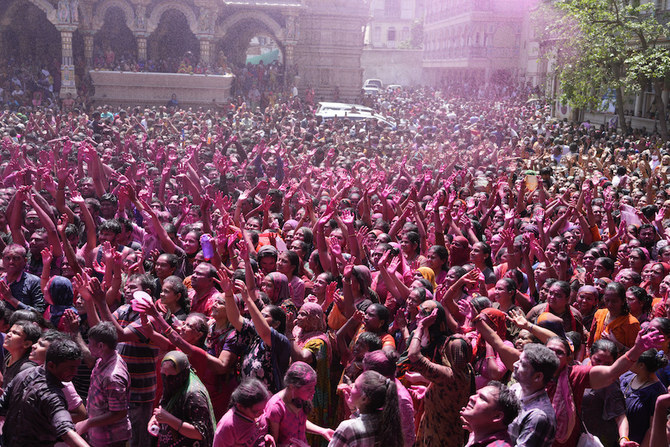
India celebrates Holi in full color as coronavirus cases dip

Devotees cheer as colored powder and water are sprayed on them during celebrations marking Holi at the Kalupur Swaminarayan temple in Ahmedabad, India, on Friday. (AP)
Short Url
Updated 19 March 2022
Follow

India celebrates Holi in full color as coronavirus cases dip

  • Known as the festival of colors, a major part of the celebration involves showering others with pigment
  • Celebrations were muted for two years due to restrictions on gatherings as COVID-19 cases soared

MOKAMA, BIHAR: Celebrations of Holi, the Hindu festival of colors, were in full swing on Friday, with people joyously splashing each other with powdered dye as the pandemic showed signs of receding across the country.

Marking the end of winter and symbolizing the triumph of good over evil, Holi is observed on the last full moon in the lunar month of Phalguna with bonfires, sweets and dancing to traditional music.

Celebrations were muted for the past two years due to restrictions on gatherings as COVID-19 cases soared, but infections have come down sharply in recent weeks from more than 300,000 a day in January to less than 3,000. 

“People are more free and at ease because the restrictions have been lifted,” Rajiv Mehta, president of a housing society in Noida, told Arab News.

This year, Mehta is hosting a Holi feast for all the housing society’s 2,000 residents.

“We are not as restrained as before and there is less fear of coronavirus this time,” he said. “This is an important festival for all of us and the day allows us to let loose, eat and play with colors without any restraint.”

Holi derives its name from Holika, the demon sister of evil King Hiranyakashipu in Indian mythology, who tried to forbid his son from worshiping the Hindu deity Vishnu and wanted to kill him with her help.

Hiranyakashipu ordered the two of them to sit on a burning pyre, lying to the son that his aunt, who was immune to fire, would protect him. But when the flames struck, it was Holika who burnt to death and demon king’s son survived with the help of Vishnu.

The night before Holi, Hindus burn pyres to symbolize the death of Holika and triumph of good over evil. As the next day arrives, they pelt each other with powdered pigments in an explosion of joy and equality, as color hides all class lines.

Dr. Vivek Vishvas, lecturer at Maharaja Agrasen College of the University of Delhi, said Holi, as a social festival, is “different from other festivals celebrated in India.”

“People, be it rich or poor, Hindu or Muslim, all come together to celebrate the festival. This festival is not complete without the involvement of the larger society.”

For Jai Prakash Yadav, a schoolteacher in Mokama in the eastern Indian state of Bihar, Holi is a “therapeutic.”

“It allows you to take liberties and engage in playful banter with others,” he said. “This year the virus is not creating havoc, and this has given greater freedom to play and celebrate this lovely festival.”

One doctor’s advice was to enjoy this freedom as long as you don’t not have coronavirus symptoms.

“Compared to the past two years, COVID-19 is less visible, and this has given the opportunity to people to indulge in Holi festivities this year,” Dr. Avinash Bhondwe, former president of the western chapter of the Indian Medical Association, told Arab News.

“If people want to play Holi, they should play. If they get a cold, they should get tested immediately to contain the spread of the virus.”


Australia Day protesters demand Indigenous rights

Updated 7 sec ago
Follow

Australia Day protesters demand Indigenous rights

SYDNEY: Thousands of people rallied in cities across Australia demanding justice and rights for Indigenous peoples on Monday, a national holiday marking the 1788 arrival of a British fleet in Sydney Harbor.
Crowds took to the streets in Sydney, Melbourne, Canberra, Perth and other cities on Australia Day, many with banners proclaiming: “Always was, always will be Aboriginal land.”
In Sydney, police allowed the protests to go ahead despite new curbs introduced after gunmen opened fire on a Jewish Hanukkah festival on Bondi Beach on December 14, killing 15 people.
Millions of Australians celebrate the annual holiday with beers and backyard barbecues or a day by the sea, and this year a broad heatwave was forecast to push the temperature in South Australian capital Adelaide to 45C.
Shark sightings forced people out of the water at several beaches in and around Sydney, however, after a string of shark attacks in the region this month — including one that led to the death of a 12-year-old boy.
Many activists describe the January 26, 1788, British landing as “Invasion Day,” a moment that ushered in a period of oppression, lost lands, massacres and Indigenous children being removed from their families.
Aboriginal and Torres Strait Islander peoples make up about four percent of the population.
They still have a life expectancy eight years shorter than other Australians, higher rates of incarceration and deaths in custody, steeper youth unemployment and poorer education.

- Anti-immigration protests -

“Let’s celebrate on another day, because everyone loves this country and everyone wants to celebrate. But we don’t celebrate on a mourning day,” Indigenous man Kody Bardy, 44, told AFP in Sydney.
Another Indigenous protester in Sydney, 23-year-old Reeyah Dinah Lotoanie, called for people to recognize that a genocide happened in Australia.
“Ships still came to Sydney and decided to kill so many of our people,” she said.
Separately, thousands of people joined anti-immigration “March for Australia” protests in several cities, with police in Melbourne mobilizing to keep the two demonstrations apart.
In Sydney, “March for Australia” protesters chanted, “Send them back.” Some carried banners reading: “Stop importing terrorists” or “One flag, one country, one people.”
“There’s nowhere for people to live now, the hospitals are full, the roads are full, you’ve got people living on the streets,” said one demonstrator, 66-year-old Rick Conners.
Several also held aloft placards calling for the release of high-profile neo-Nazi Joel Davis, who is in custody after being arrested in November on allegations of threatening a federal lawmaker.
“There will be no tolerance for violence or hate speech on Sydney streets,” New South Wales Premier Chris Minns told reporters.
“We live in a beautiful, multicultural community with people from around the world, but we will not tolerate a situation where on Australia’s national day, it’s being pulled down by divisive language, hate speech or racism,” he said.
“Police are ready and willing to engage with people that breach those rules.”