

Yemen war turns nature reserve back into waste dump

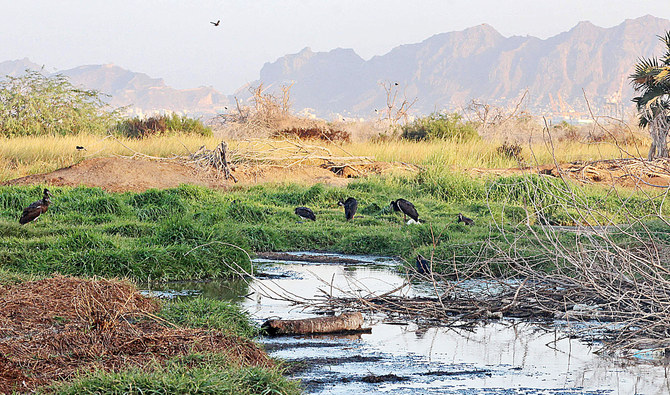
Yemen’s Al-Heswa nature reserve was once hailed as a beacon of conservation efforts by the UN but now it is swarmed by crows. (AFP)
Short Url
Updated 18 March 2022
Follow

Yemen war turns nature reserve back into waste dump

ADEN: Yemen’s Al-Heswa nature reserve was once hailed as a beacon of conservation efforts by the United Nations, but civil war has turned it into a rubbish-strewn wasteland reeking of sewage.

The ticket office has been abandoned at the entrance to the 19-hectare  site in Yemen’s southern city of Aden, where trees have been cut down and construction waste dumped.

What was long a haven for flamingos and other migratory birds is now swarmed by crows.

“Al-Heswa used to be a recreational outlet for residents and tourists,” said Aden resident Ibrahim Suhail. “It has now become a rubbish dump, full of insects and sewage.”

Declared a nature reserve in 2006, Al-Heswa was one of 35 initiatives awarded the UN’s Equator Prize in 2014 for meeting climate and development challenges through sustainable use of nature.

Wastewater that had previously flown into the sea was treated and redirected to create an artificial wetland on the site of a former garbage dump, attracting the migratory birds.

The initiative was the first of its kind in Yemen, improving livelihoods, creating jobs and generating about $96,000 in revenue in 2012.

“The communities behind Al-Heswa Wetland Protected Area have successfully transformed a garbage dump into a functioning wetland ecosystem that provides a breeding site to more than 100 migratory bird species,” the UN Development Programme said at the time. But since 2014, Yemen, already the region’s poorest country, has been embroiled in a conflict between the government, supported by the Coalition to Restore Legitimacy in Yemen, and the Iran-backed Houthi rebels.

The reserve has been left in ruins by the fighting.

The director of Yemen’s department of nature reserves, Salem Bseis, said the wastewater treatment tanks had not been serviced since 2015.

Some nearby residents have seized parts for their personal use.

“This led to a disruption in the maintenance and treatment of sewage,” Bseis said. While visitors have mostly stayed away, some parts of the reserve have been used as an “informal waste dump,” according to the UK-based Conflict and Environment Observatory.

The UN considers war-torn Yemen the world’s worst humanitarian disaster, and estimates hundreds of thousands of people have been killed, directly or indirectly, by the war.

Millions have been forced from their homes by fighting, pushing the country to the brink of famine.

“Insecurity from violence, war and conflict poses the most significant threat to the long-term sustainability of this initiative,” the UNDP Development Programme said.

“Since the intensification of the conflict in Yemen, visitor levels have dropped to zero.”

But the UN believes that all does not have to be lost.

“When peace is restored, the community is committed to working with government officials to enhance the economic and environmental services provided by the protected areas,” it added.


How succession works in Iran and who will be the country’s next supreme leader?

Updated 58 min 38 sec ago
Follow

How succession works in Iran and who will be the country’s next supreme leader?

  • An 88-member panel called the Assembly of Experts “must, as soon as possible” pick a new supreme leader under Iranian law

DUBAI: The death of Iran’s Supreme Leader Ayatollah Ali Khamenei after almost 37 years in power raises paramount questions about the country’s future. The contours of a complex succession process began to take shape the morning after Khamenei’s assassination.
Here is what to know:
A temporary leadership council assumes duties
As outlined in its constitution, Iran on Sunday formed a council to assume leadership duties and govern the country.
The council is made up of Iran’s sitting president, the head of the country’s judiciary and a member of the Guardian Council chosen by Iran’s Expediency Council, which advises the supreme leader and settles disputes with parliament.
Iran’s reformist President Masoud Pezeshkian and hard-line judiciary chief Gholamhossein Mohseni Ejei are its members who will step in and “temporarily assume all the duties of leadership.”
A panel of clerics selects a new supreme leader
Though the leadership council will govern in the interim, an 88-member panel called the Assembly of Experts “must, as soon as possible” pick a new supreme leader under Iranian law.
The panel consists entirely of Shiite clerics who are popularly elected every eight years and whose candidacies are approved by the Guardian Council, Iran’s constitutional watchdog. That body is known for disqualifying candidates in various elections in Iran and the Assembly of Experts is no different. The Guardian Council barred former Iranian President Hassan Rouhani, a relative moderate whose administration struck the 2015 nuclear deal with world powers, from election for the Assembly of Experts in March 2024.
Khamenei’s son could be a possible contender
Clerical deliberations about succession and machinations over it take place far from the public eye, making it hard to gauge who may be a top contender.
Previously, it was thought Khamenei’s protégé, hard-line President Ebrahim Raisi, may try to take the mantle. However, he was killed in a May 2024 helicopter crash. That has left one of Khamenei’s sons, Mojtaba, a 56-year-old Shiite cleric, as a potential candidate, though he has never held government office. But a father-to-son transfer in the case of a supreme leader could spark anger, not only among Iranians already critical of clerical rule, but also among supporters of the system. Some may see it as un-Islamic and in line with creating a new, religious dynasty after the 1979 collapse of the US-backed Shah Mohammad Reza Pahlavi’s government.
A transition like this has happened only once before
There has been only one other transfer of power in the office of supreme leader of Iran, the paramount decision-maker since the country’s 1979 Islamic Revolution.
In 1989, Grand Ayatollah Ruhollah Khomeini died at age 86 after being the figurehead of the revolution and leading Iran through its bloody eight-year war with Iraq. This transition now comes after Israel launched a 12-day war against Iran in June 2025 as well.
The vast powers of a supreme leader
The supreme leader is at the heart of Iran’s complex power-sharing Shiite theocracy and has final say over all matters of state.
He also serves as the commander-in-chief of the country’s military and the powerful Revolutionary Guard, a paramilitary force that the United States designated a terrorist organization in 2019 and which Khamenei empowered during his rule. The Guard, which has led the self-described “Axis of Resistance,” a series of militant groups and allies across the Middle East meant to counter the US and Israel, also has extensive wealth and holdings in Iran.