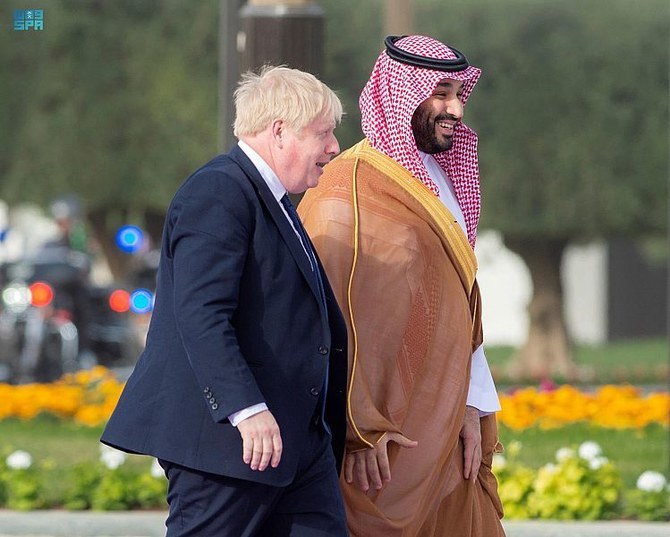

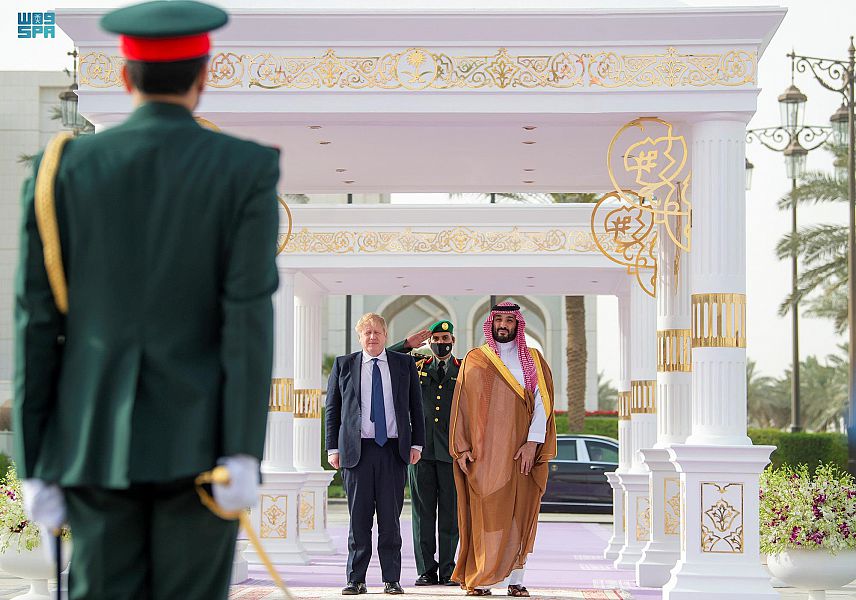
RIYADH: British Prime Minister Boris Johnson met Wednesday with Saudi Crown Prince Mohammed bin Salman to bolster economic and business ties between the two nations.
The Kingdom and other GCC nations are working on a free trade agreement that may see the light faster after this visit.
Both countries signed a memorandum of understanding to establish a strategic partnership council.
The UK still sees Saudi Arabia as a vital trade and business partner, and the volume and value of these relations are the biggest proof.
The British prime minister also urged the Saudi government to boost oil output after the severe economic sanctions against Russia following its invasion of Ukraine.
Energy security
The West fears that maintaining oil output at the current levels could lead to a big rise in the prices of crude and ultimately trigger a global recession.
Saudi Arabia is the largest producer of oil among all OPEC members.
Apart from raising the issue of oil output, Johnson also discussed other important economic projects with Saudi officials.
It is true that Saudi Arabia is still China’s biggest trade partner, but this will not discourage the UK to expand trade with the Kingdom.
There is no doubt Britain hopes to enhance its business presence in Saudi Arabia, especially since the country is currently embarked on several multi-billion-dollar projects across all the areas.
Saudi-UK trade
According to the latest data and statistics, total trade in goods and services between the UK and Saudi Arabia was SR53.57 billion ($14.28 billion) in the four quarters to the end of Q3 2021, an increase of 6.3 percent or SR3.184 billion from the four quarters to the end of Q3 2020.
Total UK exports to the Kingdom in the same reporting period rose by 7.5 percent to reach SR2.93 billion.
Saudi exports to the UK in four quarters to the end of Q3 2021 increased 2.2 percent to reach a total of SR11.79 billion.
The balance of trade between the two countries is still in favor of the UK, which reported a total trade surplus of SR30.44 billion.
Oil represented more than half of the imports from Saudi Arabia, including crude and refined products.

Johnson's visit to SABIC
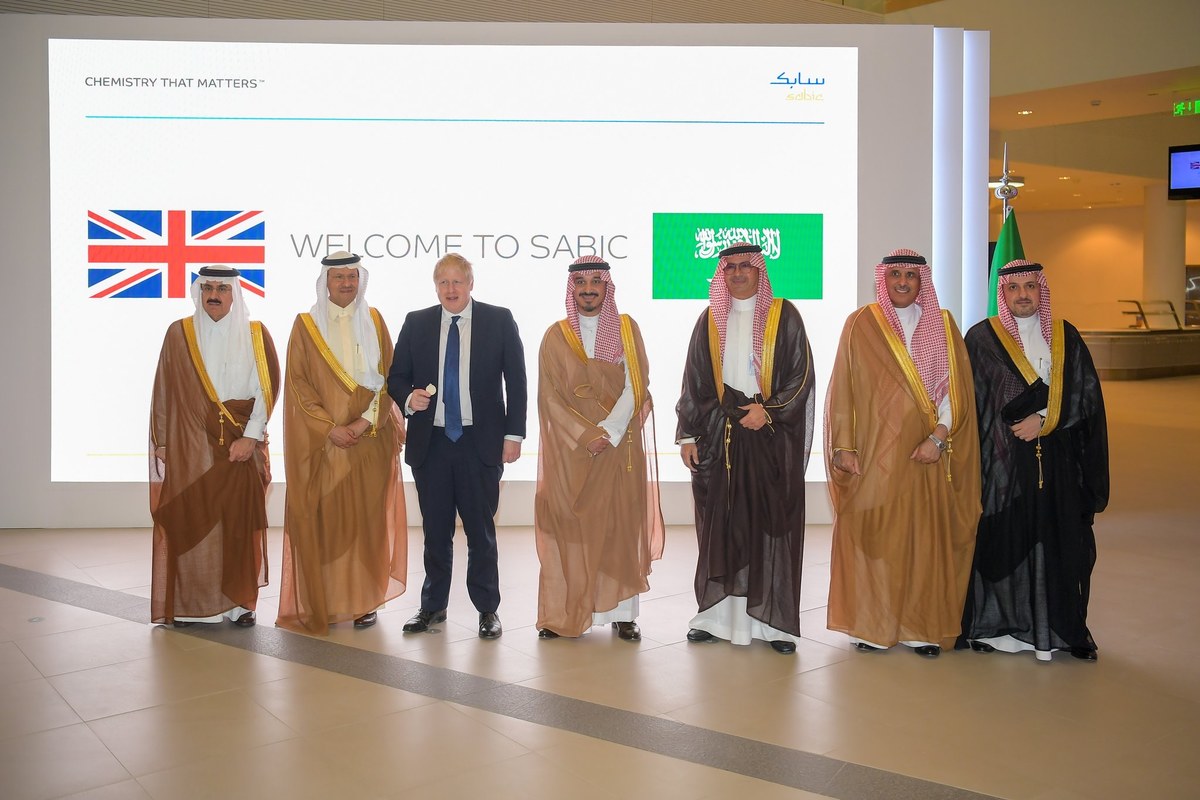
Johnson visited the SABIC Plastics Application Development Center in Riyadh on March 16, as part of his official visit to Saudi Arabia, and toured the facilities.
He was accompanied by Prince Abdulaziz bin Salman, Saudi Arabia's Energy Minister, Prince Khalid bin Bandar bin Sultan, Saudi Ambassador to the UK, Musaed Al-Aiban, Minister of State and Member of the Council of Ministers, and a number of dignitaries and officials, the company said in a statement.
The PM’s delegation included Lord Grimstone, UK Minister for Investment, and Neil Crompton, British Ambassador to Saudi Arabia.
SABIC has a strong presence in the UK, with the SABIC UK Petrochemicals Ltd. headquarters at the Wilton Center, Teesside.
The Saudi chemicals maker has manufacturing and storage facilities located over three nearby sites, at Wilton International, Teesport and North Tees.
In addition, SABIC Thornaby is the only plant worldwide that produces the Verton long glass fiber compounded products, SABIC said.
This technology is mainly supporting automotive heavy truck industry.