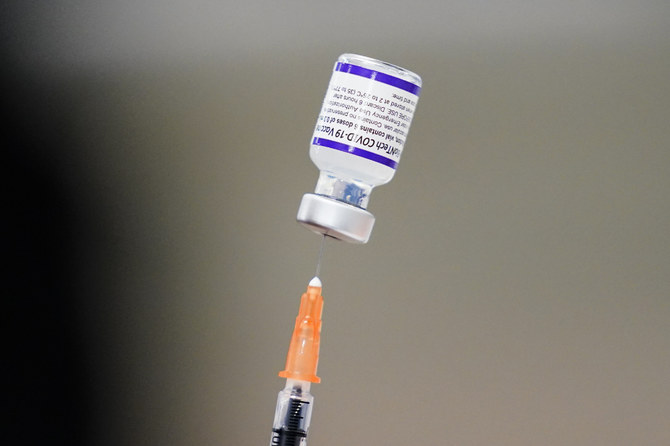
WASHINGTON: Pfizer and its partner BioNTech asked US regulators Tuesday to authorize an additional booster dose of their COVID-19 vaccine for seniors, saying data from Israel suggests older adults would benefit.
Currently the US urges two primary shots followed months later by a booster dose for everyone age 12 and older. The new application seeks to add a fourth shot only for the over-65 population that has been hit hardest by the pandemic.
The Food and Drug Administration and the Centers for Disease Control would have to approve the request. If so, a key question would be how soon seniors would be advised to roll up their sleeves.
While authorities say the vaccinations continue to offer strong protection against severe illness, they haven’t held up as well against milder infections especially those due to the omicron mutant. With COVID-19 cases finally plummeting after the intense omicron surge, public health experts are starting to look ahead to what next steps might be needed — if a new variant crops up or, barring that, whether to try shoring up coronavirus protection in the fall at the same time people get flu vaccinations.
Speaking to CBS’ “Face the Nation” on Sunday, Pfizer CEO Albert Bourla signaled the company’s plans.
“The protection that you are getting from the third, it is good enough, actually quite good for hospitalizations and deaths. It’s not that good against infections,” he said. “But we are just submitting those data to the FDA and then we will see what the experts also will say outside Pfizer.”
The US booster campaign was based on evidence that the shots’ effectiveness, particularly against milder infections, was waning about six months after the last dose. Calls for a third shot grew once it became clear the vaccines weren’t as strong against the omicron mutant as they were against earlier versions of the virus.
Many scientists say the ultimate goal of vaccination is to prevent severe illness, not mild infections, and early CDC data show the shots still are doing a good job at that. During the omicron wave, effectiveness against hospitalization was 91 percent in people who had gotten their booster two months earlier, and 78 percent by the fourth month after that booster.
Pfizer based its new application on data from Israel, which already was offering a second booster to people age 60 and older and health care workers.
While some early data left unclear just how much benefit another shot offered — or for how long — Pfizer said Tuesday that an analysis of health records of more than 1.1 million Israeli seniors showed confirmed infections were two times lower and rates of severe illness were four times lower among those who got two boosters instead of just one.
Pfizer also cited an ongoing study of health care workers that tracked a jump in virus-fighting antibodies after getting the additional booster.
In the US so far, a fourth dose is recommended only for people with severely weakened immune systems, who need three doses to begin with for the best chance at any protection.

Pfizer asks US to allow 4th COVID vaccine dose for seniors
https://arab.news/bmzry
Pfizer asks US to allow 4th COVID vaccine dose for seniors
- The new application seeks to add a fourth shot only for the over-65 population that has been hit hardest by the pandemic
UK cyclists to ride 550km in Saudi Arabia to save children with heart defects
- The H&K Cycle Club was the first team to take the Hejaz route, and their endeavour has since 2022 inspired hundreds of other cyclists to follow suit
- The cyclists expect to face scorching heat, brutal headwinds, sandstorms, and long no-U-turn stretches of roads, along with physical and mental exhaustion
LONDON: A cycling team from London set out on Sunday on a 550km journey from Makkah to Madinah in Saudi Arabia to raise funds for children in developing countries with congenital heart defects.
This is the fifth year that Shamsul Abdin, the head of the H&K Cycle Club, and 40 riders aged between 18 and 65, are taking on the challenge through the Hejaz region.
Abdin told Arab News that the “Hijrah Ride” was a replication of the journey made by Prophet Muhammad over 1,400 years ago, when he migrated from Makkah to Madinah, where he established the first city-state of Islam. This migration, known as Hijrah, also marked the beginning of the Islamic Hijri calendar.
The H&K Cycle Club has expanded from just six riders 14 years ago to more than 40 members from various cities across the UK, including London, Manchester, Oxford, and Birmingham. In November, they began their training in the freezing temperatures of the UK, aiming to cycle over 100 kilometers each day within 6 to 7 hours for a 4-day ride in Saudi Arabia. On Wednesday, they are expected to arrive in Madinah.
They have cycled throughout the UK and parts of Europe, riding from London to Istanbul to raise funds for various causes through Muntada Aid, a charity that works on projects in developing countries and organizes the “Hijrah Ride”.
They were also the first cycling team to take the Hejaz route, and their endeavour has since inspired hundreds of other cyclists to follow suit. Abdin has seen Saudi Arabia become more bike-friendly over the past five years, with cycling lanes integrated into city development, while drivers, locals, and authorities are now more aware of cyclists on the roads.
The cyclists expect to face scorching heat, brutal headwinds, sandstorms, and long no-U-turn stretches of roads, along with physical and mental exhaustion. For many riders, this will be their fifth ride in Hejaz. Some of them include Uber and bus drivers, business analysts, and even entrepreneurs, according to Abdin.
“The headwind feels like climbing a mountain; it’s a constant resistance. To overcome this challenge, we ride in a peloton, taking turns at the front. One person heads into the wind while the others line up behind, shielded from the gusts. After a while, we rotate, allowing everyone a chance to lead,” Abdin explained.
Almost £923,000 has been raised by the “Hijrah Ride” since its inception, to reach a target of one million pounds this year. Some of the money went into emergency aid programs in Gaza and Sudan. Muntada Aid aims to raise about £250,000 for its flagship project, “Little Hearts,” which will fund 150 surgeries for children with congenital heart defects in Pakistan and Bangladesh this year.
“I fell in love with this project, which gives children the opportunity to live up to their potential as adults, truly,” said Abdin, who was awarded the MBE (Member of the Order of the British Empire) in December for his contribution to charitable fundraising.
The riders will be escorted by two vehicles, one in front and one in the rear, carrying paramedics and media staff, along with food and water. They will split into two groups based on their cycling powers. Along the route, they will pass several locations, including Jeddah on the Red Sea, King Abdullah Economic City, Rabigh, Masturah, and Badr, before reaching the elevated roads of Madinah, where their journey, which started with performing Umrah in Makkah, will end.
Muntada Aid is a part of Al-Muntada Trust, which was founded in 1986 by a group of Middle Eastern students, including individuals from Qatar and Saudi Arabia, to address the famine crisis in Ethiopia. Since then, the organization has assisted children in 17 countries, including Somalia, Sudan, Chad, Kosovo, Bosnia, Bangladesh, Pakistan, Mali, and Niger. They focus on developing infrastructure in education, health, water and sanitation sectors.
Nasrun Mir, the marketing director of Muntada Aid, told Arab News that they support “Hijrah Ride” with financial backing and logistics, and that they have obtained permits through communication with the Saudi Ministry of Transport, the Ministry of Foreign Affairs, the Saudi embassy in London, and the British Consulate in Jeddah.
Mir, who is joining the journey as part of the media team this week, said that the reception in Saudi Arabia could not be friendlier.
“People offer us free food and drinks. They want to have conversations with us. They want to know what we do. In the Middle East, there is still no concept of using sports as a tool for charity. The general idea is that if I want to give money to the charity, I’ll give it to them. You don’t need to run. You don’t need to cycle,” Mir said.
In one incident, a local community prevented the riders from passing through their village unless they disembarked and sat down to eat with them. In particular sections of the road near Madinah, a Saudi police vehicle has escorted the riders for a few kilometers, he added.
“There have been incidents where people have stopped us from eating our own food during the break. They literally took our food and said, ‘No, you come to our village; you cannot eat your food. You have to have food, which we will prepare.’ This delayed ride for a couple of hours,” Mir said.


