PARIS: The stuttering progress of Russia’s invasion of Ukraine has thrown an unwanted spotlight on the Russian intelligence services, who observers say failed to prepare the Kremlin for the realities of the assault.
Several reports have suggested that a shadowy section of Russia’s powerful Federal Security Agency (FSB) has come under particular scrutiny with its leader interrogated and reportedly even under house arrest.
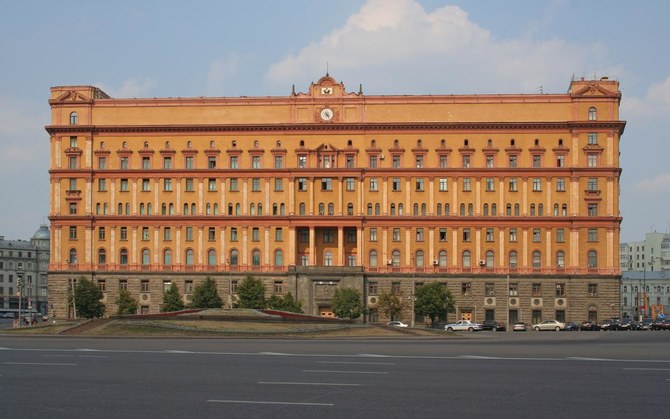
This has led several commentators to question if all is well at the ominous headquarters of the FSB on Lubyanka Square in Moscow, once the home of the KGB in the USSR.
Observers believe Russia had expected to make far more rapid progress in the invasion after it was launched on February 24, with forces that were welcomed rather than face fierce resistance from Ukrainians.
“People did not make clear to (President Vladimir) Putin the reality of the situation,” said a French intelligence source, who asked not to be named.
“The system is hardening up, bunkering down so that Putin does not receive too much bad news,” added the source.
In a report first carried by Latvia-based Russian news site Meduza, Russian intelligence experts Andrei Soldatov and Irina Borogan wrote that the first consequences of the espionage failings were now being felt.
The head of the so called 5th Service of the FSB, Sergei Beseda, and his deputy, Anatoly Bolukh, had both been placed under house arrest in an investigation, the report said.
The 5th Service is a hugely powerful branch of the FSB which oversees its operations outside Russia, notably in ex-Soviet states such as Ukraine.
It is distinct from Russia’s specialist Foreign Intelligence Service (SVR), headed by the longstanding Kremlin insider Sergei Naryshkin.
The head of Russia’s national guard Viktor Zolotov was quoted by Russian news agencies this weekend as saying that the invasion was “not going as fast as we would like” but claimed this was in a bid to avoid civilian casualties.
France-based Russian dissident Vladimir Osechkin, who runs the gulagu-net.ru site which has exposed abuses in Russian jails, also reported the house arrests which he said were officially part of an investigation on the embezzlement of funds earmarked for Ukraine.
“But the real reason was the inadequate intelligence and incomplete and false information on the political situation in Ukraine,” he said.
Osechkin’s site has meanwhile also been publishing a series of letters from a purported whistleblower called “Wind of Change” claiming a climate of fear at the FSB due to its failure to warn of the resistance to the Russian invasion.
“Putin is likely carrying out an internal purge of general officers and intelligence personnel,” the US-based Institute for the Study of War (ISW) said.
“He may be doing so either to save face after failing to consider their assessments in his own pre-invasion decision-making or in retaliation for faulty intelligence he may believe they provided him.”
FSB Dosye, an investigative site that specializes in the work of the FSB, said Monday that the reports of a full scale purge were exaggerated. Beseda had indeed been interrogated by investigators but was still in his job and not under arrest.
Bolukh had also been interrogated but had for some years no longer been the number two of the 5th Service, it said.
Beseda, according to FSB Dosye and other reports, was present in Ukraine in 2104 in a bid to assist then president Viktor Yanukovych face down a pro-Western uprising. The leader eventually fled to Russia.
The senior FSB operative was targeted by EU sanctions in July 2014 after the annexation of Crimea and outbreak of fighting in the east of Ukraine with pro-Moscow separatists.
The sanctions order says Sergei Orestovich Beseda, born in 1954, “heads a service which oversees intelligence operations and international activity.”
Questions also lurk over the the role of the SVR after its chief Naryshkin was subjected to a bizarre humiliation by Putin on television on the eve of the invasion.
Western sources say it appears incontestable that the strength of Ukrainian resistance and the unwillingness of local populations to welcome Russia took Moscow by surprise.
“Before such an operation, you should start by looking at the state of the population, in what situation you are going to operate,” said a high-ranking French official, asking not to be named.
“There was a very poor analysis of the state of the morale of the Ukrainian and Ukraine as a whole,” added the source.


![]()

Russian spies in spotlight over Ukraine shortcomings
Short Url
https://arab.news/8nnme
Russian spies in spotlight over Ukraine shortcomings
- The head of the so called 5th Service of the FSB, Sergei Beseda, and his deputy, Anatoly Bolukh, had both been placed under house arrest in an investigation: Report
- French official: ‘There was a very poor analysis of the state of the morale of the Ukrainian and Ukraine as a whole’


Latest updates


© 2026 SAUDI RESEARCH & PUBLISHING COMPANY, All Rights Reserved And subject to Terms of Use Agreement.