

MI5 dismissed two lots of intelligence ahead of Manchester Arena bombing, officer admits

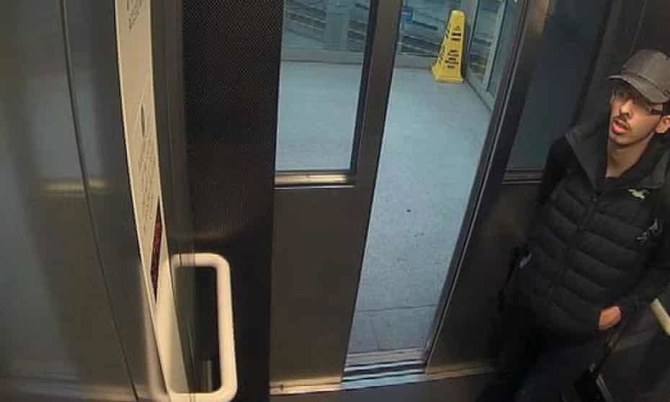
A handout file photo issued by Greater Manchester police of a CCTV image of Salman Abedi at Victoria station on the way to Manchester Arena, May 22, 2017. (GMP)
Short Url
Updated 14 March 2022
Follow

MI5 dismissed two lots of intelligence ahead of Manchester Arena bombing, officer admits

  • 22 were killed when terrorist Salman Abedi detonated a suicide vest after an Ariana Grande concert
  • Evidence received was ‘highly relevant to the planned attack,’ witness says

LONDON: The British security service has refused to reveal details of two pieces of intelligence it received and dismissed in the months before the Manchester arena bombing, an inquiry has heard.

MI5 did not explain the intelligence, but said it was assessed to be “non-terrorist criminality.”

An inquiry into the events surrounding the 2017 Manchester Arena bombing, which killed 22, is ongoing — and many parts of it, for the first time since the Sept. 11 attacks, have been carried out behind closed doors, due to the sensitive nature of what is being discussed.

A senior MI5 officer, known as Witness J, has been answering questions for two days, alongside four colleagues.

One officer admitted that, in retrospect, the intelligence received was “highly relevant to the planned attack” and could have been understood at the time to indicate “activity of pressing national security concern.”

The 2017 attack saw Islamist terrorist Salman Abedi detonate a suicide vest in the Manchester Arena at the end of a pop concert. He was assisted by his brother, Hashem Abedi, who is now serving more than two decades behind bars for his role in the deadly attack, the victims of which included many children.

In his closing statements to the inquiry, Pete Weatherby, advocating on behalf of the victims’ families, questioned whether MI5 had approached the inquiry in the right way.

He cited one witness, Witness Z, who told the inquiry it would be “hugely damaging” for MI5 and police if the inquiry had “the unintended consequence of sapping the confidence of those at the investigative and operational front line” to make decisions.

Weatherby said: “A healthy organization welcomes scrutiny — only unhealthy ones seek to avoid it.

“MI5 is a public authority and as such it is accountable to the public. The idea that the scrutiny or criticisms of a public inquiry might in some way adversely affect national security is not just plain wrong, it is corrosive in that it undermines confidence.

“Independent scrutiny and criticism is a necessary precursor to making things better for the future.”

He added: “What is hugely damaging to any public inquiry is the belief that scrutiny and criticism is somehow harmful.”

He also warned: “Failure which is not fully addressed will recur, and more lives will be lost.”

Weatherby also suggested that the service had lost sight of the plot because it was focused on Syria.

“Were the security services too fixated on Syria, and missed the risks from elsewhere? Were they too fixed on actual positive evidence of attack preparation, rather than seeing where the attack might come from?

He said: “The families I represent would really like to know what exactly did Salman Abedi have to do to prompt a meaningful response from the security services?

Weatherby pointed out that there should have been “real alarm” over the radicalization of Salman Abedi after his links with the Daesh-affiliated Libyan group Katiba Al-Bittar Al-Libi emerged.

“There was persistent information coming to them about Salman Abedi. He did not emerge from the shadows,” Weatherby said, asking: “We know from other inquiries and inquests that sometimes, sadly, there is nothing that can be done to stop individual outrages and attacks. But for the reasons we have outlined, was this one of them?”


Ukraine hosts talks with security allies in Kyiv

Updated 11 sec ago
Follow

Ukraine hosts talks with security allies in Kyiv

KYIV: Ukraine is hosting security advisers for crunch talks on Saturday as Kyiv insists negotiations are zeroing in on a deal, while Russia claims a deadly New Year strike torpedoed the efforts.
Ukrainian President Volodymyr Zelensky said around 15 countries would attend the talks, along with representatives from the European Union and NATO, with a US delegation joining via video link.
Leaders from the so-called coalition of the willing are expected to convene in France next week after Saturday’s talks.
The latest peace push comes after Zelensky announced in his New Year’s Eve address that the US-brokered plan was “90 percent” ready, but cautioned that important territorial issues remain.
Russia occupies around a fifth of Ukraine and has hit its smaller neighbor with an almost daily barrage of missiles and drones that have killed thousands of civilians and displaced millions.
Kyiv has repeatedly said Russia is not interested in peace and is deliberately trying to sabotage diplomatic efforts in order to seize more Ukrainian territory.
Russia captured the most Ukrainian land last year since launching its all-out invasion in 2022, an AFP analysis showed.
Moscow has meanwhile accused Ukraine of carrying out a “terrorist attack” and “deliberately torpedoing” a peaceful resolution after a strike on a hotel in Kherson killed 28 people celebrating the New Year.
Moscow warned of “consequences,” but Ukraine said the attack targeted a military gathering that was closed to civilians.
AFP was not able to verify either account.

- Concessions -

After US special envoy Steve Witkoff boasted about putting peace efforts back on track in the New Year, Ukraine ordered the evacuation of more than 3,000 children and their parents from frontline settlements in the Zaporizhzhia and Dnipropetrovsk regions, where Russian troops have been advancing.
More than 150,000 people have been evacuated from front-line areas since June 1, according to Ukrainian Restoration Minister Oleksiy Kuleba.
Underlining the risks for civilians, authorities in Kharkiv reported on Saturday morning that another body had been pulled from the rubble after an aerial barrage reduced multi-story buildings to smoldering heaps.
At least two people, including a three-year-old, were killed and another 19 people wounded, local officials said.
Under the current US-backed blueprint for ending the war, Ukraine would cede parts of the eastern Donbas region and agree not to join NATO.
Zelensky said last week that Ukraine has been able to wrest some concessions, notably removing the provision that land seized by Moscow’s army would be recognized as Russian.
The Russian army captured more than 5,600 square kilometers (2,160 square miles), or 0.94 percent, of Ukrainian territory in 2025, according to an analysis of data from the Institute for the Study of War, which works with the Critical Threats Project.
This includes areas that Kyiv and military analysts say are controlled by Russia, as well as those claimed by Moscow’s army.
That is more land than the previous two years combined, though far short of the more than 60,000 square kilometers it took in the first year of its invasion.
Russia made its biggest advance in 2025 in November — 701 square kilometers — whereas the 244 square kilometers it gained in December was the smallest since March, the data showed.
Russian President Vladimir Putin has consistently told his citizens that the military intends to seize the rest of the Ukrainian land he has proclaimed as Russian if talks fail.

- New cabinet appointees -

Zelensky has shuffled his cabinet ahead of the January 6 summit in France.
He announced on Friday that he offered the defense ministry to his 34-year-old minister of digital transformation, Mikhailo Fedorov.
Without explaining his decision to replace Denys Shmygal, the Ukrainian leader said he had proposed the incumbent “head another area of government work that is no less important for our stability.”
Zelensky also recently named Ukrainian military intelligence chief Kyrylo Budanov to head his presidential office.
Budanov will succeed Zelensky’s most important ally, Andriy Yermak, who resigned in November after investigators raided his house as part of a sweeping corruption probe.
“At this time, Ukraine needs greater focus on security issues, the development of the Defense and Security Forces of Ukraine, as well as on the diplomatic track of negotiations,” Zelensky said.
“Kyrylo has specialized experience in these areas and sufficient strength to deliver results.”
Budanov said he had accepted the nomination and would “continue to serve Ukraine.”