

Iran foreign ministry spokesperson says US has to take decision to revive nuclear deal

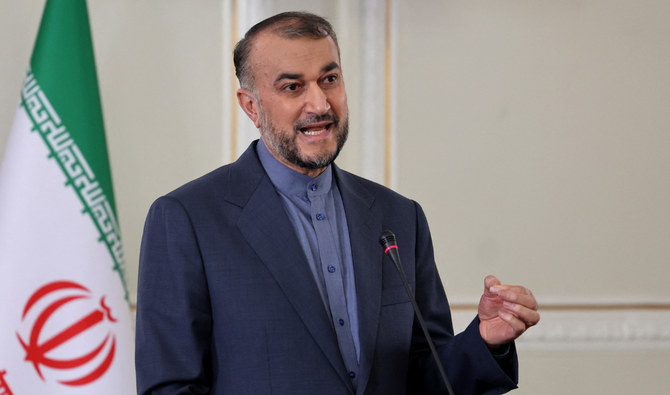
Iranian Foreign Minister Hossein Amirabdollahian. (AFP/File)
Short Url
Updated 15 March 2022
Follow

Iran foreign ministry spokesperson says US has to take decision to revive nuclear deal

  • Talks to revive the 2015 Iran nuclear pact face the prospect of collapse after a last-minute Russian demand

JEDDAH: Iran’s foreign minister is flying to Moscow on Tuesday in an attempt to rescue a nuclear deal between Tehran and world powers, amid fears that talks in Vienna may collapse.

Diplomats said last week that a new agreement to curb Iran’s nuclear program was virtually complete, but the process was thrown into disarray when Russia suddenly demanded guarantees that its trade with Iran would not be affected by sanctions over its invasion of Ukraine.

Mistrust in Tehran’s motives has also grown since the Islamic Revolutionary Guard Corps fired a dozen missiles on Sunday at Irbil, capital of the autonomous Iraqi Kurdish region.

And in a further blow to the talks in Vienna, 49 of the 50 Republican US senators said on Monday they would not support a nuclear accord with Iran. They said they would do everything in their power to reverse an agreement that did not “completely block” Iran’s ability to develop a nuclear weapon, constrain its ballistic missile program and “confront Iran’s support for terrorism.”

Iran said on Monday that Foreign Minister Hossein Amirabdollahian’s visit to Russia was “a platform for serious, frank and forward-looking talks” between two countries who had shown they could “work very closely, decisively and successfully on complex issues.”

Ministry spokesman Saeed Khatibzadeh said: “We are currently having a breather from the nuclear talks. We are not at a point of announcing an agreement now.”


Gaza fuel running short after Israel closes borders amid Iran war

Updated 2 sec ago
Follow

Gaza fuel running short after Israel closes borders amid Iran war

CAIRO/JERUSALEM: Gaza is rapidly running out of its limited fuel supply and stocks of food staples may become tight, officials say, after Israel blocked the ​entry of fuel and goods into the war-shattered territory, citing fighting with Iran.
Israel’s military closed all Gaza border crossings on Saturday after announcing air strikes on Iran carried out jointly with the United States. Israeli authorities say the crossings cannot be operated safely during war and have not said how long they would be shut.
Few days’ worth of supplies
Gaza is wholly ‌dependent on fuel ‌brought in by trucks from Israel ​and ‌Egypt ⁠and a ​lack ⁠of fresh supplies would put hospital operations at risk and threaten water and sanitation services, local officials say. Most Palestinians in Gaza are internally displaced after Israel’s two-year war with Hamas militants.
“I expect we have maybe a couple of days’ running time,” said United Nations official Karuna Herrmann, who directs fuel distribution in Gaza.
Amjad ⁠Al-Shawa, a Palestinian aid leader in Gaza, ‌who works with the UN and NGOs, ‌estimated fuel supplies could last three or ​four days, while stocks ‌of vegetables, flour, and other essentials could also soon run out ‌if the crossings remain shut.
Reuters was unable to independently verify those estimates.
Israel’s COGAT military agency, which controls access to Gaza, said that enough food had been delivered to the territory since the start of ‌an October truce to provide for the population.
“(The) existing stock is expected to suffice for ⁠an extended period,” ⁠COGAT said, without elaborating. It declined to comment on potential fuel shortages.
The truce was part of broader US-backed plan to end the war that involves reopening the Rafah border crossing with Egypt, increasing the flow of aid into the enclave, and rebuilding it.
Hamada Abu Laila, a displaced Palestinian in Gaza, said the closures were stoking fear of a return of famine, which gripped parts of the enclave last year after Israel blocked aid deliveries for 11 weeks.
“Why is it our fault, in ​Gaza, with regional wars ​between Israel, Iran, and America? It is not our fault,” Abu Laila said.