

Russian gas transit via Ukraine to EU remains steady

Short Url
Updated 13 March 2022
Follow

Russian gas transit via Ukraine to EU remains steady

MOSCOW: Despite the ongoing conflict, Russian gas transit via Ukraine to the EU remained largely unaffected — just 6 percent off the 2021 levels.

The Russian natural gas flows into Ukraine’s gas transmission system remained steady at a daily average 107.4 million cubic meter from Feb. 24 through March 11, data posted on the website of Ukraine’s Gas Transmission System Operator, also known as GTSOU, showed.

Since Feb. 24, when fighting between the Russian and Ukrainian forces began, the average daily inflows of Russian gas jumped 80 percent.

It is interesting to note that the supply of Russian gas into Ukraine’s gas system during the first two months of 2022 had fallen to 59.7 million cm, or 48 percent below the average flows in 2021.

In 2021, the average daily flows of Russian gas to Ukraine’s gas system were 114.1 million cm.
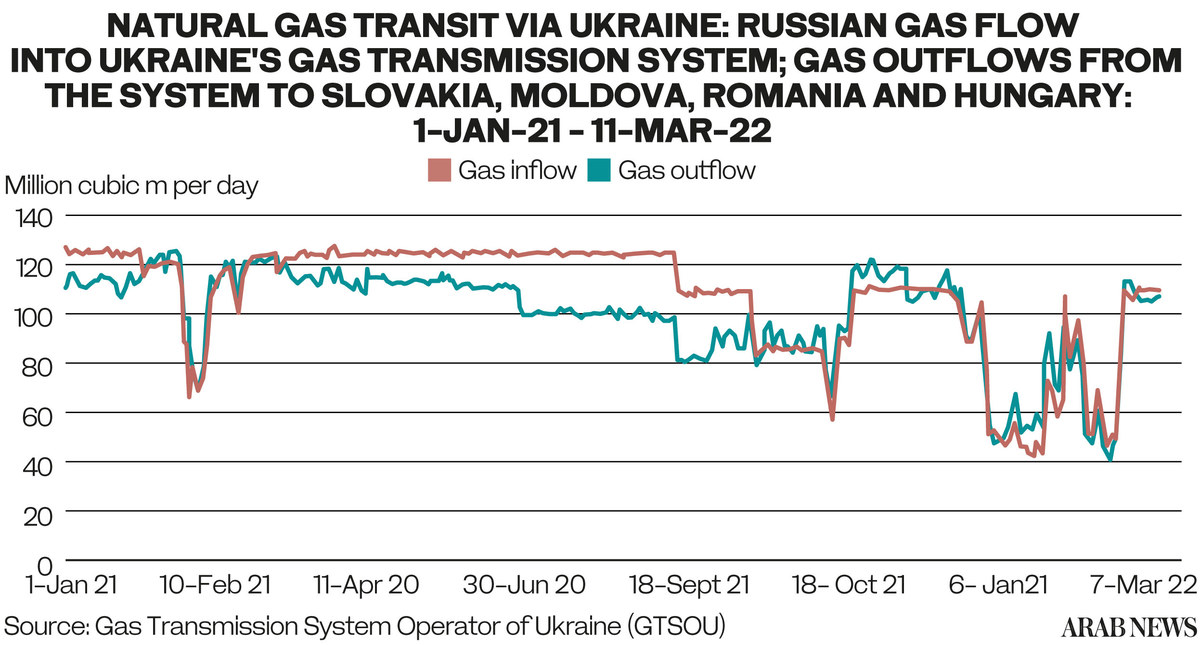
 

As for Russian gas transit figures, from Feb. 24 through March 11, average daily outflows from Ukraine’s gas transmission into EU and Moldova totaled 106.2 million cm, 177 percent more as compared to the period between Jan.1 and Feb. 23, 2022.

HIGHLIGHTS

Slovakia — via a cross-border point at Uzhgorod — 81.0 million cm      

Moldova 18.4 million cm

Romania 4.9 million cm

Hungary 1.85 million cm

The pipeline capacity booked for transit of Russian gas for the next two days — March 12 and March 13 — are little changed from the past few days, GTSOU data showed.

Russia’s Gazprom ships part of its gas supplies to Europe via Ukraine based on a “ship-or-pay” transit deal that provides for Gazprom’s obligation to ship 40 billion cm of natural gas per annum via Ukraine.


Qatar residential property sales jump 44% in 2025 as prices ease: Knight Frank 

Updated 27 January 2026
Follow

Qatar residential property sales jump 44% in 2025 as prices ease: Knight Frank 

RIYADH: Qatar’s residential property sales surged 43.5 percent in 2025 to 26.6 billion Qatari riyals ($7.30 billion), driven by rising transaction volumes even as home prices softened, according to Knight Frank. 

The number of residential deals climbed 50 percent in 2025 from a year earlier to 6,831 transactions, signaling sustained liquidity in the market despite a more competitive pricing environment, the property consultancy said in its Qatar Real Estate Market Review. 

In line with broader trends across the Gulf Cooperation Council, Qatar is seeking to strengthen its real estate sector as part of its economic diversification efforts. 

Faisal Durrani, head of research at Knight Frank for the Middle East and North Africa region, said: “Although residential prices are softening, strong growth in transaction volumes highlights continued liquidity and demand in Qatar’s core residential markets and indicating stabilization, rather than a market in retreat.”  

In the fourth quarter of 2025, residential sales activity remained concentrated in key locations, led by Doha, which recorded 564 transactions with a combined value of 2.4 billion riyals. Al Wakrah followed with 387 transactions worth 895 million riyals. 

“Average villa prices fell by 1 percent during the 12 months to the fourth quarter of 2025, reflecting a more competitive pricing environment as supply expands and buyers become increasingly value-led. Despite this moderation, prime locations remain resilient, supported by steady demand for premium schemes,” said Durrani. 

Rental rates also eased, with average villa rents down 2.4 percent year on year in the fourth quarter to 12,985 riyals per month. Prime locations continued to outperform, with West Bay Lagoon averaging 18,656 riyals a month for three-bedroom villas and up to 25,696 riyals for five-bedroom units. Overall villa rents declined 3 percent in 2025. 

“Qatar’s residential rental market continues to be shaped by tenant demand for well-located, lifestyle-led communities, with pricing remaining strong for larger villas in established neighborhoods,” said Knight Frank’s Adam Stewart.

Qatar’s office market showed similar trends, with grade-A rents falling 1.4 percent year on year to 90 riyals per sq. meter per month. Demand remained focused on prime districts, led by West Bay and the Marina District, as occupiers shifted away from older buildings. 

“Economic diversification in line with Qatar’s National Vision 2030 is supporting job growth and office demand, especially in the tech, green energy, and services sectors,” said Stewart. 

He added: “These occupiers are increasingly seeking high-specification, modern buildings with advanced facilities, and we are seeing a clear shift toward prime locations in Doha and Lusail, pulling tenants away from older stock.”